
A green roof is eco-friendly when it holds back rainwater, adds habitat, and protects the waterproofing beneath it for decades. It stops being eco-friendly when the plastic layers underneath, the extra steel needed to carry the weight, and a short working life cost more carbon than the roof ever gives back.
That is the part most people are never told. “Green roof” describes a way of building something, not an environmental guarantee. Two roofs can look identical from the pavement and have completely different environmental records, and what separates them sits underneath the plants rather than on top of them.
So here is both halves. What a living roof genuinely does, where the claims get stretched, and how to work out whether one earns its place on your building.
Table of Contents
How a green roof actually helps the environment
Four mechanisms are doing the work. Some are far stronger than others, and not all of them apply to every building.
It slows rainwater instead of dumping it into the drains
This is the strongest benefit in a British context, and the best evidenced.
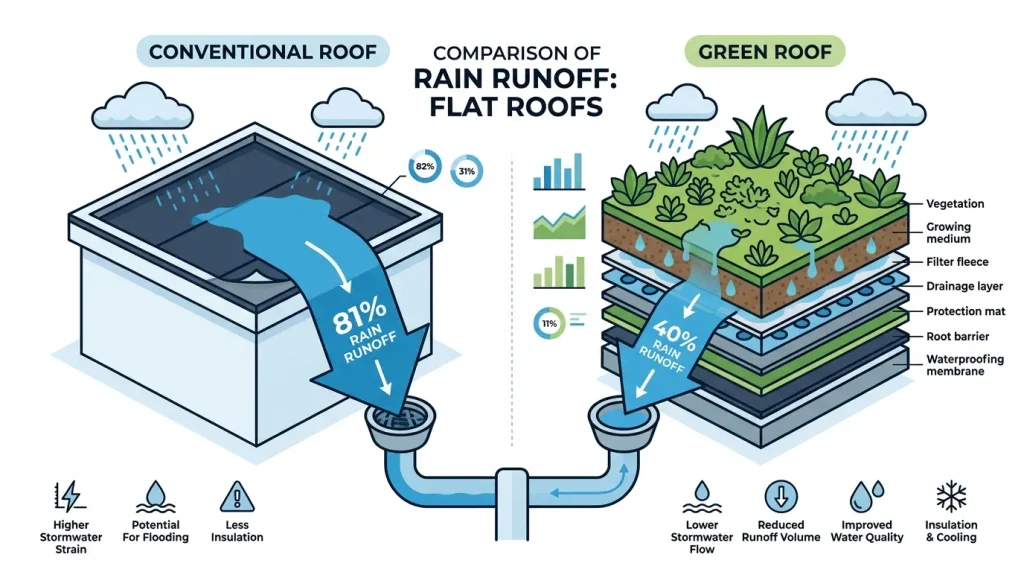
A conventional flat roof sheds roughly 81% of the rain that lands on it, almost immediately, straight into the drainage system. Put a 150mm green roof build up on the same deck and that drops to around 40%. The substrate soaks water up, the plants use some of it, and what is left leaves slowly over hours rather than all at once.
The delay matters more than the volume. Rain in the UK increasingly arrives in short heavy bursts, and drainage networks do not fail because of the total, they fail because everything hits them in the same twenty minutes. Much of Nottingham’s Victorian and inter war housing sits on combined sewers where surface water and foul water share a pipe. Overwhelm that and the overflow ends up in a watercourse.
One extension roof will not change a catchment. But a planted roof in a street of hard surfaces still contributes something real, and it is a large part of why planning authorities have started asking for them.
It cools the building, and the street outside it
Plants and damp substrate cool through evapotranspiration. On a hot afternoon the surface of a dark membrane can climb well past 60°C. A planted roof stays close to air temperature. Less heat is pushed down into the rooms below, and less is radiated back into the surrounding air.
For a single storey extension with a lot of glazing, which is the exact situation most people are in when they start asking about green roofs, that difference is noticeable by mid July.
Be careful with the winter version of this claim, though. Green roofs get sold as insulation and the effect is real but small. Wet substrate conducts heat perfectly well, and the insulation doing the actual work is the rigid board under the membrane. A green roof adds thermal mass and takes the wind chill off the surface. It does not replace insulation, and anyone telling you otherwise is selling.
It creates habitat that a garden cannot
Roof level habitat behaves differently from ground level habitat. It is warmer, drier, undisturbed by cats and footfall, and out of reach of most predators. Species that struggle lower down in built up areas do well up there. Solitary bees, certain beetles, some ground nesting birds.
The phrase carrying the weight there is habitat designed for them. A roof planted for wildlife and a roof planted to look green from the bedroom window are different products, and the second one is far more common.
It protects the waterproofing underneath
Nobody puts this one on the brochure, and it is arguably the biggest of the four.
Roofing membranes fail for two reasons: ultraviolet light, and thermal cycling. Expanding in the sun, contracting overnight, a few thousand times a year until the material stops coping. Bury that membrane under substrate and both problems largely disappear, because the temperature swing across it becomes a fraction of what an exposed roof goes through.
Suppliers tend to claim this doubles membrane life. The mechanism is sound, the exact multiple depends a great deal on what was specified underneath, but the direction of travel is not in dispute. A roof covering that never has to be manufactured, shipped and installed a second time is carbon that never gets spent at all.
Longevity, more than anything growing on top, is what makes a green roof worth building.
Do green roofs improve air quality?
Less than the figures suggest. You will come across very precise sounding numbers on this, exact percentages of sulphur dioxide removed and grams of particulates captured per square metre per year, repeated across dozens of pages with no source attached.
Follow them back and they tend to originate in a small number of studies, on large commercial installations, in other climates, some of them decades old. Plants do capture particulates and green surfaces do improve air quality at scale. Scaling those particular findings down to a 20m² extension roof in the East Midlands is not something the underlying research supports.
Treat air quality as a genuine but modest side benefit. Water management and membrane life are the arguments that survive scrutiny.
When is a green roof not eco-friendly?
Everything above is the case in favour and it is a good case. What follows rarely gets published, not because it demolishes the argument, but because it decides whether a particular roof deserves the label.
The build up has a carbon footprint of its own
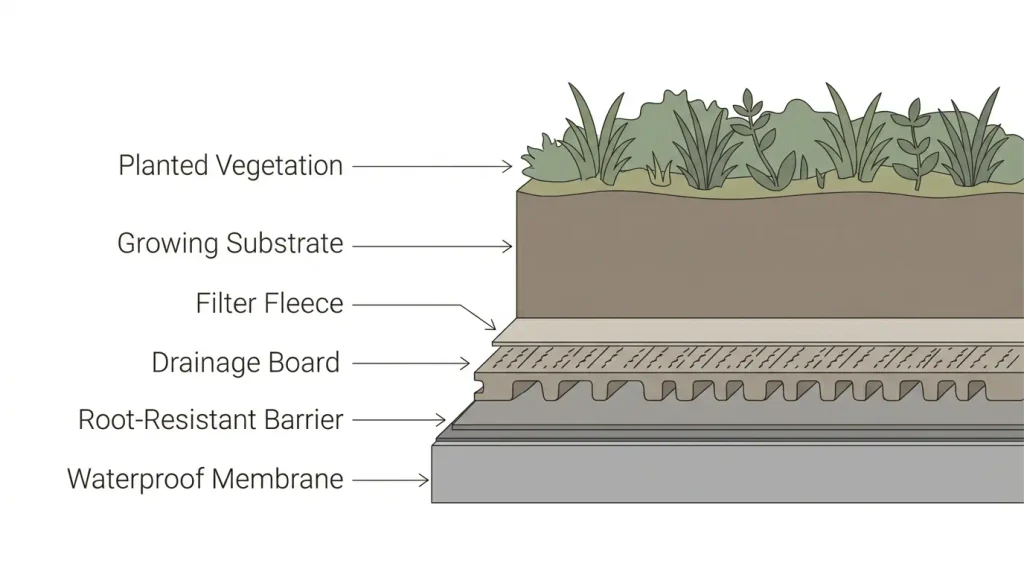
A green roof is not soil on a roof. Under the planting sits a root resistant barrier, a drainage board, a filter fleece, the growing substrate, and edge trims holding the whole thing in place. Most of those layers are manufactured plastic.
Which means every green roof starts in carbon debt. It has to run for years before the savings, reduced cooling demand, avoided membrane replacement, retained water, cancel out what it cost to build in the first place.
Life cycle studies put that payback across a very wide range, and the honest reason is that it depends almost entirely on specification and lifespan. A well built roof with forty years in it clears the debt comfortably. One stripped off after eight years because nobody ever went up there does not clear it at all. It just becomes waste, which is the same problem construction waste causes everywhere else on a site.
If the structure needs strengthening, the maths changes
A saturated green roof weighs somewhere between 50 and 200 kg per square metre depending on depth and type. Existing flat roofs, and garages and older extensions especially, were often never designed with that in mind.
If the structure needs additional steel or timber to carry it, that reinforcement brings its own embodied carbon, and it lands on the same balance sheet as the roof. Enough of it and a marginal environmental case quietly turns negative.
This is where a builder’s view is more useful than a supplier’s. A supplier sells the system. Whoever is assessing the building has to work out whether the deck, the joists and the walls below can live with a permanently heavier, permanently wetter roof, and sometimes the answer is that they cannot without work costing more than the roof itself. On a new home extension that load is a line on the structural drawings and costs almost nothing to allow for. On a twenty year old flat roof it is a survey and a difficult conversation.
Not all substrate is environmentally neutral
Green roof substrate is not topsoil. It is a lightweight engineered mix, usually a mineral aggregate with a small organic fraction blended in.
What that aggregate is made from matters. Some systems use recycled crushed brick and concrete, which is a genuinely good outcome, because it takes demolition waste out of the ground and needs no quarrying. Others use virgin expanded clay or shale, fired at high temperature, carrying real embodied energy with it. Peat has no business being in a green roof mix at all, and the better UK suppliers moved away from it years ago. It is still worth asking.
Most homeowners are never offered this choice. Asking for recycled aggregate and certified peat free substrate is one of the very few decisions available to you that improves the environmental result measurably, usually at no extra cost, and it sits in the same category as every other choice about eco friendly building materials on a project.
Is a sedum roof good for biodiversity?
Less than the marketing implies. Most domestic green roofs in this country are pre grown sedum blankets. Rolled out like turf, instantly green, low maintenance, shallow. They are popular for sensible reasons, and they deliver the water and temperature benefits perfectly well.
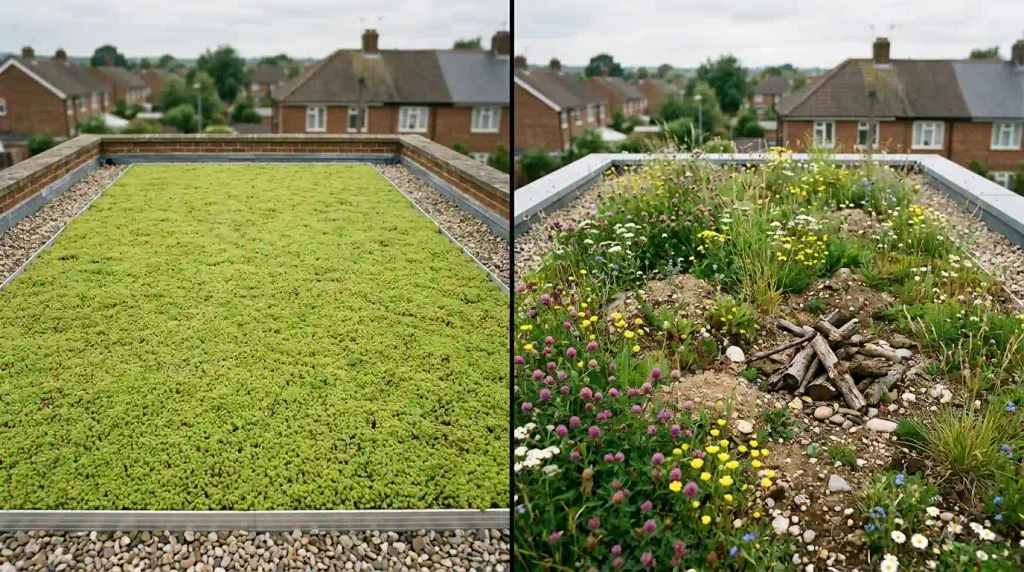
Ecologically, though, they are close to a monoculture. A uniform 40mm sedum mat supports a fairly narrow range of species.
A biodiverse roof looks different from the start. Substrate depth varies across the surface, from around 80mm up to 150mm or more. Planting is a native wildflower and grass mix rather than a single genus. There are deliberate bare patches for ground nesting insects, often with log piles or loose stone. It costs a bit more, and it looks scruffy for the first two summers. It is also a substantially better environmental product, and it is what ecologists actually mean when they talk about roofs supporting wildlife.
An irrigated roof can undo its own benefits
At the far end sit intensive roofs. Proper roof gardens, 200mm of substrate or more, shrubs, lawn, sometimes small trees. Visually they are the most impressive version of the idea and environmentally they are the most fragile.
They generally need mains irrigation through a dry summer, and often feeding as well. Irrigation water in particular is a strange thing to be spending on a feature justified partly by water management.
Intensive roofs earn their keep in dense urban schemes where they replace ground level green space that was lost. On a domestic extension in the Midlands, an extensive or biodiverse roof will nearly always do more good, for less money, with less to go wrong.
What separates a genuinely green roof from a token one
All of the above comes down to four decisions. Get them right and the environmental case holds. Get them wrong and you have bought a very expensive lawn.
Depth and plant mix matter more than the label
Depth drives almost everything. Water retention, plant diversity, how the roof copes with three dry weeks in August. The GRO Green Roof Code, which is the UK industry standard, sets 80mm as a minimum substrate depth for sedum and 100 to 150mm for wildflower systems.
If the structure allows it, vary that depth across the roof instead of laying it flat and even. Mounded areas and shallower zones create noticeably different growing conditions within a couple of metres, and that variation is exactly what produces species diversity.
Ask for a native wildflower and grass mix rather than sedum on its own. If loading or budget will not stretch that far, a sedum dominant mix with wildflower plugs worked into it is a reasonable middle position and still much better than a plain mat.
Design it to last forty years, not fifteen
Since longevity is where the environmental payback lives, design for it on purpose.
In practice that means a quality root resistant membrane rather than a standard one with a barrier added as an afterthought. Correct falls, so water drains instead of sitting. Outlets and inspection chambers you can physically reach and clear. A permanent, safe way of getting onto the roof, because a roof nobody can access is a roof nobody maintains.
Green roof failures are very rarely plant failures. They are blocked outlets, ponding water, and edge details that were awkward to reach and therefore never once checked in a decade. Anyone who has dealt with a flat roof that was never detailed properly recognises the pattern immediately.
Ask where the materials came from
Four questions worth putting to any contractor or supplier before you sign anything:
- Is the substrate recycled aggregate or virgin material?
- Is it certified peat free?
- Do the drainage layers contain recycled plastic content?
- Where were the plants grown?
Answers vary far more than you would expect. Asking also tends to produce a better specification, even when the first answer that comes back is vague.
How much maintenance does a green roof need?
An extensive green roof wants checking roughly twice a year. Clear the outlets, pull out tree seedlings and unwanted woody growth, look over the edge details. Call it a couple of hours, twice a year.
Skip it and the sequence is completely predictable. Outlets block, water ponds, the wrong plants take over, the roof looks dead by the third summer, and somewhere around year eight it gets stripped off and replaced with a plain membrane. Every environmental argument for building it in the first place has been lost at that point.
Budget the maintenance when you budget the installation. If nobody in the household is going to commit to it, better to be honest about that before the roof goes on.
Where green roofs fit into UK rules and standards
The regulatory picture has moved in the last few years, and it now touches domestic work more than most people expect.
Do green roofs count towards Biodiversity Net Gain?
Yes, though how much depends heavily on type. Biodiversity Net Gain became mandatory for most developments in England during 2024, February for major sites and April for small ones, requiring a 10% measurable improvement in biodiversity value.
In the statutory metric a biodiverse roof with varied substrate and native planting scores meaningfully. A thin sedum mat scores considerably less. It is one of the clearest practical arguments for specifying properly rather than minimally.
Most single dwelling householder work is exempt, so this will not affect a straightforward rear extension. Self builders and anyone developing more than one unit should check early rather than late.
Drainage, SuDS and runoff
Where a scheme has to demonstrate sustainable drainage, a green roof is one of the more straightforward ways of reducing and delaying runoff at source. On a tight site it is often far more practical than below ground attenuation, and planners recognise it without much argument.
If your project already has a drainage condition attached, raise the green roof early. It can form part of how you discharge that condition rather than sitting on top of it as an extra.
The GRO Green Roof Code
The GRO Green Roof Code is the UK benchmark, produced by the Green Roof Organisation. It covers system types, substrate depths, drainage, fire, wind uplift and maintenance regimes.
“Built to the GRO Code” is the phrase to look for in a quotation. It is the difference between a specified system and a contractor improvising with pond liner and topsoil, which does still happen, and which fails.
Will a green roof improve your EPC rating?
Probably not, and it is worth knowing before you spend anything.
EPCs are produced using SAP methodology, and SAP has no direct input for a green roof. The assessment looks at the U value of the roof construction, and that number is dominated by the insulation. Cooling benefit, thermal mass, reduced surface temperature, all the things a green roof genuinely delivers, mostly fall outside what SAP is set up to measure.
That is a limitation of the assessment method rather than evidence the roof is not working. But if you are adding one specifically expecting the rating to move, that expectation will probably disappoint you. If an improved rating is the actual goal, the money goes further on energy efficient design and fabric upgrades.
Is a green roof worth it on a UK home?
The environmental case is only half the decision. Here is where it lands in practice.
Where it clearly makes sense
- Flat extension roofs, particularly single storey rear extensions, where the structure is new and the load can be designed in from the first drawing
- Roofs you can actually see from an upstairs window. The visual benefit is real, and it is the main reason people keep maintaining them
- Garden rooms, garages and outbuildings, where a lightweight sedum system is straightforward and the consequences of getting it slightly wrong are small. A garage conversion with a new flat roof is a natural candidate
- Properties in flood sensitive areas, or any scheme carrying a drainage condition
Where, honestly, it does not
- Roofs needing significant structural strengthening. At that point the carbon and the cash both stop adding up
- Pitches above roughly 10 degrees without proper retention systems, which add cost and complication quickly
- Roofs with no safe access, because the maintenance will not happen, whatever anyone intends at the time
- Houses with poor loft insulation, draughty windows or single glazing. Spend the money there first. It will cut more carbon per pound than any green roof, and it is not a close contest
That last point deserves saying plainly. If the choice is between a green roof and sorting out the building fabric, fabric wins every time. A living roof is a good addition to a well insulated building, not a substitute for insulating one, and the eco friendly renovation sequence runs fabric first, everything else second.
What does a green roof cost in the UK?
Roughly £50 to £100 per square metre for extensive sedum systems, and £60 to £200 per square metre for intensive systems, supplied and installed, at 2026 prices.
Those are the headline numbers. What catches people out is everything around them: the structural survey, scaffolding and access, upgraded drainage outlets, edge retention detailing. On a small roof those fixed costs can rival the cost of the system itself, which is why a green roof on a 12m² garage rarely looks cheap per square metre.
Set against that: no membrane replacement in fifteen years, better summer comfort, and on a new build extension it is a marginal addition to a project you are already paying for. Worth reading alongside general house extension costs if you are still at the budgeting stage.
Green roof or solar panels, or both?
This comes up constantly, and the assumption underneath it is usually wrong. They are not alternatives.
Solar panels lose efficiency as they heat up. Mount them above a green roof and the cooler surface underneath keeps the panels closer to their rated output through the summer, which is when they are producing most. The combination, often called biosolar, measurably outperforms panels sitting on a bare dark membrane.
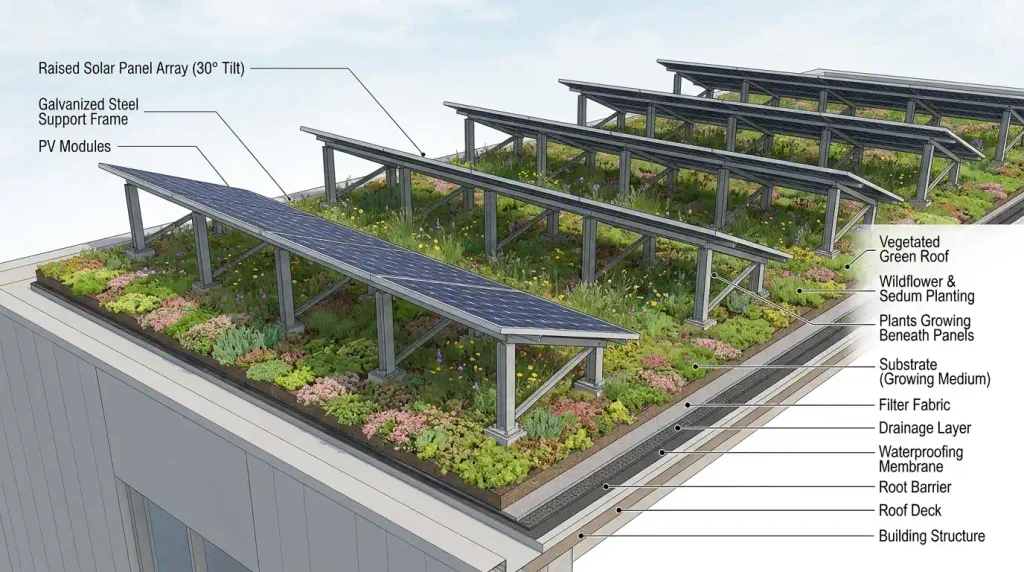
The panels go on ballasted frames on top of the roof build up, with planting between and beneath the rows. The combined load has to be designed for, so it is an early decision rather than something to retrofit.
The verdict
A green roof is eco-friendly when it is specified well, built to last, and actually maintained. It is not automatically eco-friendly because there are plants on it.
The version that earns the claim uses recycled peat free substrate, varies in depth across the surface, is planted for wildlife rather than appearance alone, is detailed so somebody can reach and clear it, and sits on a structure that was always capable of carrying it. The version that does not is a thin plastic backed mat on a structure that needed strengthening to hold it, unmaintained, stripped off inside a decade and skipped.
The difference between the two gets decided at design stage, not planting stage. And the first question is always structural. Not what to plant, but whether the building can carry a permanently heavier, permanently wetter roof.
Buon Construction works on extensions, renovations and building fabric across Nottingham and the wider East Midlands. If you are weighing up a living roof on a new extension or an existing flat roof, get in touch and we will tell you what the structure can take and what it would involve, including when it is not the right call for your building.
FAQs
Do green roofs need planning permission in the UK?
Usually not. Adding a green roof to an existing flat roof without changing its height or shape generally falls within permitted development. Permission is more likely if the roof forms part of a new extension, if the property is listed or sits in a conservation area, or if the build up raises the roof line noticeably.
Are green roofs a fire risk?
No, when built to the GRO Green Roof Code, which sets out fire breaks, vegetation free margins around openings and roof edges, and separation distances from boundaries. Dry vegetation can burn, so the detailing exists to stop spread. Roofs installed without those margins are the ones that raise concerns.
Do green roofs attract rats, wasps or other pests?
Rarely. Extensive roofs have shallow substrate and no food source, so rodents have little reason to nest there, and the insects a green roof attracts are mainly pollinators. Problems tend to come from deep intensive roofs with dense planting, or neglected roofs where woody growth has created cover.
Can you walk on a green roof?
Only where it has been designed for it. Extensive sedum and wildflower roofs take occasional maintenance access, not regular foot traffic, and repeated walking compacts the substrate and kills the planting. A usable space needs specifying upfront, with paved zones and a structure designed for the extra load.
What happens to a green roof at the end of its life?
The substrate and plants can be reused or composted, and mineral aggregate is straightforward to recover. The plastic layers are the harder part, since drainage boards, root barriers and fleeces are rarely recycled in practice. It is a further reason to build for longevity rather than replacement.
Do green roofs work on pitched roofs?
Up to a point. Below about 10 degrees no special measures are needed. Between 10 and 30 degrees the system needs retention: anti slip layers, battens or cellular grids to stop substrate migrating downhill. Above 30 degrees it becomes specialist work and the cost rises sharply.

One Response