
You can build a gazebo in your garden without planning permission, provided it meets the relevant permitted development rules. The rules are usually about its height, location, design, intended use and your property’s planning status.
England, Scotland, Wales and Northern Ireland have different planning regulations, so the rules for your location must be checked before construction begins.
A small gazebo in a back garden may qualify as permitted development, while a taller structure near a boundary or one attached to the house could require a planning application.
Before ordering materials or preparing the ground, establish what you can build. Even a small change to the roof height or position can affect the planning requirements.
Table of Contents
When Can You Build a Gazebo Without Planning Permission?
A gazebo may be built without a planning application if it qualifies as permitted development and meets all the conditions applying to your property.
Permitted development rights allow homeowners to carry out certain building works without applying for planning permission each time. In England, these rights can cover freestanding garden buildings used for ordinary domestic purposes, including outdoor seating and hobbies.
However, a gazebo being sold as a garden accessory does not automatically make it exempt.
Does a Permanent Gazebo Need Planning Permission?
A permanent gazebo does not necessarily require planning permission. In England, a freestanding structure used for domestic purposes may qualify as a permitted development outbuilding.
A modest timber gazebo positioned in the back garden, for example, may qualify if it meets the relevant height, boundary, land coverage and positioning requirements.
Permanently fixing the posts into the ground does not automatically mean permission is required. Equally, choosing a small structure does not guarantee an exemption.
Do Temporary or Pop-Up Gazebos Need Planning Permission?
A lightweight pop-up gazebo used occasionally for a garden party will not normally need planning permission if its installation and use do not amount to development requiring consent.
A structure that remains in place for months, has substantial ground fixings or effectively becomes a permanent garden feature may be assessed differently.
If you intend to keep a portable gazebo throughout the year, check its planning status rather than assuming its removable frame makes it exempt.
What Is the Difference Between a Gazebo and a Pergola?
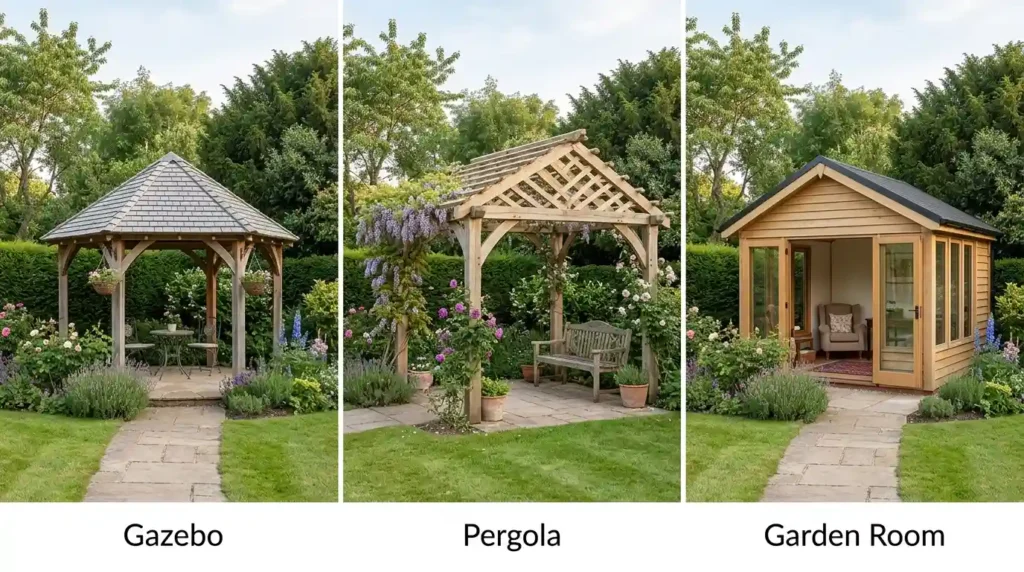
A gazebo usually has a covered roof supported by posts, with open or partially enclosed sides. A pergola typically has an open or slatted overhead framework, although some modern designs include adjustable covers.
A garden room is generally more enclosed and may include windows, doors and insulation.
These differences can affect the planning assessment, but the product name alone does not determine whether permission is required.
If you are comparing garden structures, our guide to pergola planning permission in the UK explains the requirements for that type of installation.
What Are the Gazebo Planning Permission Rules in England?
In England, a gazebo that qualifies as a domestic outbuilding may be built under permitted development rights if it meets the relevant conditions.
The main considerations are height, boundary distance, location, land coverage and intended use.
How Tall Can a Gazebo Be Without Planning Permission?
The maximum permitted height depends on the roof design and the gazebo’s position.
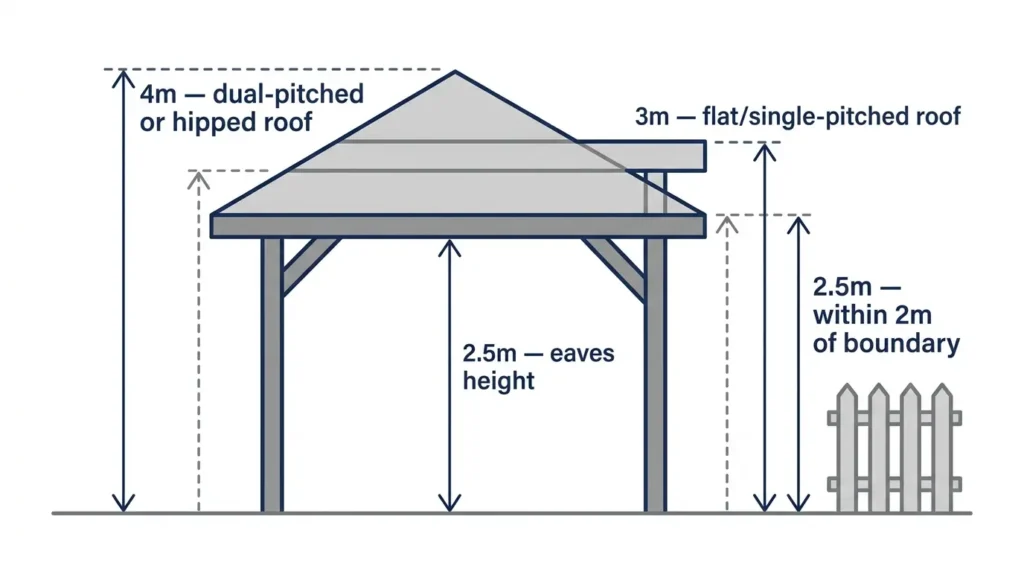
| Gazebo design or position | Maximum height |
| Dual-pitched or hipped roof | 4 metres overall |
| Flat, single-pitched or other roof | 3 metres overall |
| Eaves height | 2.5 metres |
| Any part within 2 metres of a property boundary | 2.5 metres overall |
These are England-specific limits for qualifying outbuildings. All other permitted development conditions must also be satisfied.
For example, a gazebo with a dual-pitched roof may reach 4 metres if positioned sufficiently far from the boundary. Move the same structure within 2 metres of the boundary, and the maximum overall height falls to 2.5 metres.
Measure the finished structure to its highest point, including the roof. For sloping ground, the English rules measure building height from the highest ground level immediately adjacent to the structure.
How Close Can a Gazebo Be to a Garden Boundary?
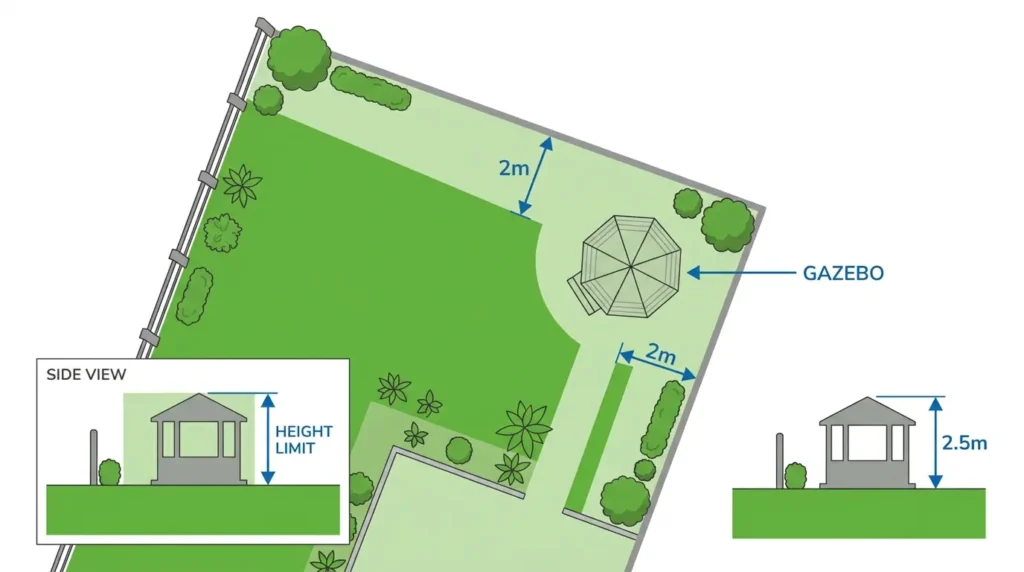
In England, a gazebo can potentially be installed within 2 metres of a property boundary without planning permission, provided its overall height does not exceed 2.5 metres and all other applicable conditions are met.
This does not mean every gazebo must be positioned at least 2 metres away from your neighbour’s fence.
Check the legal property boundary, which may not correspond exactly with the existing fence line. Include roof overhangs when measuring the distance.
If you plan to replace your boundary fence during the project, our guide to fencing rules and regulations in the UK explains the separate requirements.
How Much of Your Garden Can a Gazebo Cover?
In England, extensions, outbuildings and other relevant additions must not cover more than 50% of the land surrounding the original house to qualify under the standard outbuilding permitted development rules.
The calculation excludes the original house’s footprint but includes qualifying additions already occupying the surrounding land.
For example, if the land surrounding your original house measures 100 square metres, the relevant coverage allowance is 50 square metres. If existing extensions and outbuildings occupy 35 square metres, only 15 square metres remain within that allowance.
The original house means the property as originally built or, if constructed before 1 July 1948, as it stood on that date.
Previous owners’ extensions can therefore affect your available allowance.
Can You Put a Gazebo in Your Front or Side Garden?
A gazebo in your front garden may require planning permission.
Under England’s standard outbuilding rules, permitted development does not cover structures positioned forward of a wall forming the principal elevation of the original house.
Side gardens can also have restrictions, particularly in conservation areas, National Parks and other designated locations.
For corner plots or unusually shaped properties, confirm which areas fall forward of the principal elevation before choosing a location.
Does a Gazebo on Raised Decking Need Planning Permission?
A gazebo installed on raised decking may need a separate planning assessment.
In England, decking can generally qualify as permitted development if it is no more than 30 centimetres above ground level, meets the applicable land coverage conditions and is not positioned forward of the principal elevation.
A higher platform may require planning permission.
Consider the gazebo and decking together, including the finished height, neighbouring properties and any additional restrictions affecting your garden.
When Will a Gazebo Require Planning Permission?
A gazebo generally requires planning permission if it constitutes development and cannot qualify under permitted development rights or another applicable planning permission.
This may happen because it exceeds the permitted dimensions, occupies a restricted location or is intended for a use outside ordinary domestic purposes.
Gazebos That Exceed Permitted Development Limits
A gazebo exceeding the applicable height, positioning or garden coverage limits cannot rely on the standard permitted development allowance.
For instance, a 3-metre-high gazebo positioned within 2 metres of a garden boundary would exceed England’s standard 2.5-metre overall height limit for an outbuilding in that location.
You could reduce its height, move it further from the boundary or apply for planning permission.
Exceeding a permitted development limit does not automatically mean an application will be refused.
Gazebos at Listed Buildings and in Conservation Areas
Listed buildings and properties in conservation areas can be subject to additional restrictions.
In England, constructing an outbuilding within the grounds of a listed building is not covered by the standard outbuilding permitted development right. Listed building consent may also be necessary where the proposed works affect the building’s special interest.
Conservation areas and other designated locations can restrict the position and size of garden structures.
Confirm the property’s planning status before purchasing a permanent gazebo.
Flats, Maisonettes and Properties With Restricted Development Rights
The standard English permitted development rules for domestic outbuildings generally apply to qualifying houses, not flats or maisonettes.
Some houses also have restricted rights because of their planning history, planning conditions or an Article 4 direction.
An Article 4 direction removes specified permitted development rights within a defined area.
If your property has additional restrictions, an otherwise qualifying gazebo may require planning permission.
Gazebos Attached to the House or Used for Other Purposes
An attached gazebo may be assessed as an extension or another form of development rather than a freestanding outbuilding.
Its design, structural connection and intended use determine which planning provisions apply.
A gazebo used for ordinary family seating is also different from an enclosed structure intended to provide separate residential accommodation or commercial premises.
For more substantial attached structures, our article on garden room extensions attached to a house explains the relevant construction considerations.
Do Gazebo Planning Permission Rules Differ Across the UK?
Yes. Each UK nation has separate planning legislation, and the requirements for garden buildings are not identical.
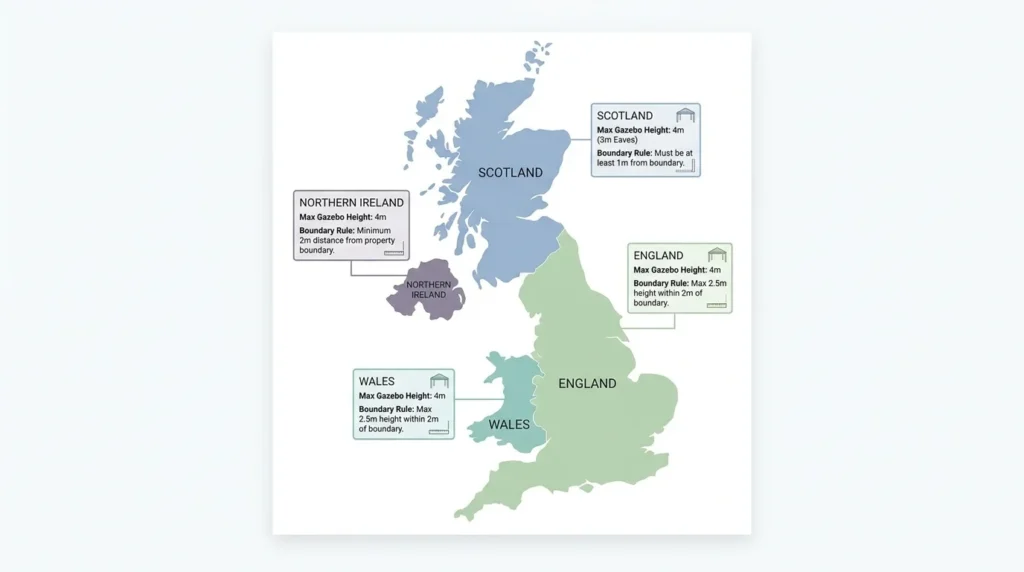
Gazebo Planning Permission in Wales
In Wales, qualifying domestic outbuildings have different maximum heights depending on roof design.
A roof with more than one pitch can generally reach 4 metres, while a single-pitched or other non-flat roof is limited to 3 metres. A flat roof has a 2.5-metre limit.
Additional restrictions apply near property boundaries and the house itself, with further conditions for protected properties and designated land.
Check the applicable Welsh planning requirements before installation.
Gazebo Planning Permission in Scotland
In Scotland, qualifying domestic garden buildings may fall under Class 3A permitted development rights.
The maximum overall height is generally 4 metres, with an eaves height limit of 3 metres. Any part of the building within 1 metre of the property boundary must not exceed 2.5 metres.
Restrictions also apply to positioning, garden coverage and protected properties.
Gazebo Planning Permission in Northern Ireland
Northern Ireland has separate permitted development rules governing domestic outbuildings.
Qualifying structures are subject to a maximum overall height of 4 metres, alongside restrictions involving boundary proximity, eaves height, garden coverage and road-facing elevations.
The conditions differ from those applying in England, so consult your local council’s planning department before installing a permanent gazebo.
How Do You Check Whether Your Gazebo Needs Planning Permission?
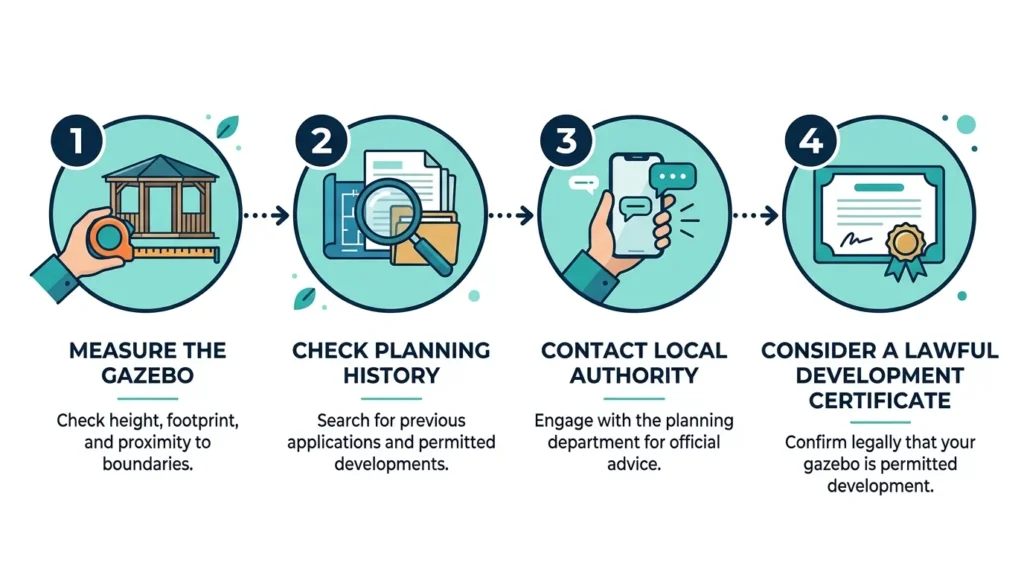
The safest approach is to assess your proposed gazebo against the rules applying to your property and obtain clarification where necessary.
Step 1: Measure the Gazebo
Record its overall height, eaves height, roof design, footprint and distance from property boundaries.
Include roof overhangs and consider whether existing extensions or garden buildings affect the available land coverage allowance.
Step 2: Check Your Property’s Planning History
Establish whether your property is listed, lies within a conservation area or has restrictions affecting permitted development rights.
Previous extensions and planning conditions should also be considered.
Your local council’s planning register may contain relevant information.
Step 3: Contact Your Local Planning Authority
If you are uncertain, provide your council with the gazebo’s proposed dimensions, location, design and intended use.
A simple garden plan and photographs can help explain the project.
Ask whether the structure qualifies as permitted development and whether any property-specific restrictions apply.
Step 4: Consider a Lawful Development Certificate
In England, a Lawful Development Certificate can provide formal confirmation that a proposed gazebo would be lawful for planning purposes.
It differs from planning permission because the council assesses whether the proposed works are lawful under the relevant legislation.
This can be useful for substantial permanent gazebos or properties where the permitted development position is unclear.
What Happens if You Build a Gazebo Without Planning Permission?
If your gazebo requires planning permission and you build it without approval, the local planning authority may investigate a breach of planning control.
Depending on the circumstances, the council may request alterations, consider a retrospective planning application or take formal enforcement action requiring removal.
A retrospective application is not guaranteed to succeed.
If your gazebo has already been installed, establish its dimensions, installation date and planning history before seeking advice from the relevant authority.
Resolving planning questions before construction is generally easier than making changes to a completed structure.
What Should You Consider Before Building a Permanent Garden Gazebo?
Once the planning position is clear, consider how the gazebo will fit into your garden.
Choose a location that provides useful shelter without obstructing access or unnecessarily affecting neighbouring properties.
Timber and metal are common construction materials, although their maintenance requirements differ. Suitable foundations, secure fixings and effective drainage are essential for permanent installations.
If you are also planning a patio, decking or replacement fencing, organise the work together. Completing the gazebo’s foundations before laying surrounding paving can prevent unnecessary alterations later.
For more substantial installations, professional construction support may be useful, particularly where foundations, ground conditions or structural requirements are complicated.
If the gazebo forms part of a larger outdoor improvement, reviewing the cost of a garden renovation can help you prepare your budget.
Buon Construction provides home renovation and landscaping services in Nottingham for homeowners planning permanent improvements to their properties.
Frequently Asked Questions
Can I put a gazebo next to my neighbour’s fence?
Yes, potentially. In England, a qualifying gazebo within 2 metres of a property boundary must not exceed 2.5 metres in overall height under the standard outbuilding permitted development rules. All other applicable conditions must also be satisfied.
Does a wooden gazebo need planning permission?
Not necessarily. Construction material alone does not determine whether permission is required. A wooden gazebo may qualify as permitted development if its dimensions, location and intended use meet the applicable requirements.
Can I install a gazebo on an existing patio?
Yes, provided the gazebo meets the relevant planning conditions. An existing patio does not automatically authorise a new structure above it. Check that the foundations and supporting surface are suitable for the installation.
Does a gazebo with a solid roof need planning permission?
Not always. A solid-roof gazebo may qualify as a permitted development outbuilding. Its roof design, overall height, location and intended use determine which requirements apply.
Can I attach a gazebo to my house?
An attached gazebo may be assessed as an extension rather than a freestanding outbuilding. Check the applicable planning requirements before installation.
Does a gazebo need planning permission if it is only used in summer?
Seasonal use does not automatically exempt a gazebo. A genuinely temporary structure may not require consent, while a permanent gazebo should be assessed under the relevant planning rules.
Can my neighbour object to my gazebo?
A neighbour can raise concerns about privacy, daylight or other impacts. If a planning application is required, they may submit comments. However, an objection does not automatically prevent lawful development.
Can the council make me remove a gazebo?
Yes. If a gazebo breaches planning control, the council may take enforcement action requiring alterations or removal. The outcome depends on the circumstances and applicable legislation.
