
A full garden renovation costs between £3,000 and £30,000 in the UK. For an average back garden, most people end up somewhere between £7,000 and £15,000. Small courtyards start nearer £3,000, and a large redesign in good materials can pass £30,000 without anyone trying particularly hard.
That’s a wide spread, and there’s a reason for it. Two gardens of the same size, on the same street, can come back with quotes thousands apart depending on what’s underneath them and how you get a barrow to the back. Below are the 2026 numbers, what moves them, and where the money genuinely goes.
Table of Contents
Garden renovation cost at a glance
| Type of work | Garden size | Typical cost |
| Tidy-up and refresh | Any | £1,500 – £4,000 |
| Courtyard or small garden | Up to 40m² | £3,000 – £7,000 |
| Average back garden | 40 – 100m² | £7,000 – £15,000 |
| Large garden or full redesign | 100m²+ | £15,000 – £30,000 |
| High-specification redesign | 100m²+ | £30,000+ |
These are national ranges from published 2026 UK cost guides. Where you land inside a band has more to do with ground conditions and access than with your postcode.
Garden renovation cost by size
Courtyard and small gardens (under 40m²)
£3,000 to £7,000.
A courtyard sounds like it ought to be the cheap option. Per square metre it rarely is. There’s no room for a digger, nowhere to stack materials, and every slab and every bag of spoil goes through the house or down a passage by hand. Labour climbs accordingly.
The bottom of that range gets you a clearance, a properly levelled base and a decent paved surface. Push towards £7,000 and you’re adding a rendered or brick boundary wall, lighting and planting. Two to three weeks on site, typically.
The average UK back garden (40 – 100m²)
£7,000 to £15,000.
Most projects sit here, and it’s the band that varies most. Flat garden, side access, drains properly? New paving, fencing, turf and beds might come in around £8,000. Take the same garden, put it on clay, slope it away from the house and reduce the access to a 900mm gate, and you can double that without changing a single material.
Three to six weeks, weather permitting.
Large gardens and full redesigns (100m²+)
£15,000 to £30,000, and beyond if the specification is ambitious.
Costs climb steeply once you start moving levels or building retaining structures. Retaining walls are engineering rather than gardening. They want proper foundations, reinforcement and drainage behind them, none of which you can see in the finished garden but all of which you can see on the invoice.
Anywhere from six weeks to three months. Larger projects are often better phased across two seasons.
What each job costs on its own
Handy if you’d rather price up a shortlist than take a whole-garden figure on trust.
| Job | Typical UK cost (2026) |
| Garden clearance | £250 – £800 |
| Waste removal / skip hire | £150 – £400 per skip |
| Levelling and groundworks | £20 – £120 per m² |
| Patio concrete or budget slabs | £1,500 – £5,000 |
| Patio natural stone or porcelain | £8,000 – £12,000 |
| Paving, supply and lay | £65 – £80 per m² |
| Timber decking | £1,100 – £3,250 |
| Decking per square metre | £50 – £120 per m² |
| Turfing, supplied and laid | £750 – £1,000 (£12 – £30 per m²) |
| Artificial grass, installed | £25 – £100 per m² |
| Fencing installation | £800 – £3,000 |
| Garden or retaining wall | From £1,000 (brickwork £45 – £65 per m²) |
| Planting scheme | £500 – £3,000 |
| Garden lighting | £500 – £1,500 |
| Garden shed or store | From £850 |
| Garden designer’s plans | £500 – £1,500 |
On labour: one operative runs roughly £110 to £180 a day. A small groundworks or landscaping team, which is what a real renovation needs, is £200 to £400 a day.
Where the money actually goes, and it isn’t the plants
Most cost guides step around this. A garden renovation is a construction job with some planting at the end of it. On a £12,000 project the plants might be £1,000 of the total. The rest is building work.
Groundworks, levelling and access
The first fortnight produces nothing you’d photograph. Clearing, digging out, carting spoil away, laying and compacting a sub-base. If the ground slopes, or the old patio turns out to be sitting on 300mm of unusable rubble, this stage eats budget before a single new slab appears.
Access decides a surprising amount too. A garden a machine can reach is cheaper than one where every load of muck comes out through the kitchen. That single difference is worth thousands on a large job.
Hard landscaping
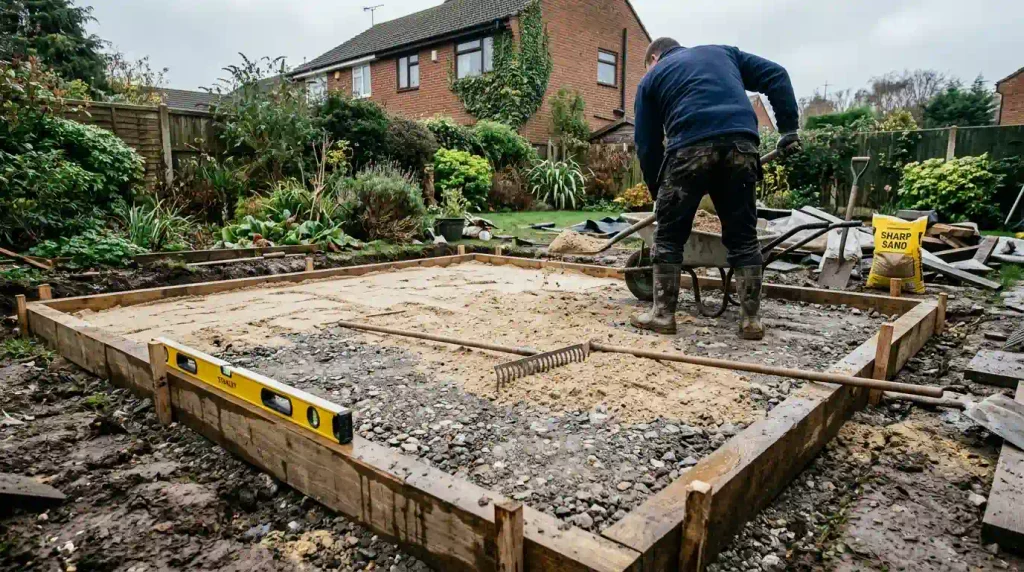
Patios, paths, steps, walls. Usually the biggest line on the quote, often 40 to 60% of it.
Material choice matters. What’s underneath matters more. A beautiful stone patio laid on a thin or poorly compacted base will lift, rock and open up at the joints inside a few winters, and the only real fix is to take it up and start again.
Boundaries and drainage
Fencing, walls, gates. Then drainage, which nobody thinks about until the first proper autumn downpour.
If your garden holds water, that gets designed out during the groundworks or it doesn’t get designed out at all. Putting a soakaway into a finished garden means digging most of it back up.
Planting comes last and costs least
Turf, topsoil, beds, shrubs. It’s what makes the garden feel finished, and it’s usually the smallest number on the page.
Which explains something you’ll notice while collecting quotes: a renovation priced by someone who mainly does soft landscaping can look cheap, then run over, because the construction beneath it was never properly costed in the first place.
Seven things that change the price
Access. Rear access for a machine and a tipper takes real money off a large project. A terrace with a narrow entry adds labour to every single stage.
What’s underground. Clay, old concrete bases, buried rubble, tree roots, unmarked services. None of it is visible when the quote is written, which is why sensible builders carry a contingency and less sensible ones find out in week two.
Changes in level. A sloping garden isn’t a flat garden with steps added. Every retaining structure needs footings, drainage and often reinforcement, and that’s a different job with a different price.
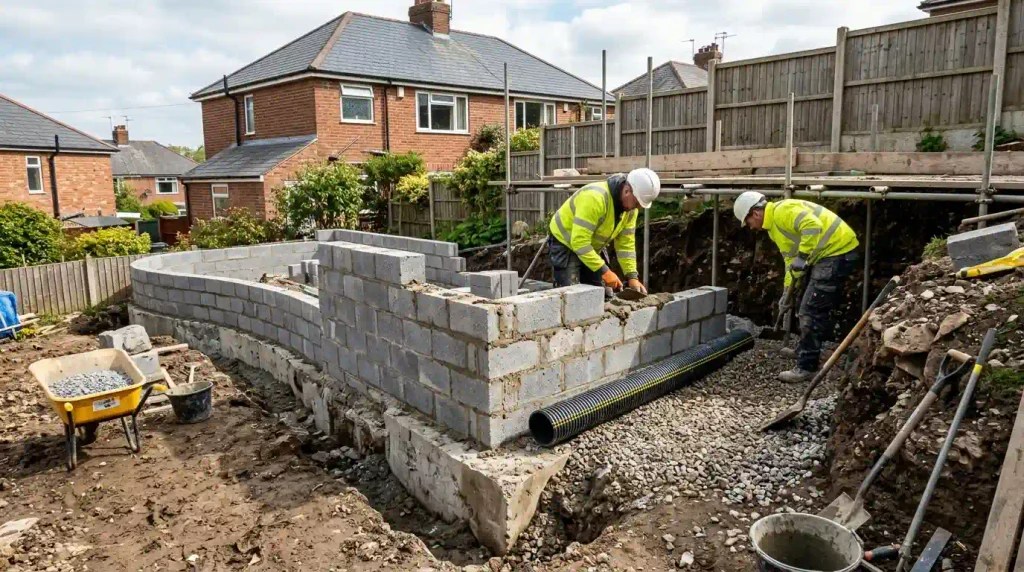
Drainage. Cheap if it’s planned in. Expensive if it isn’t.
Materials. Budget concrete flags, Indian sandstone and porcelain across the same area can be a threefold difference. Same labour, very different bill.
Time of year. Groundworkers and landscapers are booked solid March to August. Autumn and winter usually mean better availability and keener prices, and there is nothing wrong with laying a patio in November.
VAT. Rarely mentioned and worth 20%. A firm below the VAT registration threshold doesn’t charge it; a larger one does. Two quotes that look £2,000 apart on a £10,000 job can be identical underneath. Check whether each figure includes it before you compare anything.
What a garden renovation costs in Nottingham and the East Midlands
Nearly every published UK cost guide leans towards London and the South East, where labour runs 20 to 30% above the national average. That quietly inflates the headline figures for everyone living somewhere else.
The East Midlands sits at, or a little under, the national middle. So for a garden in Nottingham or the wider county, plan around the lower-to-middle part of each band above rather than the top of it. A 60m² back garden that a London-weighted guide prices at £15,000 is realistically a £9,000 to £12,000 job here, assuming decent access and no drainage surprises.
Labour rates account for most of that gap. Skip hire, aggregate and tipping charges are local too, and on a project shifting several tonnes of spoil they mount up faster than people expect.
Costs that don’t show up in the first quote
Skips and muck away. A full renovation throws out more than anyone anticipates. Old slabs, subsoil, broken concrete. Two or three skips at £150 to £400 each, or a grab lorry, and it’s frequently itemised separately or left off entirely.
Drainage and soakaways. If the garden needs a soakaway or a land drain, that sits outside the cost of the paving above it, and it’s governed by Building Regulations rather than left to preference.
Paving a front garden. In England, laying more than 5m² of impermeable surfacing in a front garden needs planning permission. Use a permeable material, or drain the surface into a border or lawn, and you stay within permitted development. It catches people out constantly, usually when a front garden is being turned into parking.
Party Wall notices. Excavating near a neighbour’s building, or working on a wall that straddles the boundary, can bring the Party Wall etc. Act 1996 into play. Notice periods run to a month or two, so it’s worth establishing early rather than the week before work starts.
Protected trees. A tree under a Tree Preservation Order, or any tree in a conservation area, can’t simply be taken down. Conservation area work needs six weeks’ written notice to the council. Felling a protected tree without consent is a criminal offence and the fines are not small.
How long does a garden renovation take?
Small courtyard or a basic refresh: one to two weeks. Average back garden with new paving, fencing and turf: three to six weeks. Large garden with level changes and retaining walls: six weeks to three months.
Those are time-on-site figures. Bring a garden designer in and you can add several months at the front for drawings and scheduling. Weather shifts everything: slabs go down fine in the cold, but not onto waterlogged ground.
How to bring the cost down without regretting it
Phase it. Groundworks, drainage and hard landscaping first; planting, lighting and a shed the following year. The disruptive, buried, expensive work gets done properly and the rest can wait.
Keep the levels you’ve got. Reworking levels is one of the largest single cost drivers in any garden. Design around the slope rather than fighting it and you’ll save thousands.
Change the material, not the area. A big porcelain patio is expensive. A big patio in good concrete flags with a stone border reads as deliberate and costs a fraction.
Reuse the hardcore. Broken-out concrete and old slabs can often be crushed on site and used as sub-base instead of being paid to leave and replaced with bought aggregate. You save at both ends.
Book off-season. October to February generally means shorter waits and better pricing.
Don’t economise on the base or the drainage. These are the two places where saving £800 costs you £5,000 four years later.
How to read a garden renovation quote
A quote worth trusting will itemise:
- Clearance and waste disposal, with skips or loads stated
- Excavation depths and the sub-base build-up
- Drainage, specified rather than assumed
- Materials named by product, not just “paving”
- Labour, with some indication of team size and duration
- Provisional sums, clearly marked as provisional
- Whether the total includes VAT
- Payment stages tied to work actually completed
A single line reading “garden renovation £11,500” tells you nothing and can’t be compared against anybody else’s. Ask for the breakdown. Any established firm will already have one.
Getting a quote in Nottingham
Buon Construction handles the construction side of garden renovation across Nottingham and Nottinghamshire: groundworks and levelling, patios and paving, garden and retaining walls, rendering, fencing and drainage. If you’d rather have a figure for your own garden than a national average, get in touch for an itemised quote and we’ll come and look at the site properly. There’s more on the full range of what we do as well.
FAQs
How much does a small garden renovation cost in the UK?
Between £3,000 and £7,000 for a garden under 40m². Courtyards tend towards the upper end, because materials and waste usually have to be moved by hand, and that adds labour to every stage of the job.
Can I renovate a garden for £5,000?
Yes, in a small to medium garden, provided you’re selective. £5,000 covers a clearance, a modest patio, new fencing and turf on a level, accessible plot. It won’t stretch to changing levels, building retaining walls or laying natural stone.
Is it cheaper to renovate a garden in winter?
Often. Demand drops away between October and February, so availability improves and pricing tends to be keener. Groundworks and hard landscaping can be done year-round; turfing and planting are the parts worth holding for spring.
Do I need planning permission for a garden renovation?
Usually not for patios, decking, fencing or planting in a rear garden. You do need it to lay more than 5m² of impermeable surfacing in a front garden, and there are height limits on fences and outbuildings. Trees under a Tree Preservation Order, or in a conservation area, need council consent before any work.
What’s the difference between a garden makeover and a full renovation?
A makeover is cosmetic: clearance, new turf, fresh planting, fencing repainted. That’s typically £1,500 to £4,000. A renovation rebuilds the structure underneath levels, drainage, paving, walls which is why those figures start around £3,000 and climb from there.
Do landscapers charge by the day or by the job?
Both. Smaller work is usually priced per day, around £110 to £180 for one person and £200 to £400 for a team. Full renovations are nearly always quoted as a fixed price for the whole project, which suits you better, because it puts the risk on the contractor rather than on your budget.
How much does a courtyard renovation cost?
£2,000 to £6,000 for straightforward work, rising past £8,000 once you add walls, built-in seating or premium paving. Small courtyards cost more per square metre than open gardens because of the access restrictions.
Does a garden renovation add value to a UK house?
It can, though it shows up more in saleability than in a specific valuation. Solid hard landscaping and a garden that visibly drains well reassure buyers. Elaborate planting is more a matter of taste and rarely returns its cost directly.
Is VAT included in a garden renovation quote?
Depends on the contractor. Firms trading below the VAT registration threshold don’t charge it; larger firms do, at 20%. Confirm it before comparing two quotes, because it’s very often the whole difference between them.
