
No. UK construction costs are not expected to fall in 2026. They are still rising: construction material costs were up 5.4% in the year to May 2026 according to Department for Business and Trade data, overall building costs rose 3.8% over the past year, and the industry’s main forecaster, BCIS, expects costs to climb a further 13% over the next five years.
If you’ve been holding off on an extension, a renovation or a build waiting for prices to come back down, that’s not the news you wanted. But it is the honest answer, and honestly, it’s the same answer this question has had every year since 2022. People asked whether construction costs would go down in 2022, then 2023, then 2024, and each year the reply was no, just a slower rate of increase. There’s a structural reason for that, which we’ll get into, because understanding it changes what you should actually do.
What the headline hides, though, is more interesting than the headline itself. Some individual materials genuinely are falling in price right now. And weak demand means contractors are quoting more competitively than they have in years. So while the indices climb, 2026 is quietly a better time to commission work than the averages suggest. Here’s the full picture, with the data behind every claim.
Table of Contents
The Short Answer: No. Here’s What the Data Shows
The numbers as they stand in mid-2026:
| Measure | Latest figure | Source |
| Construction material costs (all work) | +5.4% year to May 2026 | DBT |
| General building costs (materials, labour, plant) | +3.8% year to Q2 2026 | BCIS |
| Tender prices (what clients actually pay) | +3.2% year to Q2 2026 | BCIS |
| Labour costs | +7.1% year on year | BCIS |
| Five-year building cost forecast | +13.1% by 2031 | BCIS |
| Five-year tender price forecast | +15.5% by 2031 | BCIS |
These national indices show the direction of the market, but they do not tell you what an individual project may cost. For current rates across different types of work, see our guide to UK building costs per square metre.
Three of those lines deserve translation. Building costs are what it costs a builder to build: materials, wages, plant. Tender prices are what clients pay, which includes the builder’s overheads and margin. Notice that tender prices are rising more slowly than input costs right now. That isn’t generosity. It’s weak demand. There isn’t enough work around, so contractors are absorbing cost increases into their margins to win jobs. It won’t last (BCIS expects tender prices to outpace costs over the five-year forecast as activity recovers), but while it does, clients are getting the better end of the squeeze.
The third line to sit with is labour, up 7.1% in a year. Materials get the headlines, but wages are the pressure that never reverses. More on that shortly.
What’s Driving Construction Cost Inflation in 2026?
Four forces are pushing prices in different directions at once. That tug-of-war explains why the market feels so confusing from the outside.
Material costs: a mixed picture, not a wall of increases
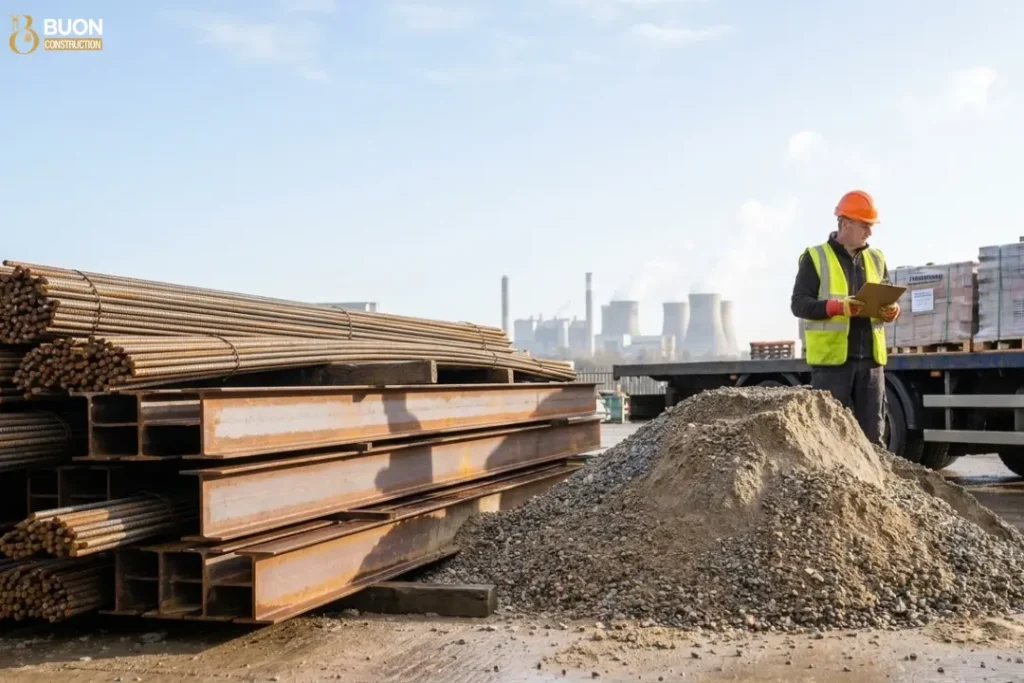
The cost of building materials rose 5.4% in the year to May 2026, but the average conceals wild variation between products. Fabricated structural steel was up 13.1% over the same period. Aggregates, meaning the gravel, sand and clays that go into almost everything, rose 12.2%. Meanwhile cement actually fell 5%, and concrete reinforcing bars dropped around 7% in the year to March.
That spread matters. If your project is groundworks-heavy or steel-heavy, your costs are running well ahead of the headline index. If it’s a straightforward masonry job, the picture is considerably gentler. Treating “material prices” as one number is how budgets go wrong. The smart money looks at the specific materials a project actually uses.
For context on how far we’ve come: DBT data shows that average material prices in 2025 were more than double their 2005 level. The post-2020 surge didn’t just pass through the system. It moved the floor.
Labour: the pressure that doesn’t reverse
Construction wages rose 7.1% year on year on the BCIS labour index, and the direction of travel is locked in. The National Living Wage went up 4.1% to £12.71 an hour in April 2026. The electrical trades have a three-year pay deal already signed: roughly 4% this year, 4.6% next, nearly 5% the year after. Skilled trades remain genuinely scarce, from electricians to groundworkers to bricklayers who can match older housing stock, and scarcity sets the rate.
Here’s the uncomfortable truth inside that. Material prices can fall when demand drops or energy cheapens. Wages don’t. Nobody hands back a pay rise. Labour is 40 to 50% of most build budgets, and it only moves one way, which is half the answer to why building costs never go back down.
Energy and global events
Materials inflation accelerated this year partly because of the Middle East conflict, which pushed Brent crude above $100 a barrel for months. Bricks, cement, glass, plasterboard and steel are all energy-hungry to make, so oil and gas prices land in UK builders’ merchants with a few months’ lag. A ceasefire has since pulled oil back from the peak, but BCIS notes any easing takes time to work through supply chains. And in a BCIS poll of over 350 construction professionals this spring, 95% still expected materials costs to rise over the next 12 months.
If it seems odd that a war thousands of miles away changes the price of a brick made in Nottinghamshire, that’s the mechanism: energy in, price out.
Interest rates and weak demand: the force holding prices down
Here’s the twist. The strongest downward pressure on construction prices right now isn’t falling costs. It’s the lack of work. BCIS forecasts total new construction output to shrink 2.7% this year before recovering from 2027. High interest rates are the main culprit: the Bank of England has held Bank Rate at 3.75%, the rate cuts markets expected at the start of 2026 are off the table, and expensive borrowing keeps developments and big renovations on hold.
Less work means hungrier contractors, and hungrier contractors mean sharper quotes. It’s the one part of this story that runs in the client’s favour, and it’s temporary by definition.
Why Building Costs Never Went Back Down After 2022
The pattern people hoped for, where prices spike and then correct, is how petrol works. It is not how construction works. Building costs ratchet: they rise fast under pressure and then settle at the new level rather than falling back. Four mechanisms lock the ratchet.
Wages are one-way. The surge between 2021 and 2023 pushed trade rates up sharply. Those rates became the new baseline the day they were agreed, and every pay deal since builds on top of them.
Energy costs reset supplier baselines. Brick kilns, cement works and steel plants repriced their entire output during the energy crisis. When energy eased, prices softened at the edges. They didn’t return to 2019, because suppliers’ own cost bases had permanently shifted.
Capacity left the industry. Construction accounted for roughly one in nine UK business insolvencies in 2023, and the collapse of ISG in 2024 left over £700 million owed to suppliers and subcontractors, taking more firms down with it. Fewer suppliers and fewer contractors means less competitive pressure, precisely when you’d want more of it.
The rate collapsed. The level didn’t. Housebuilding cost inflation peaked at 15.3% in mid-2022 on the BCIS housebuilders’ index and now runs at about 2.3%. That’s the whole story in two numbers: the pace of increase fell by more than 80%, and prices still never came down.
So when homeowners ask whether building costs will ever go down, a question that comes up regularly during our initial meetings at Buon Construction, the honest answer is this: the overall index almost certainly will not. Individual material prices can fall, however, and that is where the real opportunity lies.
Which Building Material Prices Are Actually Falling?
While the overall index climbs, several materials are moving the other way in 2026:
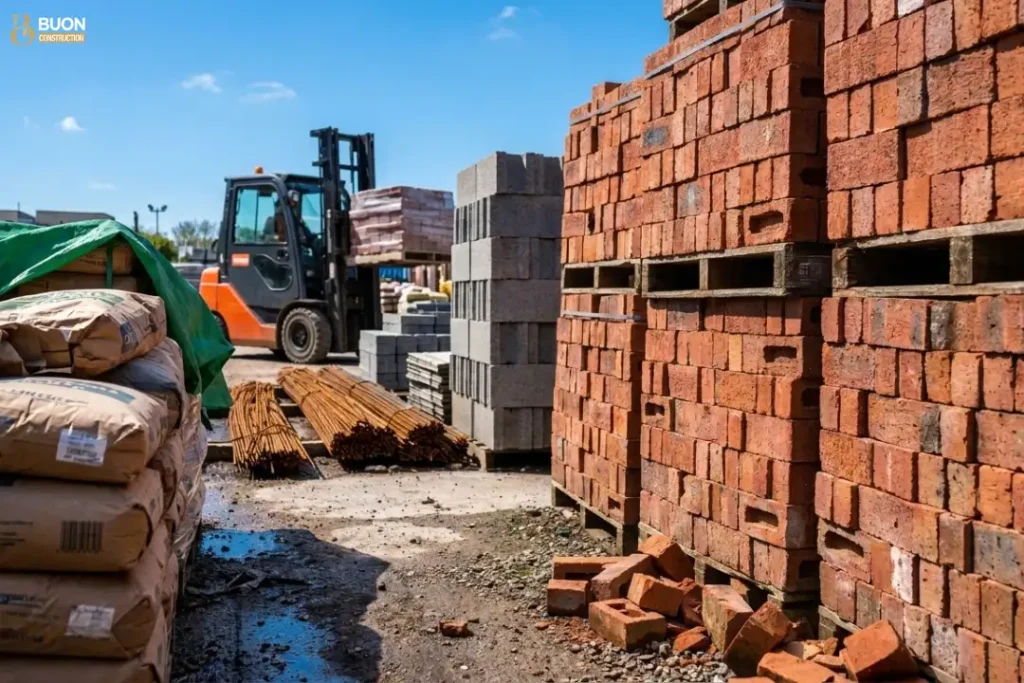
- Cement, down 5% year on year, the steepest fall of any tracked material
- Concrete reinforcing bars, down around 7% over the year to March
- Precast concrete products (blocks, bricks, tiles, flagstones), easing month on month
- Bricks, not falling outright, but brick stocks are at their highest levels in years while deliveries run about a quarter below 2021 levels. Manufacturers sitting on half a billion bricks is negotiating leverage, if your builder uses it
There’s a practical lesson in that list. You can’t time the market, but you can time a purchase. A project specified and bought intelligently in 2026 can capture falling concrete and cement prices, negotiate hard on bricks, and lock in steel early before further increases. That’s worth more than a year of waiting for an index that isn’t coming down. It’s also worth asking about reclaimed bricks and other salvaged materials on the right job; on period properties they’re often better as well as cheaper than forcing a match with new stock.
Construction Cost Projections: 2026 to 2031
The clearest forward view comes from BCIS, whose latest five-year forecast expects building costs to rise 13.1% and tender prices 15.5% between now and 2031. Read those two numbers together and they tell a story. As demand recovers from 2027 onwards, contractors will stop absorbing cost increases and start passing them on with margin restored. The gap between what building costs and what clients pay is at its narrowest now, in the weak-demand trough.
Treat any forecast, including that one, as direction of travel rather than gospel. The last five years featured a pandemic, a European war, an energy crisis and a Middle East conflict, none of which appeared in anyone’s projections. What the forecasts agree on is the direction: up, at low-to-mid single digits a year, with tender prices accelerating as activity returns. Nobody credible is forecasting a fall.
Should You Wait to Build, or Start Now?
Run the waiting maths on a real project. A £100,000 extension deferred by a year, with building costs rising around 4%, costs roughly £4,000 more. That’s before tender prices start climbing faster as demand recovers, and before another year of your life passes without the space you wanted. Defer to 2028 and the same job plausibly costs £8,000 to £12,000 more. Waiting is not a neutral act. It’s a purchase of time at construction-inflation prices.
Now the honest counter-case. If your finances are stretched by current interest rates, waiting for cheaper borrowing is legitimate; a rate cut saves real money on a mortgage-funded project, potentially more than cost inflation takes away. And if your project is steel-heavy or groundworks-heavy, this year’s double-digit rises in those categories sting.
For a more detailed breakdown by size, specification and region, see our guide to house-extension costs in 2026
But for most homeowners, 2026 sits in a strange sweet spot that the headlines miss entirely. Input costs are rising, yet quotes are keen, because good contractors have gaps in their order books for the first time in years. When activity recovers, and every forecast says it will from 2027, that window closes from both ends: prices rise and lead times stretch. In our experience, the clients who do best aren’t the ones who time the market. They’re the ones who get a fixed price while the market favours them.
How to Cut Construction Costs Without Cutting Quality
Whatever the indices do, these choices move your number.
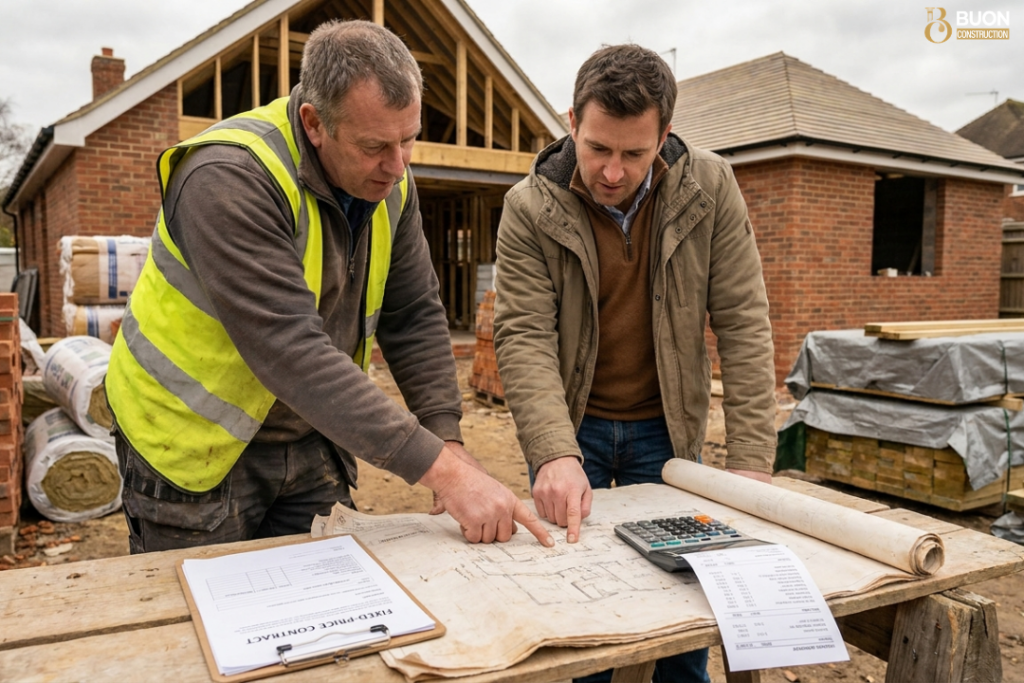
Fix the price while contractors are hungry. A fixed-price contract in a weak-demand market transfers inflation risk to the builder at the moment builders are most willing to accept it. In 2022 nobody would fix a price. In 2026 the good ones will.
Buy the falling materials at the right moment. Concrete, cement and reinforcement are cheaper than a year ago. A builder who procures deliberately, rather than ordering everything the week it’s needed, captures that. Ordering the correct quantities, storing materials properly and reusing suitable leftovers can also prevent avoidable spending. Our guide explains practical ways to minimise construction waste throughout a project.
Simplify the design. The cheapest cost saving in construction is a line not drawn. Rectangular footprints, standard rooflines and off-the-shelf sizes beat clever geometry every time the budget matters.
Consider reclaimed and alternative materials. Reclaimed bricks, salvaged slates and standard-spec concrete where premium spec adds nothing are savings that improve some jobs rather than compromising them.
Phase the project. Build the essential structure now at today’s fixed price. Defer the landscaping, the fancy driveway, the garden room. Cashflow beats borrowing at 2026 rates.
Hold a real contingency. Ten percent, ring-fenced. Cost inflation makes mid-project surprises dearer than they used to be, and the projects that end badly are rarely the ones that budgeted honestly.
The Verdict, and What To Do With It
Construction costs in the UK will not fall in 2026, and the honest reading of the data says the index never falls. It just rises at different speeds. What the averages hide is a rare alignment that favours anyone ready to commit: falling prices on specific materials, contractors quoting keenly, and fixed prices available from firms that wouldn’t have offered them three years ago. That alignment ends when demand recovers, and the forecasts say it will.
For homeowners and property developers planning work in Nottingham or the wider East Midlands, Buon Construction can prepare an itemised, fixed-price quotation based on the actual design, specification and site conditions. This gives you a clear figure to assess before committing to the work.
Last updated: July 2026. Figures from BCIS and Department for Business and Trade data published to June 2026. This page is reviewed and updated as new quarterly data is released.
FAQs
Will building costs ever go down in the UK?
The overall level, almost certainly not. Wages don’t fall, and they’re roughly half of every build cost. What does happen is the rate of increase slowing (it’s a fraction of its 2022 peak) and individual materials falling, as cement and reinforcing steel are right now. Plan around a rising index and time specific purchases instead.
How much have construction costs increased since 2020?
Substantially. Average material prices in 2025 were more than double their 2005 level, with the sharpest jumps between 2020 and 2023. Housebuilding cost inflation peaked at 15.3% a year in mid-2022. The pace has since slowed to low single digits, but the level never returned to pre-pandemic norms.
What building materials are going up in price in 2026?
Fabricated structural steel leads, up 13.1% in the year to May 2026, with aggregates (gravel, sand and clays) up 12.2%. Energy-intensive materials broadly rose after oil prices spiked during the Middle East conflict. Overall material costs rose 5.4% across the same period.
Are any construction material costs falling in the UK?
Yes. Cement is down 5% year on year, concrete reinforcing bars fell around 7%, and precast concrete products are easing. Brick manufacturers are also holding their largest stocks in years, which strengthens buyers’ negotiating positions even though list prices haven’t dropped.
Is 2026 a good time to build or extend?
For most projects, better than the headlines suggest. Input costs are rising, but weak demand means contractors are quoting competitively and willing to agree fixed prices, a combination that disappears when activity recovers, which forecasters expect from 2027. If borrowing costs are your constraint, waiting for rate cuts is the one defensible reason to delay.
Why are construction costs so high in the UK?
A stack of compounding pressures: a persistent skilled labour shortage driving wages up around 7% a year, energy-intensive materials repriced by successive global shocks, supplier and contractor insolvencies reducing competition, and rising regulatory costs. Each pushed the baseline up. None of them reverses on its own.
How much will construction costs rise by 2031?
BCIS forecasts building costs to rise 13.1% and tender prices, meaning what clients actually pay, 15.5% over the five years to 2031. Tender prices outpacing costs signals contractors rebuilding margins as demand recovers, which is why waiting tends to cost more than the raw inflation figure implies.
Do lower interest rates reduce construction costs?
Not directly. Rates don’t change the price of bricks or wages. They cut borrowing costs for the client and, over time, revive demand. That second effect actually pushes construction prices up, because busier contractors quote higher. Cheaper borrowing plus dearer building is the usual sequence after rate cuts.

7 Responses
Very good
Awesome
Awesome
Awesome
Awesome
Awesome
Very good