
Vinyl beats laminate in four areas that determine how a floor performs: water resistance, wear, comfort underfoot, and ease of repair. In a kitchen, bathroom, utility room or busy hallway, it is usually the better long-term buy.
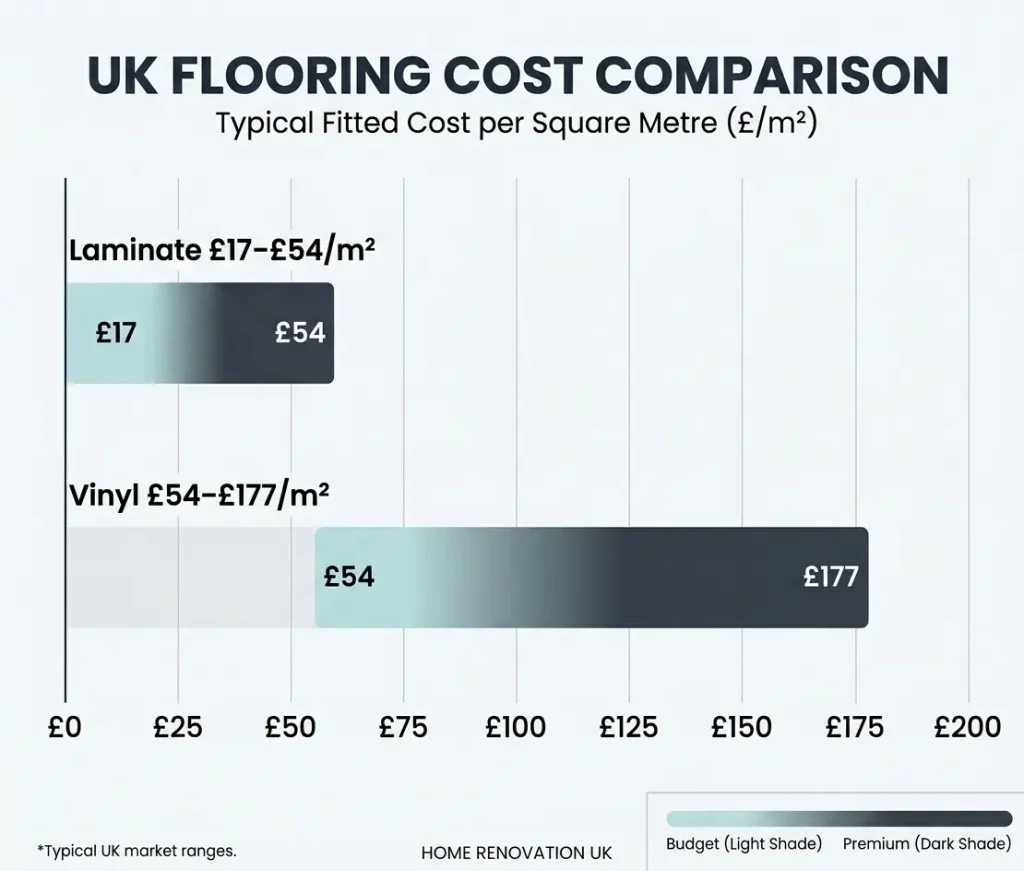
It also costs more. In the 2026 UK guide prices, laminate ranges from roughly £17 to £54 per square metre fitted. Vinyl (LVT) runs from about £54 to £177. That gap is the real decision, and most comparison articles skate past it.
Below is what separates the two materials, where the difference genuinely matters, what each costs, and the situations where laminate is still the sensible choice.
Table of Contents
Vinyl vs Laminate: The Short Answer
Vinyl is a solid plastic-based plank that water cannot damage. Laminate is a wood-fibre board with a printed surface, and its core swells if water reaches it. Almost every other difference follows from that.
Where vinyl wins:
- Water. Unaffected by spills, mopping, and humidity. Laminate is not.
- Wear. A good wear layer holds its finish longer than a melamine surface.
- Comfort. Warmer and softer underfoot, and quieter.
- Repairs. A single damaged plank can be lifted and replaced.
- Thickness. Slim profiles suit rooms where door clearance is tight.
Where laminate still competes:
- Price. A third to a half the fitted cost.
- Subfloor tolerance. A rigid core bridges imperfections vinyl would telegraph.
- Surface hardness. High-grade laminate resists scratching very well.
- Range. Deep embossing and wide planks at accessible prices.
Expect vinyl to cost two to three times more once fitted, and expect that gap to widen if the subfloor needs work.
What Each One Is Actually Made Of
The performance differences are not marketing. They come from what sits inside the plank.
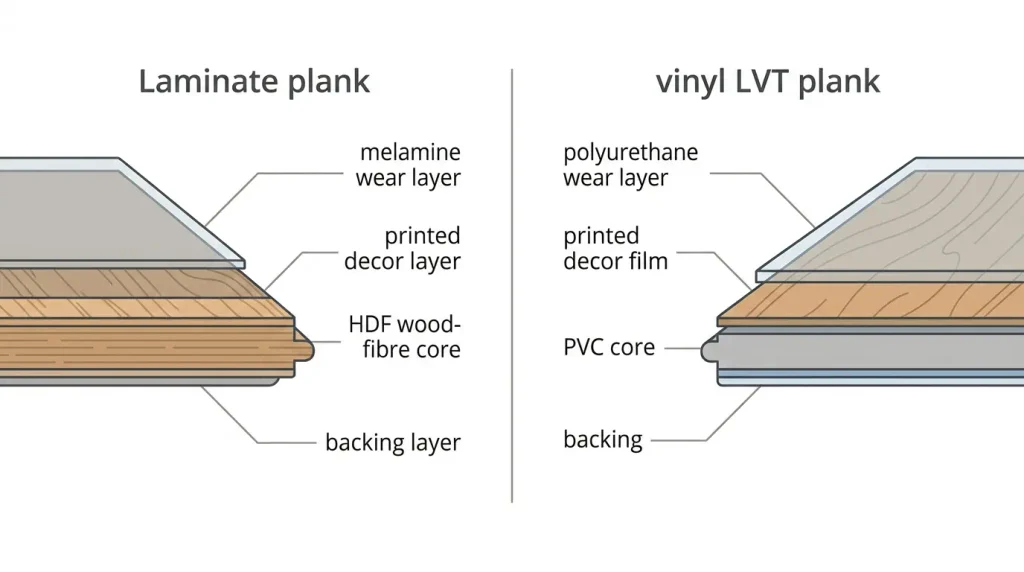
Laminate: a board with a printed layer
Laminate is built around a high-density fibreboard core, which is compressed wood fibre. A printed film showing the wood or stone effect sits on top, sealed under a clear melamine wear layer, with a backing layer underneath for stability.
That melamine surface is hard and resists scratching well. The vulnerability is the core. Wood fibre absorbs water, and once it swells it never returns to shape.
Vinyl: a solid plank
Luxury vinyl tile is built from PVC-based layers: a backing, a core, a printed decor film, and a clear wear layer, usually with a polyurethane finish for stain resistance.
There is no wood fibre anywhere in it. Water has nothing to swell.
The three types of vinyl people confuse
“Vinyl” covers three quite different products, and quotes vary hugely depending on which one is being priced.
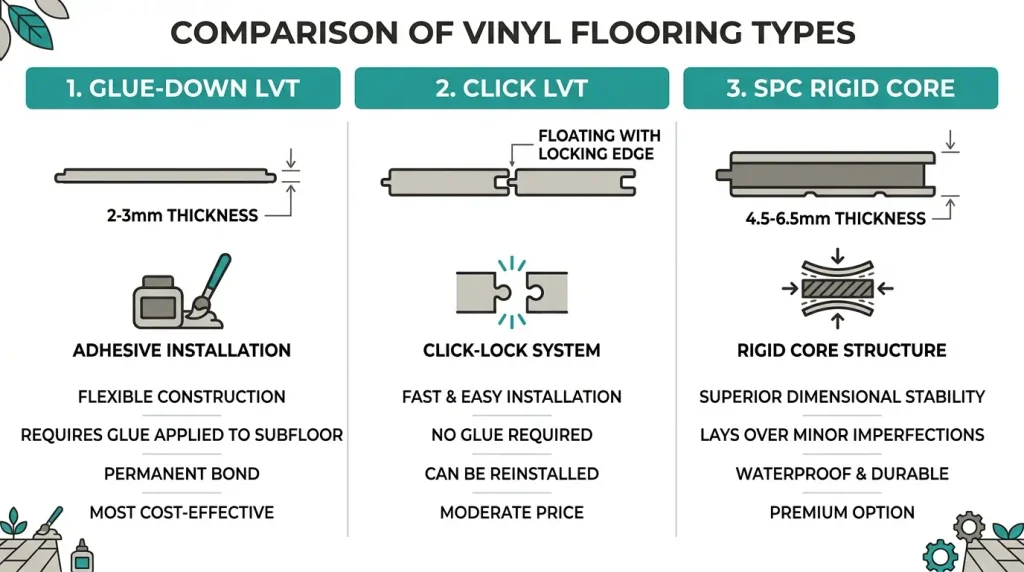
Glue-down LVT is thin and flexible, typically 2mm to 3mm, bonded straight to the subfloor. It gives the most solid feel underfoot, the closest thing to a watertight installation, and the slimmest build-up. It also demands the flattest subfloor.
Click LVT uses a locking edge and floats over an underlay. Faster to fit and liftable, but the joints let water reach the subfloor.
SPC rigid core is a denser click product, usually 4.5mm to 6.5mm, often with an acoustic backing bonded on. It handles temperature swings better, forgives a slightly imperfect subfloor, and feels firmer underfoot. It is also colder and harder than flexible LVT.
Glue-down for the best result. SPC for the best balance of practicality and performance. Click LVT where speed and budget matter most.
Water Resistance: The Difference That Decides Most Rooms
Vinyl is waterproof as a material. Laminate is water-resistant at best, and its core will swell if water sits on it or reaches it from below. In any room where water is a normal event, this settles the argument.
Why laminate’s core is the weak point
Modern laminate has improved. Sealed edges, hydrophobic coatings and tighter joints mean a spill wiped up within a few hours usually does no harm.
The problem is water that nobody wipes up. A dishwasher leaking overnight, a bath overflow, a slow radiator drip. The core absorbs it, swells at the joints and lifts at the edges. That damage is permanent, and the plank has to come out.
Products sold as waterproof laminate use a treated core and sealed joints. They perform considerably better than standard laminate. They still do not match vinyl.
What waterproof really means
Vinyl planks can sit in water unaffected. The claim is accurate at material level, and it is why vinyl has taken over UK kitchens and bathrooms.
But a waterproof material is not the same as a watertight floor, and this rarely gets said.
A click vinyl floor is made of waterproof planks with unsealed joints. Standing water finds its way through them to the subfloor and underlay beneath. The planks survive. The subfloor may not, and trapped moisture under a floating floor causes odour and mould.
For a floor that genuinely holds water out, you want glue-down vinyl with sealed joints, on a prepared and moisture-tested subfloor. In a wet room or a bathroom with a shower, that distinction is worth paying for.
Where it decides the choice
Kitchens, utility rooms, bathrooms, and cloakrooms all point to vinyl without much argument. So do conservatories, where condensation and temperature swings punish laminate.
In basements and below-ground rooms, moisture testing and the floor build-up matter more than the finish alone. Vinyl is often preferable to conventional laminate because the product itself is not vulnerable to swelling, but the substrate still needs appropriate moisture control.
In dry bedrooms and studies, either material works.
Durability: Wear Layers and AC Ratings Compared
Both are rated for durability, but on different scales. That makes comparing two quotes harder than it should be.
How is laminate rated
Laminate uses AC ratings under the European standard EN 13329, running from AC1 to AC6.
- AC1 to AC2: light domestic. Rarely worth buying.
- AC3: heavy domestic. The realistic minimum for a UK home.
- AC4: light commercial. The right call for hallways, kitchens, and homes with pets or children.
- AC5 and AC6: commercial. Overspecified for most houses.
How vinyl is rated
Vinyl is rated by wear layer thickness, the clear protective layer over the printed film, and by use class under EN ISO 10874.
- 0.3mm: light domestic. Fine in a spare bedroom, marginal anywhere busy.
- 0.55mm: the residential standard, and suitable for light commercial. This is what most UK homes should be buying.
- 0.7mm and above: commercial grade. Worth it in a hallway taking constant traffic, or a home with large dogs.
Total plank thickness is not the same as the wear layer, and retailers sometimes blur the two. A 5mm plank with a 0.3mm wear layer will wear out faster than a 2.5mm plank with 0.55mm.
Comparing them like for like
| Setting | Laminate | Vinyl wear layer |
| Spare bedroom, light use | AC3 | 0.3mm |
| Living room, average household | AC3 to AC4 | 0.55mm |
| Kitchen or hallway, family home | AC4 | 0.55mm |
| Pets, heavy traffic, rental | AC4 to AC5 | 0.7mm |
| Light commercial | AC5 | 0.7mm and above |
Scratches, dents and pets
The honest position: laminate resists surface scratching slightly better because melamine is harder than a vinyl wear layer. Vinyl resists dents, chips, and impact better because it has some flex.
Grit damages both. A doormat at every external door does more for either floor than a rating upgrade.
For homes with dogs, vinyl is still the better pick, less because of claws and more because of water tolerance and the quieter surface.
Realistic lifespan
There is no useful single lifespan for either material. Product quality, use class, moisture exposure, installation and maintenance matter more than the label on the box. However, many residential warranties run 15–25 years.
Laminate fails at the joints, from water or from wear at doorways, and when it goes, it gets replaced wholesale. Vinyl dulls slowly in the wear layer, and individual planks can be swapped along the way.
Residential vinyl warranties commonly run around 15 years. Compare warranty terms rather than headline claims, and read what they exclude.
Comfort, Warmth and Sound
Why vinyl feels warmer
Vinyl conducts heat more readily than fibreboard, so it reaches room temperature faster and feels less cold on bare feet. It also has slight give, which makes it more comfortable to stand on while cooking.
SPC rigid core is the exception. It is denser, harder and noticeably colder than flexible LVT. If underfoot comfort is a priority, glue-down or flexible click vinyl will feel better.
Footstep noise
Laminate is the noisier of the two. A hard melamine surface floating over thin underlay produces the hollow click everyone recognises. Vinyl is denser and less resonant, so it sounds quieter both in the room and to the room below.
Underlay does most of the work. Cheap 2mm foam under laminate will sound cheap. An acoustic underlay, or SPC with a bonded acoustic backing, changes the room completely.
Vinyl in leasehold flats
Check your lease before choosing anything hard.
Many UK flat leases require carpet and underlay across most of the floor area, and those clauses are enforceable however good your underlay is. Where hard flooring is allowed, acoustic underlay is normally a condition of consent.
Vinyl with a decent acoustic layer performs better on impact sound than laminate, which makes it the easier product to get approved. Our guide to renovating a flat covers the permissions in full.
Subfloor Preparation: The Cost Nobody Quotes For
Vinyl needs a flatter subfloor than laminate, and preparing it is where a vinyl quote quietly gains £15 to £25 per square metre. This is the usual reason two quotes look wildly different.
Why vinyl shows everything
Thin glue-down vinyl bonds to the surface beneath and takes its shape. A ridge, a screw head, a trowel mark or a board joint will show through as a visible line within weeks. That is not a fitting fault. It is the material doing what it does.
Why laminate forgives more
Laminate floats rather than bonds, so its rigid core bridges minor undulations. Standard tolerance is around 3mm over 2 metres, which most existing floors already meet.
What preparation involves
On concrete or screed: moisture testing, then a latex smoothing compound, usually around 3mm, to give a flat sealed surface. On chipboard or floorboards: overboarding with plywood, screwed at close centres, joints filled and sanded. Over existing tiles: filling grout lines and levelling. On anything where moisture could rise: a damp proof membrane.
If a vinyl quote makes no mention of subfloor preparation, ask what happens if the floor turns out not to be flat. The answer tells you whether you are comparing like with like.
Underfloor Heating: Which Performs Better
Both work over underfloor heating, but vinyl transfers heat faster because it is denser and thinner, so rooms warm up quicker and run more efficiently. Laminate’s fibreboard core acts as a mild insulator.
If you are weighing up a heated floor as part of a wider job, our underfloor heating cost guide covers the system side.
The 27°C limit
Many major flooring manufacturers set a maximum floor-surface temperature of 27°C, but the product-specific installation instructions take precedence, with some manufacturers permitting 28°C. Go above it and vinyl can distort, discolour or de-bond, while laminate gaps and cups.
That is surface temperature, not room temperature. Use a thermostat with a floor probe rather than an air sensor, because the surface above a heating pipe runs considerably warmer than the air around it.
Commissioning rules
These get skipped routinely, and they cause most heating-related floor failures:
- Switch the heating off at least 24 hours before laying, or hold the surface below 18°C if it cannot be turned off.
- Leave it off for a further 24 hours after fitting.
- Raise the temperature gradually, no more than 5°C per day, until it reaches normal operating level.
- Reverse the process at the end of the heating season rather than switching off abruptly.
Expansion gaps
Any floating floor moves with temperature. Leave a minimum 5mm perimeter gap, and never trap the floor under a kitchen plinth, door frame or heavy island. A restrained floating floor over underfloor heating will buckle.
What Each Costs in the UK
Figures below are 2026 UK guide ranges. Real prices depend on room size, layout, subfloor condition and region.
Laminate
| Item | Cost per m² |
| Budget board, 6mm to 7mm | £8 to £12 |
| Mid-range, 8mm AC3 | £14 to £20 |
| Premium, 10mm to 12mm AC4 | £22 to £30 |
| Herringbone | £18 to £35 |
| Underlay | £1 to £7 |
| Fitting, straight lay | £5 to £8 |
| Fitting, complex or herringbone | £8 to £15 |
Typical fitted total: £17 to £54 per m².
Vinyl
| Item | Cost per m² |
| Entry glue-down, 0.3mm to 0.4mm wear layer | £29 to £35 |
| Mid-range glue-down, 0.55mm wear layer | £37 to £60 |
| Premium glue-down, 0.7mm to 1.0mm | £62 to £87 |
| Click rigid core (SPC) | £43 to £69 |
| Installation, including adhesive, latex smoothing and trims | £25 to £40 |
Typical fitted total: £54 to £104 per m² for standard plank, £115 to £177 for premium, and around £125 for mid-range herringbone.
For a wider comparison across materials, see our flooring cost guide.
Judge it over 15 years, not on day one
On a 20m² kitchen, mid-range laminate fitted might come in around £600 to £750. Mid-range vinyl might be £1,400 to £2,100.
The case for vinyl is not that it is cheap. It is that in a kitchen it is unlikely to need replacing inside 15 years, whereas laminate in the same room has a realistic chance of being damaged by water once. Replacing a laminate kitchen floor a single time wipes out the saving and adds the disruption of emptying the room again.
In a bedroom that argument disappears, and laminate is better value.
Where the money goes
In a vinyl quote, material is often less than half the total. Subfloor preparation, adhesive, trims and labour make up the rest. In a laminate quote, material and underlay dominate and labour is a smaller share.
That is why vinyl quotes vary so much between fitters. They are pricing different amounts of preparation, not different floors.
Appearance, Repairs and Resale
Realism
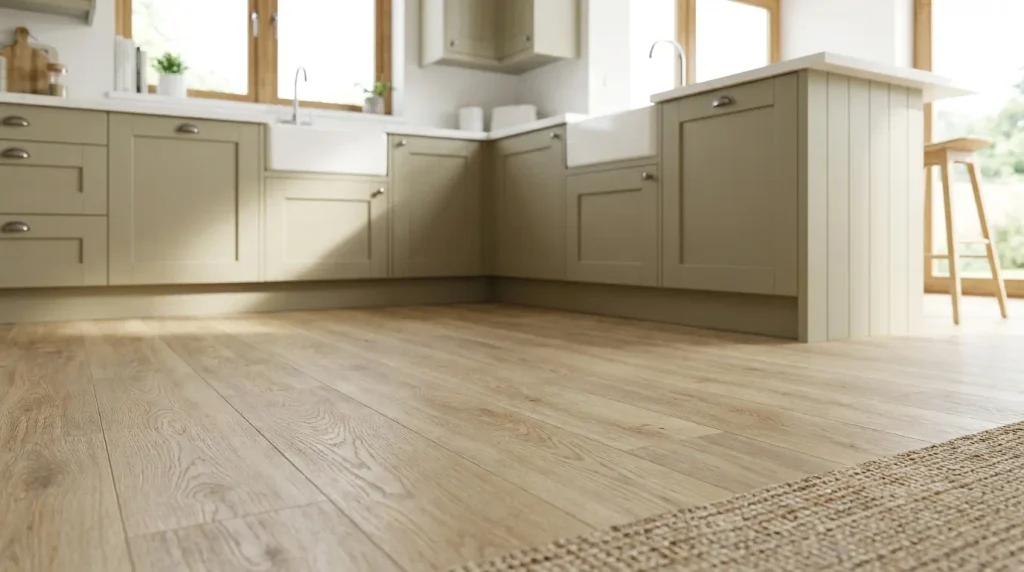
Both have improved enormously. Premium laminate uses deep embossing that follows the printed grain, and at the top end it is convincing.
Vinyl wins on edge detail and on stone and tile effects, where the thinner profile and micro-bevelled edges sit closer to the real material. It handles herringbone and other patterns more cleanly too.
View samples in the actual room, in daylight and under your own lighting. Print quality varies more between ranges than between materials, and the floor needs to suit everything else in the room. Our guide to finding your interior design style is a useful starting point.
Repairs
Glue-down vinyl is the easiest floor to repair. A damaged plank is heated, lifted, and a replacement is bonded in. Keep spare planks from the original batch and the repair is close to invisible.
Click vinyl and laminate both need unclicking back to the damaged board, or cutting it out and gluing in a replacement. More disruptive, and more visible afterwards.
Does either add value?
Neither adds measurable value on its own. What both do is remove an objection. A swollen laminate floor in a kitchen is a job the buyer prices in. A sound, well-fitted floor is not.
For what moves the needle, see which renovations boost value.
When Laminate Is Still the Right Choice
A comparison that never recommends the cheaper option is not a comparison. Laminate is the better call in five real situations.
Tight budgets. At roughly a third of the fitted cost, a good AC4 laminate in a dry room beats a cheap 0.3mm vinyl bought to squeeze inside a vinyl budget. Specification matters more than material.
Rental turnover. Where the floor gets replaced every tenancy or two anyway, the cheaper product with the shorter life is the rational choice in bedrooms and living rooms.
Uneven subfloors. If the floor beneath is out of tolerance and levelling is impractical, laminate bridges what vinyl would reveal. That alone can close the price gap.
Bedrooms and dry rooms. Water is the main argument for vinyl. Take it away and the case weakens.
Where you want a thicker board. A 12mm laminate has a solidity underfoot that thin glue-down vinyl does not, with textures and plank widths vinyl cannot match at the same price.
How to Choose: Room by Room
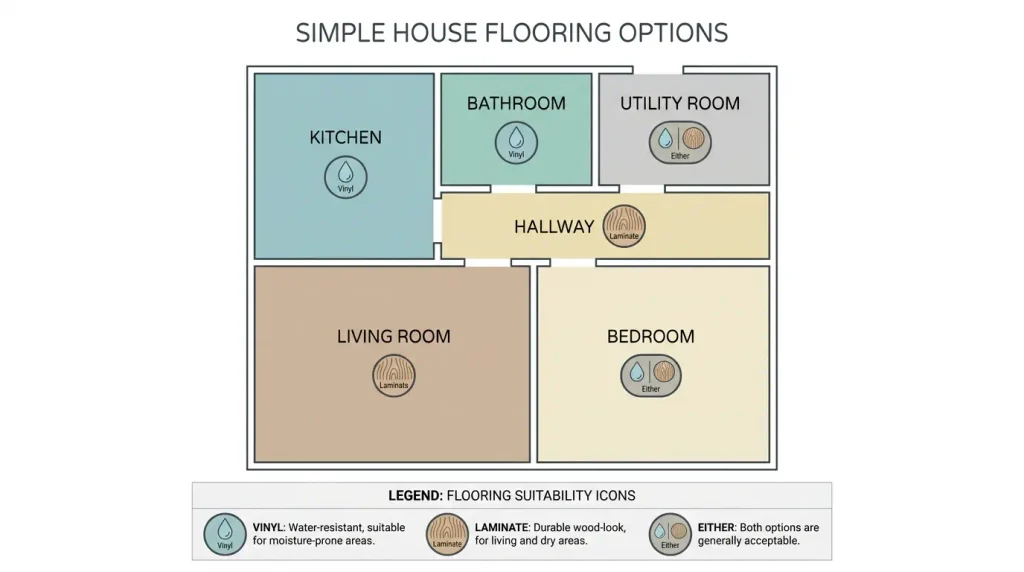
Kitchens. Vinyl. Spills, appliance leaks and mopping make this the clearest case, and glue-down where the budget allows. Settle it alongside the rest of the kitchen specification rather than as an afterthought.
Bathrooms and wet rooms. Vinyl, glue-down, sealed joints. Laminate does not belong in a bathroom. Tiles are the alternative worth pricing: see our guide to bathroom tile materials and the bathroom renovation guide.
Hallways. Vinyl at 0.55mm or above, or AC4 laminate if budget is the constraint. This is the highest-wear area in most homes.
Living rooms. Either. Vinyl for quietness and warmth, laminate for a thicker board and a wider range at the price.
Bedrooms. Laminate is perfectly adequate, and the saving is better spent elsewhere.
Flats. Vinyl with acoustic underlay, subject to the lease.
Basements and garage conversions. Vinyl, with a damp proof membrane and moisture testing.
Getting the Installation Right
A well-specified floor fitted badly performs worse than a modest floor fitted properly.
What to ask before accepting a quote
- What condition is the subfloor in, and what preparation is included?
- Has moisture been tested, and what were the readings?
- What wear layer or AC rating is being supplied?
- Is underlay included, and which type?
- How are thresholds, trims and expansion gaps being handled?
- If it is going over underfloor heating, what commissioning process will be followed?
A quote that answers all six is a real quote. One that gives a rate per square metre and nothing else is a guess.
Acclimatisation
Both materials need time in the room before fitting, usually 24 to 48 hours in the conditions they will live in. Laying a cold floor delivered that morning is a common cause of gapping later.
Protecting it afterwards
If other work is still running, protect the new floor properly. Grit under a dust sheet acts like sandpaper. Our guide to protecting flooring during construction covers what actually works.
Flooring Supply and Fitting in Nottingham
The choice becomes straightforward once you know the condition of the subfloor, how each room gets used, and what the budget has to cover elsewhere.
Buon Construction fits vinyl, LVT and laminate as part of home renovations across Nottingham and the East Midlands, including kitchen and bathroom projects where the flooring has to work alongside everything else. You can see the standard of finish in our recent projects.
For a straight assessment of what suits your rooms and your budget, get in touch.
FAQs
Can you put laminate in a bathroom?
Not advisable, even with water-resistant laminate. The fibreboard core swells permanently once water reaches it, and bathrooms combine standing water with constant humidity.
Does vinyl flooring scratch easily?
Not with an adequate wear layer. Laminate’s melamine surface is marginally harder, but vinyl resists dents and impacts better. Grit is what damages both, so use doormats at external doors.
Is vinyl or laminate better for dogs?
Vinyl, in most homes. It handles accidents and mopping without damage, it is quieter under claws, and it is less slippery than laminate. Specify a 0.7mm wear layer for larger breeds.
Is LVT the same as vinyl flooring?
LVT is a type of vinyl flooring. It stands for luxury vinyl tile, covering tiles and planks, as distinct from sheet vinyl. Most modern residential vinyl flooring is LVT.
Can I put vinyl flooring in a leasehold flat?
Only if your lease permits hard flooring. Many leases require carpet across most of the floor area. Where hard flooring is allowed, acoustic underlay is usually a condition of freeholder consent.
Can you lay vinyl over existing laminate?
Generally no. Floating one floor over another causes movement that fails the joints, and most manufacturers exclude it from warranty. The exception is a fully bonded, flat and sound existing floor, and even then check the manufacturer’s guidance first.
