
In 2026, underfloor heating has moved from being a luxury feature to a mainstream heating option across the UK. Rising energy costs, improved insulation standards, and government support for low-carbon heating have all contributed to this shift.
Underfloor heating installation costs in the UK typically range from £50 to £190 per square metre, depending on system type, property age, region, and installation complexity. For small rooms like bathrooms, costs often start from £800 to £1,500. Whole-house systems for average homes usually fall between £6,000 and £8,000, while large detached homes, older properties, or complex retrofits can reach £11,000 to £13,000.
In simple terms, underfloor heating costs in 2026 range from £50 to £190 per square metre, with electric systems usually cheaper to install and water systems usually cheaper to run long term. The best choice depends on whether you are fitting one room or a whole house, and whether the job is a new build or a retrofit.
What matters most is not just the headline cost, but how the system fits the way your home is built, insulated, and used.
Table of Contents
Is underfloor heating worth the cost in the UK in 2026?
Underfloor heating is generally worth the cost in 2026 for homeowners who plan to stay in their property long term and value comfort, efficiency, and future-proofing.
From an energy perspective, underfloor heating operates at much lower flow temperatures than traditional radiators. While radiators typically require water temperatures of 65–75°C, underfloor heating usually runs effectively at 35–45°C. This difference directly reduces energy demand, especially in well-insulated homes.
Energy prices in 2026 make this efficiency increasingly important. Average electricity prices sit around 24.5p to 26p per kWh, while gas averages approximately 6.04p per kWh. Homes using heat pumps benefit even more, as heat pumps deliver higher efficiency at lower temperatures. This is one reason underfloor heating pairs so well with low-carbon systems.
Government support further improves the financial case. The £7,500 Boiler Upgrade Scheme significantly reduces the upfront cost for homeowners installing air source heat pumps. In real-world terms, many households effectively offset the additional cost of underfloor heating when upgrading from a radiator system to a heat pump-ready floor system.
That said, underfloor heating may not be worth it for every property. Homes with poor insulation, suspended timber floors in poor condition, or owners planning to sell within a few years may not see sufficient return on investment.
Does underfloor heating replace radiators completely?
Yes, underfloor heating can replace radiators completely when it is designed and installed correctly.
In new builds and major renovations, underfloor heating is often specified as the sole heating system. Modern building regulations require high insulation standards, which reduce heat loss and make floor-based heating more than sufficient to maintain comfortable indoor temperatures.
In older homes, a hybrid approach is sometimes used. A common real-world example is a 1930s semi-detached house where underfloor heating is installed downstairs during a kitchen extension, while radiators remain upstairs to avoid lifting bedroom floors.
The key factor is heat loss calculation. If the heat loss of each room is accurately calculated and matched with the correct pipe spacing or heating mat output, underfloor heating alone can comfortably replace radiators. Problems usually arise when systems are underspecified to save money.
From a usability standpoint, removing radiators frees up wall space, improves furniture layout, and creates cleaner interior aesthetics, which many homeowners value highly.
Is it expensive to run underfloor heating in a small bathroom?
Running underfloor heating in a small bathroom is usually inexpensive, particularly when electric systems are used.
A typical UK bathroom measures between 3 and 5 square metres. An electric underfloor heating mat in this space usually has an output of around 150–200 watts per square metre. Even when run for several hours per day, the total electricity usage remains relatively low.
Using 2026 electricity prices, most homeowners spend £15 to £30 per month heating a bathroom floor. In real-world usage, many people only run bathroom heating during mornings and evenings, further reducing costs.
Bathrooms are ideal spaces for underfloor heating because they warm quickly, retain heat well, and benefit greatly from warm floor surfaces. The comfort improvement often outweighs the modest running cost.
What’s better: electric or water underfloor heating for a kitchen?
The better option depends on the kitchen size, layout, and whether the installation is part of a renovation or new build.
Electric underfloor heating is often preferred for existing kitchens. Installation is quicker, floor build-up is minimal, and upfront costs are lower. For a typical 12 m² kitchen, electric systems often cost between £1,200 and £2,000 installed.
Underfloor water heating is better suited to large kitchens or open-plan kitchen-dining areas. Although installation costs are higher, water systems are cheaper to run long term and integrate better with boilers and heat pumps.
In real-world projects, homeowners extending their kitchen often choose water systems because pipework can be installed during construction with minimal disruption.
Does underfloor heating increase the value of my property?
Underfloor heating generally increases property value, particularly in competitive housing markets.
Buyers increasingly expect modern heating solutions, especially in new builds, extensions, and renovated properties. Underfloor heating is associated with comfort, efficiency, and modern living standards.
In practical terms, estate agents often highlight underfloor heating as a premium feature in listings. While it may not add a fixed monetary amount to every property, it improves marketability and can help a home stand out.
Homes with underfloor heating are also perceived as more future-ready, particularly when paired with heat pumps or smart controls.
How long does underfloor heating take to warm up?
Warm-up time depends heavily on system type and floor construction.
Electric underfloor heating systems typically respond within 30 to 60 minutes. These systems heat the floor surface directly and are ideal where quick responsiveness is required.
Water systems embedded in concrete screed have higher thermal mass. When completely cold, these systems can take up to 4 hours to reach full operating temperature. However, once warm, they retain heat exceptionally well.
In real-world use, most homeowners keep underfloor heating running at a steady background temperature rather than allowing it to cool completely.
Is underfloor heating safe for pets and children?
Underfloor heating is one of the safest heating systems available for family homes.
Floor surface temperatures are regulated and remain warm rather than hot, eliminating burn risks. There are no exposed pipes, sharp edges, or hot metal surfaces.
In practice, pets often seek out warm floors, and parents appreciate the absence of hot radiators in children’s rooms and play areas.
Can I leave my underfloor heating on all the time?
Yes, and this is often the most efficient way to use it.
Underfloor heating is designed to maintain stable indoor temperatures. Switching systems on and off frequently can increase energy consumption due to repeated warm-up cycles.
Most real-world installations use programmable thermostats to maintain a low background temperature, with small adjustments during occupied periods.
Does underfloor heating reduce dampness or condensation?
Underfloor heating can help reduce condensation by eliminating cold spots on floors and lower walls.
Even heat distribution raises surface temperatures above the dew point, reducing moisture buildup. This is particularly beneficial in kitchens, bathrooms, and ground-floor rooms.
However, underfloor heating does not fix underlying damp problems such as rising damp, leaks, or poor ventilation.
What are the pros and cons of underfloor heating vs radiators?
Underfloor heating provides even heat distribution, improved comfort, and better energy efficiency. It frees wall space and operates quietly.
Radiators are cheaper to install and respond more quickly to temperature changes. They are easier to retrofit and simpler to repair.
In real-world homes, underfloor heating excels in modern, insulated spaces, while radiators remain practical in older properties with limited renovation scope.
Which flooring works best with underfloor heating?
Hard flooring materials conduct heat best.
Tiles and stone offer excellent heat transfer and durability. Vinyl and engineered wood also perform well when properly specified.
Solid hardwood and thick carpets reduce efficiency and require careful consideration.
Can I put underfloor heating under thick carpet?
Only if the combined carpet and underlay tog value does not exceed 2.5.
High tog carpets act as insulation and significantly reduce heat output. Many manufacturers provide UFH-compatible carpet ranges.
How much does underfloor heating cost per square metre in 2026?
Electric systems typically cost £50 to £85 per m² installed. Water systems usually range from £90 to £150 per m², but complex retrofits or London installations can reach £185 to £190 per m².
Costs vary based on floor preparation, insulation, zoning, and labour.
Do I need to lift my existing floors to install underfloor heating?
In most renovations, yes. Existing flooring must be removed to install insulation and heating elements. This increases labour and material costs.
In new builds, underfloor heating is installed as part of the floor structure, avoiding disruption.
How much is a wet underfloor heating system for a 3-bedroom house?
Most 3-bedroom homes cost £5,500 to £7,500 for a wet system.
Larger detached houses often exceed £8,000, with complex layouts reaching £11,000 to £13,000.
Factors include total floor area, insulation quality, and zoning complexity.
Can I install underfloor heating myself, or do I need a plumber?
Electric mats can be laid by competent homeowners, but electrical connections must be completed by a qualified electrician.
Water systems require professional plumbers or heating engineers due to pipework, pressure testing, and boiler integration.
How long does it take to install underfloor heating in a new build?
Single rooms typically take 1 to 2 days. Whole-house installations usually take 1 to 2 weeks, depending on size and coordination with other trades.
What is the best underfloor heating for a conservatory?
Choosing the best underfloor heating for a conservatory comes down to how the space is built, how often you use it, and how much disruption you’re willing to allow during installation. Conservatories are tricky because they usually have a lot of glass and poor thermal mass. This affects how fast they heat up and how much energy they need to stay comfortable.
Why do conservatories lose heat faster than other rooms?
Conservatories have large glazed areas (windows and roof panels) and often sit on slab bases or raised floors. These features make them heat hungry: cold surfaces quickly absorb heat, and warm air escapes fast. Traditional radiators struggle in this environment, leading many homeowners to prefer underfloor heating because it warms from the ground up and reduces cold spots at floor level. In practical terms, a conservatory without proper heating often ends up being too cold to use in winter and too hot in summer without shading.
Electric underfloor heating: best for existing conservatories
Electric systems are usually the best choice for existing conservatories, especially where you want minimal disruption.
Electric underfloor heating consists of thin heating mats or cables that lie just beneath your finished floor. They are installed directly on top of the existing subfloor or insulation board, then covered with your final floor finish (tiles, laminate, vinyl, etc).
Why electric systems work well here:
- Minimal floor height increase: Electric mats are thin, often adding only a few millimetres to the floor level, which reduces the need for door or threshold adjustments.
- Fast installation: Most electric systems in a conservatory can be fitted in a day or two, without major construction work.
- Independent control: They can be installed with their own thermostat and schedule, so you only heat the conservatory when you’re using it.
- Lower upfront cost: Electric systems are typically cheaper to install than water systems when only a single room is being heated.
Real-world example:
A homeowner with an existing conservatory measuring around 20 m² could have an electric mat system installed over a weekend. The installer would lay insulation board first, then the electric heating mat, then the new floor finish. With a dedicated thermostat, the conservatory could be comfortable on chilly mornings without affecting the main house heating.
While electric systems cost a bit more to run per kWh of heat, the convenience and minimal installation disruption often outweigh the running cost difference for a room that isn’t heated all day, every day.
Water (wet) underfloor heating: best for new-build or major extensions
Water-based systems are often the best choice for new-build conservatories or those being extended and rebuilt.
Underfloor water heating uses pipes embedded in a screed layer beneath the floor. These pipes connect to your boiler, heat pump, or other central heating source, circulating warm water to heat the floor mass.
Why water systems are ideal for new-build conservatories:
- Greater efficiency for larger areas: Water systems can be more cost-effective in bigger conservatories or spaces that are used frequently.
- Better integration with heat pumps and boilers: If you’re already installing a heat pump for the main house or extension, adding water underfloor heating in a new conservatory makes sense and improves overall system efficiency.
- Lower running costs long-term: Although installation costs are higher, water systems generally run cheaper than electric mats when used regularly over many seasons.
Real-world example:
A conservatory being built as part of a new rear extension (30 m²) could have water underfloor heating installed as part of the base floor construction. Insulation boards and pipework are laid before the screed is poured. Once the screed cures, the system becomes part of the solid floor structure, delivering comfortable, even heat throughout the season with relatively low running costs, particularly when paired with a heat pump.
The downside is the need for floor screed and higher installation costs up front, plus the increased floor height from the screed itself. However, for new builds or major renovations, that isn’t usually a barrier.
Key factors to consider before choosing underfloor heating for a conservatory
Without good insulation under the floor and around the walls and roof, any heating system will struggle. A conservatory with poor insulation can lose up to 50 per cent of its heat within a few hours. Installing underfloor insulation boards beneath the heating system dramatically improves performance and running costs.
Insulation quality
Without good insulation under the floor and around the walls and roof, any heating system will struggle.
Frequency of use
Rooms used daily all year round are better suited to water systems.
Integration with the main heating
If you are extending your home and already installing a boiler or heat pump, extending the water underfloor heating improves efficiency.
Floor covering
Ceramic or stone tiles conduct heat best, while vinyl and engineered wood can also work well when specified correctly.
What makes underfloor heating work well in a conservatory
Underfloor heating works best in conservatories when the floor is insulated, the glazing is upgraded, and the room is treated as part of the main home rather than a separate add-on. Insulation boards under the system reduce heat loss into the slab, which can otherwise waste a large chunk of your energy. Proper zoning also matters because conservatories often need different schedules from the main house. The final piece is floor finish, with tiles and stone usually giving the best heat transfer.
Summary: the best choice for your conservatory
- Existing conservatory with minimal disruption:
Electric underfloor heating: Thin and quick to install, controlled independently, good for occasional use. - New-built or fully renovated conservatory:
Water (wet) underfloor heating: More efficient long-term, integrates with central heating, best for frequent use. - If you plan to pair with a heat pump:
Water underfloor heating becomes even more efficient, especially over larger areas.
By choosing the right system for your conservatory’s construction and use patterns, you ensure you get comfortable, even warmth, without unnecessary cost or disruption.
Do I need a new boiler to install underfloor heating?
Most modern boilers are compatible with underfloor heating.
However, low-temperature systems such as heat pumps deliver better efficiency and future-proofing.
How much does a smart thermostat for underfloor heating cost?
Smart thermostats for underfloor heating typically cost between £100 and £200 per zone in the UK in 2026, but the real cost includes both the device and the professional installation. When you factor in wiring, setup, and integration with a central heating system or heat pump, the full installed cost is often £200 to £350 per thermostat.
A “zone” here means a separately controlled area of underfloor heating; for example, one thermostat for the kitchen, another for living areas, etc. Larger homes with many zones will require multiple thermostats.
What affects the thermostat price?
Features and connectivity:
- Basic digital thermostats with simple scheduling and temperature control usually sit around £100 to £120.
- Wi-Fi or smart thermostats that connect to apps and work with voice assistants (Alexa, Google Home) typically cost £150 to £200.
- Advanced models with learning schedules, occupancy detection, or room sensors can reach £220 to £280+.
Smart thermostats usually include intuitive mobile apps, remote control, and usage reports. These features help homeowners optimise energy usage and reduce bills by avoiding unnecessary heating.
Why installation matters
Even the best thermostat is only as good as its setup. In the UK, wiring a thermostat into an underfloor heating system must be done safely and to regulation, so you generally need a qualified electrician. An electrician typically charges £40 to £60 per hour, and most installations take 2–4 hours, depending on how many zones you’re wiring up.
A typical electrician’s cost for one thermostat might be:
- Two hours of labour: £80–£120
- Hardware and wiring accessories: £20–£40
- Total installed cost per thermostat: £200–£350 (smart model)
If you have multiple rooms and separate zones, the per-thermostat cost trend stays similar, though some electricians offer a small discount when installing several at once.
Real-world examples
Example 1
A homeowner converting a 20 m² kitchen into a cosy year-round space chooses a smart thermostat with app control and daily scheduling. The thermostat costs £175, and installation by an electrician adds £120, so the total installed cost is about £295.
Example 2
A whole-house underfloor heating setup with three zones (living room, kitchen, upstairs bathroom) uses three smart thermostats at £180 each. Wiring and setup for three zones might take a day’s work, totalling around £300 in labour. The total installed expenditure ends up around £840–£900, or roughly £280–£300 per zone.
Is a smart thermostat worth it?
Smart thermostats are more expensive than basic digital ones, but they can significantly improve efficiency. With features like adaptive scheduling, remote temperature control, and energy usage insights, many households save on running costs over time, especially when heating multiple zones or using a heat pump.
In summary:
- Device cost: £100–£200 per thermostat
- Installed cost with electrician: £200–£350 per zone
- Smart features: app control, remote access, learning schedules, energy reports
Having a good thermostat makes all the difference in comfort and running cost, so while it adds to the install bill, it often pays back through better temperature control and lower wasted energy.
Is it cheaper to install underfloor heating in a new build or a renovation?
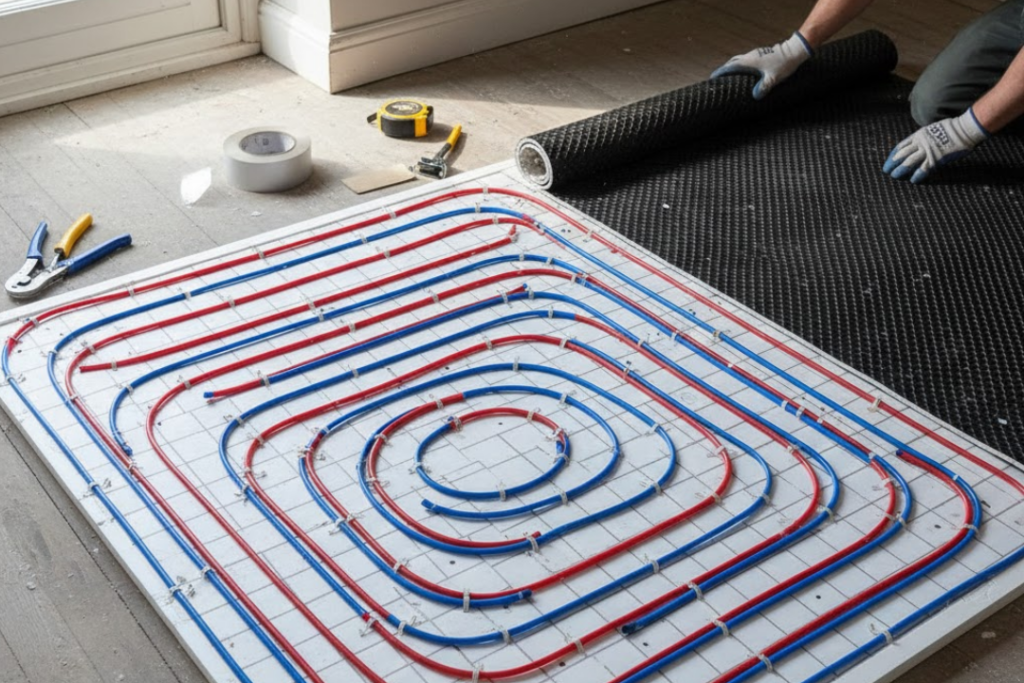
It is almost always cheaper to install underfloor heating in a new build than in a renovation. This comes down to access, floor construction, disruption, and extra preparatory work required in older buildings.
Let’s unpack what that means in real terms.
Why do new builds cost less
When underfloor heating is part of the original construction, it gets installed at the same time as the floor itself. The floor structure, insulation boards, pipework or heating mats, screed (for water systems), and finish all go down in one continuous process.
This delivers savings because:
- There’s no existing floor to remove
- There’s no re-levelling or adjustment of existing surfaces
- There’s no repair work, dust, or demolition
- Tradespeople can work efficiently without extra protection or sequencing
For example, in a typical new build:
- Electric underfloor heating might be £50–£65 per m²
- Water underfloor heating might be £80–£110 per m²
Those prices stay relatively stable because the floor layers are planned together and labour is continuous.
Why renovations cost more
In a renovation, especially in older homes, underfloor heating almost always requires lifting the existing floor covering. That might mean removing tiles, laminate, wood or carpet, and in many cases breaking up the screed or concrete base underneath.
There are a number of hidden costs that add up:
1. Floor removal and disposal
Removing old flooring is labour-intensive and takes time. Waste needs to be transported and disposed of safely.
2. Subfloor preparation
Many older subfloors are uneven, warped, damp, or built over voids. They often need levelling compounds or new screed, and that all costs time and materials.
3. Higher labour time
Labour rates are applied to each stage: demolition, prep, laying insulation, pipes or mats, screed, drying time, re-flooring finishes, and final trims.
4. Door and skirting adjustments
Raising the floor by 15–20 mm (or more) means doors need trimming and skirtings may need re-fixing.
For renovation installs, typical costs are:
- Electric underfloor heating £60–£85 per m²
- Water underfloor heating £95–£150 per m²
- Complex renovations in older houses can reach £180–£190 per m²
That’s partly labour and partly materials, but the big difference is time and effort compared with a clean new build.
Example 1: New build ground floor extension
A homeowner adds a 30 m² kitchen/dining space as part of a new build extension.
- Underfloor heating was installed with the slab and insulation, so no demolition was needed.
- Total cost was around £3,000–£4,000 for a water system, insulation, screed and finish.
This kind of job flows naturally with other work, so costs stay controlled.
Example 2: Renovation in a 1950s home
A homeowner wants underfloor heating in the existing lounge (25 m²).
- They need tiles removed, old levelling screed taken up, new insulation boards laid, piping installed, and new screed poured.
- They also need doors trimmed and skirtings refitted.
- The total cost ends up around £4,000–£5,500 for a water system because of the extra preparation.
This is a very typical difference you see when comparing renovation projects with new builds.
End-to-end cost comparison (example)
| Cost Type | New Build (per m²) | Renovation (per m²) |
| Electric UFH | £50–£65 | £60–£85 |
| Water UFH | £80–£110 | £95–£150 |
| Complex renovation premium | — | £170–£190 |
Factors that can tilt the balance
Insulation quality:
If a renovation project already has good insulation and a clean subfloor, the gap between new build and retrofit costs narrows.
Floor covering choice:
If you are replacing tiles anyway, some of the disruption cost is shared between the new floor and the underfloor heating installation.
Heat source compatibility:
Renovations often need additional work to tie underfloor heating into existing boilers or heat pumps, whereas new builds integrate systems from the outset.
What are the hidden costs of installing underfloor heating?
Hidden costs include insulation boards, screed, door trimming, electrical upgrades, and flooring reinstatement.
These items can add thousands if not included in initial quotes.
How much does a qualified electrician charge to wire underfloor heating?
Electricians typically charge £40 to £60 per hour. Most zones cost £150 to £300 to wire.
Does underfloor heating work with an air source heat pump?
Yes, underfloor heating is ideal for heat pumps. The £7,500 Boiler Upgrade Scheme significantly reduces installation costs, driving adoption in 2026.
How do I balance an underfloor heating manifold step-by-step?
Balancing an underfloor heating manifold means setting the flow rate on each loop so every room warms evenly. Most uneven heating problems come down to one loop getting too much flow and another getting too little. Do this slowly and methodically, and you can usually fix cold rooms without any major work.
Before you start: what you need
- A small flat screwdriver or Allen key (depends on your manifold)
- A pen and paper (or phone notes)
- Access to the manifold, thermostats, and ideally, the flow meters
- 30 to 60 minutes of uninterrupted time
Safety and sanity checks first
- Turn the heating on and let it run for at least 30 to 60 minutes first. You cannot balance a cold system properly.
- Set all room thermostats high (for example, 24 to 26°C) so every zone calls for heat while you adjust.
- Make sure the pump is running, and the boiler or heat pump is actually delivering warm water.
- Check the manifold pressure (wet systems). If pressure is very low, top up first or you will chase problems that are not balancing.
Step-by-step manifold balancing
Step 1: Identify what type of manifold you have
Most UK manifolds have:
- Flow meters on the top rail (clear plastic tubes with a float and numbers)
- Return valves on the bottom rail (often under white caps or actuators)
You normally balance using the return valves and read the result on the flow meters.
Step 2: Fully open every loop first
- Remove the actuator heads if fitted, or ensure they are fully open.
- Open every return valve fully.
- On the flow meters, open them fully too if they are adjustable.
This gives you a clean starting point. Many people try to balance without resetting, and it never stabilises.
Step 3: Bleed air out before balancing
Airlocks ruin balancing because they block flow.
- Turn off the pump.
- Bleed the manifold using the bleed points.
- If your manifold has fill and drain valves, you can flush one loop at a time:
- Close all loops
- Open one loop
- Push water through until the air at the tops
- Turn the pump back on and recheck the flow.
If you still hear gurgling or some loops show zero flow, you likely still have air trapped.
Step 4: Get each loop length if possible
Loop length matters because longer loops need more flow to deliver the same heat.
Where to find it:
- Installer label on the manifold
- Commissioning sheet
- Sometimes written on the pipe tags
If you cannot find loop lengths, you can still balance by temperature and comfort; it just takes longer.
Step 5: Set a sensible target flow
Most domestic UFH loops end up somewhere around:
- 0.8 to 2.0 litres per minute per loop for typical rooms
That is not a fixed rule. Big rooms or long loops may need more, small rooms need less. If your system has guidance on the manifold sticker or the design sheet, use that.
Step 6: Start balancing from the shortest loop to the longest
This is the easiest way to stop short loops from stealing all the flow.
- Find the loop that warms fastest or has the highest flow. That is often the shortest.
- Partly close the return valve on that loop in small turns.
- Watch its flow meter drop slightly.
- Move to the next strongest loop and repeat.
Your goal is to stop the “easy” loops dominating the pump output.
Step 7: Adjust in small moves only
Do not crank valves aggressively. Do this instead:
- Turn the return valve a quarter turn
- Wait 2 to 3 minutes
- Watch the flow meters stabilise
- Repeat until each loop is near its target
If you rush, you will constantly overshoot, and everything will drift.
Step 8: Check the temperature difference between the flow and the return
This is a real-world way to confirm balance.
What you want:
- A reasonably consistent temperature drop across each loop
Most systems aim for a flow-to-return difference that is steady across loops. If one loop returns almost as hot as it leaves, it is likely flowing too fast. If another loop returns much cooler than the rest, it may be flowing too slowly or losing heat.
If you have clip-on pipe thermometers, this becomes much easier. If not, you can still feel pipes by hand carefully, but thermometers are more reliable.
Step 9: Confirm each room actually responds
Now leave it running for a proper settling period:
- Keep the thermostats high for another 60 to 90 minutes.
- Walk through the rooms and note what is happening:
- One room roasting while another is cold means the cold room still needs more flow or has an airlock
- Warm perimeter but cold middle can point to floor covering issues or spacing issues
- Warm floor but cold air can mean heat loss is higher than the system output in that room
Step 10: Lock settings and return thermostats to normal
- Once the flows look right, write down the flow rates per loop.
- Put actuators back on if removed.
- Set the thermostats back to normal schedules.
Give it 24 hours of normal use before making more changes. Underfloor heating is slow, especially wet screed systems.
Common problems when balancing
One loop shows zero flow
Most common causes:
- Airlock
- Closed valve under actuator
- Stuck pin valve
- Blockage or kinked pipe
Bleed first. Then check that the valve pin moves freely.
Some rooms never heat properly, even after balancing
Likely causes:
- Room heat loss is too high (poor insulation, lots of glass, draughts)
- Thick carpet or high tog underlay
- Incorrect pipe spacing or loop design
You get flow, but floors stay cold
Check:
- Water temperature leaving the heat source
- Mixing valve setting
- Pump speed
- Whether the thermostats are actually opening the actuators
Real-world example: fixing a cold bedroom loop
A common scenario in a 3-bed house is the downstairs loop stealing flow because it is short. The living room heats quickly, but the far bedroom upstairs stays lukewarm.
The fix is usually:
- Reduce the living room loop flow to around 1.0 to 1.2 L/min
- Increase the long bedroom loop toward 1.5 to 2.0 L/min
- Bleed the bedroom loop again
- Leave the system running overnight at a steady temperature
Nine times out of ten, that brings the cold room back.
When to call a professional
Call a heating engineer if:
- You cannot remove airlocks
- Pressure keeps dropping
- You suspect a leak
- Your manifold has no readable flow meters, and the rooms stay uneven after repeated attempts
- The mixing valve or pump appears faulty
Balancing is safe to do yourself, but a persistent imbalance usually means something else is wrong.
Why is my underfloor heating cold in some rooms but not others?
This is one of the most common underfloor heating problems in UK homes, and in the vast majority of cases, it is not a system failure. It is usually caused by an imbalance, air control issues, or differences between rooms, rather than anything fundamentally wrong with the pipes under the floor.
Below is a complete, real-world breakdown of why this happens and how professionals diagnose it.
1. The system is not properly balanced
This is the number one cause of uneven heating.
Underfloor heating works by sending warm water through multiple loops. Shorter loops naturally receive more flow because water takes the easiest path. Longer loops, often serving bedrooms or rooms further from the manifold, get starved of flow.
What this looks like in real homes:
- The living room or kitchen heats quickly
- The far bedroom, hallway, or extension stays lukewarm
- The thermostat keeps calling for heat, but nothing improves
This is not a pipe fault. It is a flow distribution problem that requires balancing at the manifold. Until flow rates are adjusted loop by loop, some rooms will always underperform.
2. Airlocks are trapped in specific loops
Air inside a wet underfloor heating system blocks water movement. Unlike radiators, underfloor heating pipes are long and horizontal, which makes them more prone to trapped air.
Typical symptoms:
- One or two rooms stay cold while others work fine
- The flow meter for the cold room shows very low or zero flow
- Gurgling or faint clicking noises from the manifold or pump
Airlocks usually affect individual loops, not the whole system. That is why only certain rooms are cold. Bleeding the system loop by loop often restores heat immediately.
3. The thermostat or actuator for that room is not opening
Each room or zone normally has:
- A thermostat on the wall
- An actuator on the manifold controls that loop
If either fails, the loop stays closed even though the system is running.
Common real-world causes:
- Thermostat batteries are misconfigured
- Actuator stuck in the closed position
- Wiring fault between the thermostat and the manifold
- Smart thermostat losing connection after a power cut
A simple test professionals use is to remove the actuator head. If the room starts warming after removal, the problem is control-related, not pipe-related.
4. Floor coverings are restricting heat output in certain rooms
Not all floors transmit heat equally.
Rooms that stay cold often have:
- Thick carpet
- High-tog underlay
- Solid hardwood flooring
- Multiple rugs are placed on top
Underfloor heating relies on heat passing through the floor. If one room has tiles and another has deep carpet, the carpeted room can feel significantly colder even though the system underneath is working correctly.
This is especially common in bedrooms where comfort carpets are used.
5. Heat loss is higher in some rooms than others
Underfloor heating can only replace the heat a room loses. If a room loses heat faster than the system can supply it, it will never reach the desired temperature.
High heat-loss rooms include:
- Conservatories
- Rooms with large glazing
- Bay windows
- Poorly insulated external walls
- Rooms above garages or voids
Real-world example:
A rear extension with bifold doors may have underfloor heating installed correctly, but without sufficient insulation or correct pipe spacing, it will always lag behind internal rooms.
This is a design limitation, not a fault, and often requires either higher flow, closer pipe spacing, or supplementary heating.
6. Incorrect water temperature reaching the floor
Underfloor heating requires the right flow temperature. If the water entering the manifold is too cool, distant or high-loss rooms suffer first.
This commonly happens when:
- The mixing valve is set too low
- A heat pump is undersized or incorrectly configured
- The boiler flow temperature is reduced too aggressively
- Weather compensation is misconfigured
Rooms closest to the manifold may still feel warm, while further rooms go cold.
7. Pump speed is too low for the system size
The circulation pump must be powerful enough to push water through all loops.
If the pump speed is too low:
- Short loops work fine
- Long loops struggle
- Flow meters fluctuate or drop intermittently
This often occurs after:
- A pump replacement
- Energy-saving settings are being changed
- Incorrect commissioning
Increasing pump speed slightly often restores balance, but this should be done carefully to avoid noise or wear.
8. The system has not had time to stabilise
Underfloor heating is slow by design.
In screeded systems, it can take 24 to 72 hours for temperature changes to equalise across all rooms, especially after adjustments or first commissioning.
A common mistake is making multiple changes too quickly, which creates confusion and instability.
9. The loop itself has a fault or blockage
This is rare, but possible.
Causes include:
- Kinked pipe during installation
- Debris or sludge inside the loop
- Damaged pipe from later building work
Professionals confirm this only after ruling out air, balance, controls, and heat loss. Most suspected “pipe faults” turn out not to be pipe faults at all.
Real-world example from UK homes
A common scenario in 3-bed houses:
- The open-plan living area heats perfectly
- The upstairs bedroom never reaches a temperature
- The flow meter shows movement, but the room stays cold
In most cases, the fix is:
- Reduce flow to the large downstairs loop
- Increase flow to the long upstairs loop
- Bleed air from the upstairs circuit
- Leave the system running steadily for 24 hours
This resolves the issue without lifting floors.
What you should do first
Before assuming the worst:
- Check thermostats and batteries
- Look at the manifold flow meters
- Bleed air from the system
- Confirm floor coverings are suitable
- Allow enough time for stabilisation
Only after these checks should you move on to a deeper investigation, such as checking the mixing valve, pump settings, or loop condition.
27. How do I find a leak in my underfloor heating without ripping up the floor?
Finding a leak in underfloor heating sounds terrifying, but in most real UK cases, you do not need to dig up the entire floor. Modern systems allow leaks to be confirmed, isolated, and located with a high degree of accuracy before any floor is touched. The key is to work methodically and rule things out in the right order.
Below is the full step-by-step process used by professional heating engineers, explained in plain language.
Step 1: Confirm that you actually have a leak
Not every pressure drop is a leak. Before assuming the worst, confirm the problem.
Signs that usually indicate a real leak:
- System pressure drops repeatedly after topping up
- You hear air entering the system even after bleeding
- One zone stops heating while others still work
- The boiler or heat pump frequently shows low-pressure warnings
Important distinction:
If pressure drops only when the system heats up, it may be an expansion vessel or filling loop-related, not a leak in the floor.
Step 2: Isolate the underfloor heating from the boiler or heat pump
This is the most important diagnostic step and costs nothing.
What to do:
- Turn off the heat source
- Close the flow and return valves that feed the underfloor heating manifold
- Leave the system isolated for 12 to 24 hours
What this tells you:
- If pressure still drops, the leak is inside the underfloor heating system
- If pressure holds steady, the issue may be elsewhere in the heating circuit
This step alone can save hundreds by avoiding unnecessary floor investigations.
Step 3: Isolate each underfloor heating loop one by one
Underfloor heating is divided into loops (zones). You can use this to your advantage.
How to do it:
- Close all loops on the manifold
- Open only one loop
- Pressurise the system
- Leave it for several hours
- Monitor pressure
- Repeat for each loop
Result:
- The loop where pressure drops is the one with the leak
Real-world example:
In a typical 3-bed house, this process often narrows the problem down to one room, not the whole floor.
Step 4: Use pressure testing to confirm severity
Once the leaking loop is identified, a pressure test tells you how serious it is.
What happens:
- The loop is pressurised with water or air
- Pressure is monitored over time
What the results mean:
- Slow pressure drop = small pinhole or joint seep
- Rapid pressure loss = more significant damage
Small leaks often come from installation damage, such as:
- Screws through pipes during flooring work
- Sharp aggregate in screed
- Movement stress near door thresholds
Step 5: Use thermal imaging to narrow the location
This is where you avoid ripping up the whole floor.
How it works:
- The system is briefly heated
- A thermal camera scans the floor surface
- Escaping warm water creates a visible temperature anomaly
What engineers look for:
- Hot spots or cold patches that do not match the pipe layout
- Irregular heat patterns
- Damp areas retain heat longer than the surrounding floor
In real UK jobs, thermal imaging often narrows the leak location to within 300 to 500 mm, which means only a small section of floor needs opening.
Step 6: Use moisture mapping for confirmation
If thermal results are unclear, moisture testing is used.
What happens:
- A moisture meter is run across the floor in a grid pattern
- Readings are compared room by room
What it shows:
- Elevated moisture levels near the leak
- Dry readings elsewhere
This is especially useful under tiles, vinyl, or engineered wood, where moisture spreads slowly.
Step 7: Use tracer gas testing for stubborn leaks
For very slow or hidden leaks, professionals use tracer gas.
How it works:
- Water is drained from the loop
- A harmless gas mixture is injected under pressure
- Sensors detect gas escaping through the floor
Why it works:
- Gas escapes faster than water
- It pinpoints the exact exit point
This method is commonly used in high-value homes where minimal floor damage is essential.
Step 8: Only lift the floor where evidence overlaps
You should never lift flooring without evidence.
Professionals only open the floor where:
- Pressure testing confirms the loop
- Thermal imaging shows an anomaly
- Moisture readings increase
- Pipe layout drawings align with findings
In most real cases, this limits floor removal to:
- One or two tiles
- A small section of screed
- A narrow strip under laminate or vinyl
Step 9: Repair and re-pressure test before closing the floor
Before any floor is reinstated:
- The pipe is repaired or replaced locally
- The loop is pressure tested again
- The system is left under pressure for several hours
Only once pressure remains stable should the floor be closed.
Common real-world causes of underfloor heating leaks
Understanding the cause helps prevent repeated problems.
Most leaks come from:
- Screws or nails driven through floors during later works
- Poor protection around doorways or expansion joints
- Damaged pipe during installation
- Rare manufacturing defects
The PEX pipe itself is extremely durable. When leaks occur, they are almost always due to external damage, not pipe failure.
When should you stop DIY investigation?
Call a professional if:
- Pressure drops rapidly
- You cannot isolate loops clearly
- The system has no readable manifold controls
- The property is insured, and you need documented evidence
Many UK home insurance policies cover trace-and-access work when done professionally.
Bottom line
You do not need to rip up the entire floor to find an underfloor heating leak.
By:
- Isolating loops
- Pressure testing properly
- Using thermal imaging and moisture mapping
Most leaks are found accurately and repaired with minimal disruption. In real homes, this often means lifting one small section, not destroying the floor.
How do I calculate heat loss before installing underfloor heating?
Most UK rooms need roughly 40 to 120 watts per square metre, depending on insulation and glazing, and that number decides whether underfloor heating will feel comfortable or constantly struggle.
Heat loss is usually measured in watts. A well-insulated modern room might need roughly 40 to 60 watts per square metre, while an older room with solid walls or lots of glazing can sit closer to 80 to 120 watts per square metre or more. This matters because underfloor heating must be designed to match that demand using the right pipe spacing, insulation thickness, and flow temperature.
A proper heat loss calculation also prevents overspending. If the numbers are lower than expected, you may not need dense pipe spacing, extra zones, or higher flow temperatures. If the numbers are high, the solution is usually insulation upgrades first rather than turning the system hotter.
In real projects, heat loss calculations matter most for extensions, conservatories, rooms above garages, and spaces with large bifold doors, because those are the rooms where undersized underfloor heating struggles and running costs spike.
If your heat loss is high, improving insulation often gives a bigger comfort boost than increasing the underfloor heating temperature.
Room-by-Room Underfloor Heating Cost Table (2026)
Room-by-room pricing helps homeowners budget realistically, because installers price differently for small wet areas, large open-plan rooms, and extensions:
| Room | Typical Size | Electric UFH | Water UFH |
| Bathroom | 3–5 m² | £800–£1,200 | £1,200–£2,000 |
| Kitchen | 10–15 m² | £1,200–£2,000 | £2,000–£3,500 |
| Living Room | 20–30 m² | £2,000–£3,000 | £3,500–£5,500 |
| Extension | 25–40 m² | £2,500–£4,000 | £4,500–£7,000 |
New Build vs Renovation Cost Comparison
New builds are cheaper mainly because there is no floor demolition, levelling work, disposal, or re-fitting of trims and doors:
| Factor | New Build | Renovation |
| Cost per m² | Lower | Higher |
| Disruption | Minimal | Significant |
| Installation speed | Faster | Slower |
| Insulation | High | Variable |
| Overall cost certainty | High | Lower |
London vs Midlands Pricing Comparison
Regional differences come from labour rates, access restrictions, parking, and the higher frequency of complex retrofits in London:
| Region | Electric UFH | Water UFH |
| London | £70–£100 per m² | £130–£190 per m² |
| Midlands | £50–£85 per m² | £90–£150 per m² |
Final Verdict: Is Underfloor Heating Worth Installing in the UK in 2026?
Yes. Underfloor heating is worth installing in the UK in 2026 for most well-insulated homes, new builds, and long-term homeowners, especially when combined with a heat pump and government support.
Underfloor heating delivers lower running costs, better comfort, and future-proof efficiency because it operates at low temperatures and distributes heat evenly across the room. In a market where electricity averages 24.5p to 26p per kWh and gas around 6.04p per kWh, systems that use less energy to maintain comfort have a clear advantage.
For homeowners upgrading to low-carbon heating, underfloor heating becomes significantly more affordable when paired with an air source heat pump. The £7,500 Boiler Upgrade Scheme reduces upfront costs and is one of the main reasons underfloor heating adoption has accelerated in 2026. In real-world projects, this grant often offsets much of the additional cost compared to radiator-based systems.
Underfloor heating is not always the right choice for every property. Older homes with poor insulation, suspended timber floors, or limited renovation budgets may find full-house retrofits expensive. In these cases, targeted installations in bathrooms, kitchens, or extensions usually provide the best return.
From a long-term perspective, wet underfloor heating systems are a durable investment. While pumps typically last 10 to 15 years, the PEX pipework itself is commonly warrantied for 35 to 50 years, making it part of the building fabric rather than a short-term upgrade. This longevity also supports resale value and buyer appeal.
In summary
- Best suited to new builds, extensions, and heat pump systems
- Strong long-term upgrade for comfort, efficiency, and property value
- Partial installations are often the smartest option for older homes
When correctly designed and installed by experienced contractors such as Buon Construction, underfloor heating remains one of the most effective and future-ready heating solutions available to UK homeowners in 2026.

One Response