
A small bathroom renovation costs between £2,000 and £13,000 in the UK, with most jobs landing between £3,500 and £8,000. A downstairs cloakroom starts around £2,000. A small family bathroom of 3 to 5m² usually runs £5,000 to £8,000 for decent mid-range work. Small wet rooms cost more again, because the waterproofing is a job in its own right.
If you were expecting a small room to come in at half the price of a big one, that’s worth clearing up before you start collecting quotes. It doesn’t work that way, and the reason is genuinely useful to understand.
For larger rooms and general pricing, see our guide to what a full bathroom renovation costs. This page deals with small bathrooms specifically.
Table of Contents
Small bathroom renovation cost at a glance
| Room type | Typical size | Budget | Mid-range | Premium |
| Cloakroom / downstairs WC | 1.5 – 3m² | £2,000 – £3,500 | £3,500 – £5,500 | £5,500 – £8,000 |
| Small family bathroom | 3 – 5m² | £3,000 – £5,000 | £5,000 – £8,000 | £8,000 – £13,000 |
| En-suite | 3 – 6m² | £3,000 – £5,500 | £5,500 – £10,000 | £10,000 – £18,000 |
| Small wet room | 2 – 5m² | £4,000 – £7,000 | £7,000 – £12,000 | £12,000+ |
National ranges from published 2026 UK cost guides, labour and materials included. As a sense check, a full refit works out at roughly £1,500 to £3,000 per square metre. Wet rooms add another £200 to £500 per square metre for the waterproofing.
What counts as a small bathroom?
Worth pinning down, because those four rows describe genuinely different pieces of work.
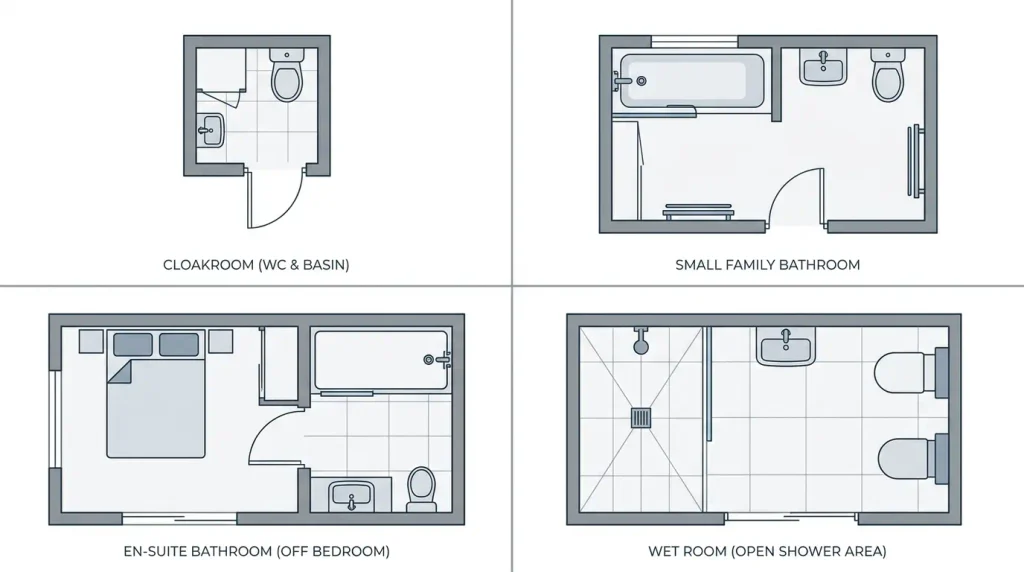
Cloakroom or downstairs WC, 1.5 to 3m². WC and basin. No bath, no shower, and usually no window.
Small family bathroom, 3 to 5m². The standard terrace or semi bathroom. WC, basin, and either a bath with a shower over it or a separate enclosure.
En-suite, 3 to 6m². Similar footprint, but it sits somewhere the house was never plumbed for, and often comes with a sloping ceiling or an awkward corner to work around.
Small wet room, 2 to 5m². The whole floor is the shower tray. Tanked, gradient-screeded, different specification throughout.
An en-suite of the same square footage as a small bathroom frequently costs more, not less. Where it sits in the house matters more than how big it is.
Small bathroom renovation cost by type
Cloakroom or downstairs WC
£2,000 to £5,500 for most refits.
Cheapest of the four, though rarely as cheap as people expect for a room you can barely turn around in. There’s still a strip-out, plumbing connections, an extractor if there’s no window, tiling or panelling, and a plastered finish to pay for.
Three to five days on site.
Small family bathroom
£5,000 to £8,000 mid-range. Nearer £3,000 to £5,000 if you keep the layout and buy sensibly.
The most common job of the four. New suite, new tiling, new flooring, walls made good, new extractor, usually a heated towel rail. Leave everything roughly where it currently sits and you’ll stay in the lower half of that range without much effort.
Five to eight days.
En-suite
£5,500 to £10,000 mid-range.
En-suites carry a cost nobody sees coming: distance from the soil stack. Bedrooms weren’t plumbed when the house was built, so the waste run tends to be long, awkward, or reliant on a pump. Ventilation is often trickier too, since plenty of en-suites have no external wall to duct through.
Five to ten days.
Small wet room
£7,000 to £12,000 mid-range, and it climbs from there.
That premium buys tanking, a gradient screed or preformed former, and a linear drain. Done properly, a small wet room is excellent, particularly where accessibility matters. Done cheaply, it leaks into the room below, and putting that right costs more than the original job did.
Eight to sixteen days.
Why a small bathroom doesn’t cost half what a big one does
This is the part most cost guides skip. A bathroom refit is a fixed sequence of trades, and that sequence doesn’t get shorter because the room got smaller.
Strip out. First fix plumbing. Electrics. Board and plaster. Tile. Second fix. Fit the suite. Seal, test, clean.
Every one of those happens in a 2m² cloakroom exactly as it happens in an 8m² family bathroom. In practice a small bathroom tends to come in around 70 to 80% of the cost of a standard one. Not 50%.
The costs that don’t shrink with the room
- Strip-out and disposal. A small bathroom still fills a skip. Old suite, old tiles, old floor.
- Plumbing first fix. Same number of connections: hot, cold, waste, WC, shower feed.
- Electrical work. Same isolation, same fan, same lighting circuit, same certificate.
- The extractor. Identical either way.
- The suite. A compact WC and basin cost roughly what full-size ones do. Occasionally more, since space-saving designs are specialist items.
- Second fix labour. Same fittings to install, level and seal.
- Set-up, deliveries, travel, waste. Fixed per job, not per square metre.
What actually scales
Tiles, flooring, plasterboard, and tiling hours. That’s more or less the whole list. On a mid-range job those come to about a third of the total, which is why halving the floor area gets nowhere near halving the bill.
It also explains why the per-square-metre figure climbs as rooms get smaller, and why comparing two quotes on a rate per m² will mislead you in a small room.
Where the money goes in a small bathroom
Typical lines for a 3 to 4m² bathroom.
| Cost line | Typical price |
| Strip-out and disposal | £300 – £600 |
| Skip hire (6–8 yard) | Around £320 per week |
| Plumbing first fix | £400 – £800 |
| Electrical work, certified | £300 – £600 |
| Boarding and plastering | £300 – £700 |
| Tiling labour | Around £300 per day, 2–3 days |
| Tiles and flooring (materials) | £20 – £400+ per m² |
| Bathroom suite | £600 – £2,500 |
| Suite installation and second fix | £800 – £1,500 |
| Extractor fan | £200 – £300 |
| Heated towel rail | £250 – £600 |
On trade rates: plumbers charge roughly £40 to £60 an hour, electricians £45 to £60, and tilers usually work to a day rate around £300. Most bathroom fitters will quote the whole job as a fixed price, which is the arrangement you want.
The decision that changes the price most: moving the toilet
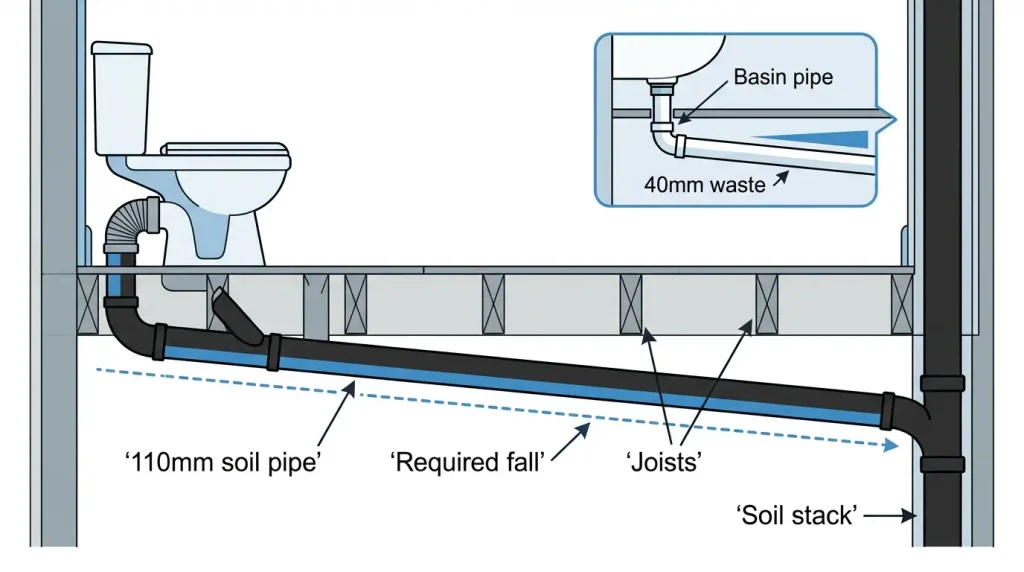
If you take one thing from this page, take this.
A WC discharges through a 110mm soil pipe, and that pipe needs a consistent fall to reach the soil stack. Move the toilet more than a metre or so and you’re lifting the floor, re-routing pipework between joists, and sometimes building the floor level up to get the fall. Which then affects the door, the threshold and the flooring.
Budget £500 to £1,500 on top for a WC relocation, and more if the floor genuinely has to come up.
Basins and showers are far more forgiving. Their 40mm wastes are easier to route and tolerate a longer, shallower run. So if you want to rethink a small bathroom’s layout cheaply, move those and leave the toilet alone.
A macerator is the other route, roughly £400 to £800 fitted. It gives you freedom, but it’s audible, it needs a power supply, some buyers dislike them on principle, and the drainage regulations only allow a macerator WC where there’s access to another WC discharging to a gravity drain. Fine as a second bathroom. Not an answer for the only one in the house.
Building Regulations for a small bathroom
A like-for-like refit rarely troubles building control. Several parts of the job are still regulated, though, and they tend to be exactly what a suspiciously cheap quote has left out.
Electrical work, Part P and bathroom zones
Bathrooms count as special locations. Fittings are specified by zone — inside the bath or shower, immediately above it, and within 600mm of it — each with a minimum IP rating, with RCD protection throughout.
Notification rules differ between England and Wales, so check with your electrician which applies to your job. Either way the work has to meet BS 7671 and you should be handed a certificate at the end. If a quote makes no mention of certification, ask why not.
Ventilation under Part F
Bathrooms need mechanical extract ventilation. An openable window alone isn’t enough under current guidance. Internal bathrooms and en-suites without an external wall need ducting run out to an outside face, and occasionally that costs more than the fan itself.
Hot water safety
New bath installations are subject to a maximum hot water temperature at the outlet, which in practice means fitting a thermostatic mixing valve. A small item, easily overlooked, and it belongs on the quote.
When you need building control
Approval is required if you’re creating a bathroom where there wasn’t one, altering drainage, or taking out a structural wall to make the room work. Replacing a suite in an existing bathroom, in the same positions, generally isn’t.
Small bathroom renovation costs in Nottingham and the East Midlands
Most published UK cost guides lean towards London and the South East, where bathroom labour runs 15 to 25% above the national average. Every figure downstream of that is inflated for the rest of the country.
The East Midlands sits at, or a little under, the national middle. For a small bathroom in Nottingham or the wider county, a realistic mid-range figure is £4,500 to £7,000 for a 3 to 4m² room with a good suite, full tiling, new flooring and certified electrics, assuming the layout stays broadly where it is.
Specification shifts that number far more than postcode ever will. The gap between £30 per m² tiles and £150 per m² tiles outweighs any regional variation you’ll find.
How long will I be without a bathroom?
Cloakroom: three to five days. Small family bathroom: five to eight days. En-suite: five to ten days. Small wet room: eight to sixteen days.
If it’s the only bathroom in the house, raise this at the quoting stage rather than the week before work starts. Two things help. Get everything delivered and checked before the strip-out begins, because waiting on a back-ordered shower tray with no bathroom is miserable. And ask your fitter to sequence the WC so it’s reconnected at the end of each day wherever the work allows. Plenty will, if you ask early enough. Almost nobody offers.
Where to save on a small bathroom, and where not to
Worth saving on
- Keeping the existing layout. Easily the biggest lever you have.
- A good plain tile across most of the room, with the money spent on one small feature area.
- Standard-sized suites from a mainstream range. They fit better and they’re far easier to get parts for in five years.
- Booking outside spring. Bathroom fitters are at their busiest January to April.
Not worth saving on
- Waterproofing behind tiles, and tanking in a wet room. The most expensive thing on this page to get wrong.
- The extractor fan. Cheap ones are loud, get switched off, and you end up with mould.
- The shower valve. It gets used twice a day for the next fifteen years.
- Isolation valves on every feed. Pennies now, saves a full drain-down later.
- Electrical certification.
Getting a quote in Nottingham
Buon Construction takes on small bathroom renovations across Nottingham and Nottinghamshire: plumbing, certified electrical work, plastering, tiling and full fit-out, run as a single job rather than a handful of trades you have to coordinate yourself. If you’d rather have a figure for your own bathroom than a national average, get in touch for an itemised quote. There’s more on the full range of what we do as well.
FAQs
Can you renovate a small bathroom for £3,000?
Yes, in a 3 to 4m² bathroom, provided you keep the existing layout, pick a mainstream suite and use mid-priced tiles. £3,000 covers a straightforward replacement refit. It won’t stretch to moving the toilet, converting to a wet room, or premium fittings.
How much does a cloakroom or downstairs toilet renovation cost?
£2,000 to £3,500 for a basic refit, £3,500 to £5,500 mid-range. Small as the room is, the fixed costs of strip-out, plumbing, electrics and plastering all still apply, which is why it seldom comes in under £2,000.
Is it cheaper to just replace the suite instead of a full renovation?
Considerably, if the tiling, flooring and plaster are sound. A WC, basin and bath swapped on their own typically costs £1,200 to £2,500 fitted. That saving evaporates the moment tiles have to come off, because it exposes the walls and you’re back to a full refit.
Do I need building regulations approval for a small bathroom renovation?
Usually not for a like-for-like refit in an existing bathroom. You will need it for a new bathroom, for altering drainage, or for removing a structural wall. Electrical work and ventilation are regulated regardless and should be certified.
How much does it cost to move a toilet?
£500 to £1,500 in most cases, and more if the floor has to be lifted to re-route the soil pipe and achieve the right fall. A macerator is the alternative at £400 to £800 fitted, though it isn’t suitable for the only WC in a property.
Should I take the bath out and fit a shower?
Depends who lives there and what happens next. A shower enclosure makes a small bathroom feel considerably bigger and suits most households day to day. If it’s the only bathroom in a family house, losing the bath altogether can put off buyers with young children later. A shower over a P-shaped bath is the usual compromise.
How much does a small wet room cost?
£4,000 to £7,000 at the budget end, £7,000 to £12,000 mid-range. The premium over a standard bathroom covers tanking, a gradient screed or former, and a linear drain, and it typically adds £200 to £500 per square metre.
How much does a small en-suite cost?
£5,500 to £10,000 for mid-range work. En-suites often cost more than a small bathroom of the same size, because of the distance from the soil stack and the difficulty of ducting an extractor where there’s no external wall.
How long does a small bathroom renovation take?
Five to eight days on site for a standard small bathroom, three to five for a cloakroom, eight to sixteen for a wet room. Add lead times for the suite and tiles, all of which should be on site before the strip-out starts.
