
Half the fencing jobs that go wrong in Nottinghamshire go wrong before anyone picks up a spade. Someone orders 1.8m panels for a front boundary. Someone replaces a fence that turns out to belong to next door. Someone on a modern estate finds out the covenant in their deeds bans front fencing altogether, three days after the posts went in.
Three rules cover most situations. Two metres is the general height limit, one metre applies next to a road, and the boundary belongs to whoever the title plan says it belongs to. The trouble is that the exceptions are where the money gets lost.
This is general guidance for England, with the main differences for Scotland, Wales and Northern Ireland noted below. Your local planning authority and your title deeds are the final word on your property.
Table of Contents
The rules in short
- Height. Up to 2 metres above ground level without planning permission. One metre if the fence is adjacent to a highway used by vehicular traffic.
- Planning permission. Needed for listed buildings and their curtilage, where an Article 4 direction applies, and where a planning condition removes the right.
- Covenants. A restrictive covenant in your deeds can ban a fence that planning law would allow. Covenants win.
- Ownership. Decided by the title plan at HM Land Registry, not by which side the posts face.
- Maintenance. There is no general legal duty to maintain a boundary fence unless your deeds impose one.
- Neighbours. You do not need their permission to replace your own fence. You do need their permission to stand on their land.
- Hedges have their own height law. Fences do not. That difference catches a lot of people out.
Every one of those has an exception worth understanding before you buy anything.
Fence height rules in the UK
The 2 metre rule and the 1 metre exception
Permitted development rights let you put up a gate, fence, wall or other means of enclosure up to 2 metres above ground level without applying for planning permission.
That drops to 1 metre where the fence is adjacent to a highway used by vehicular traffic.
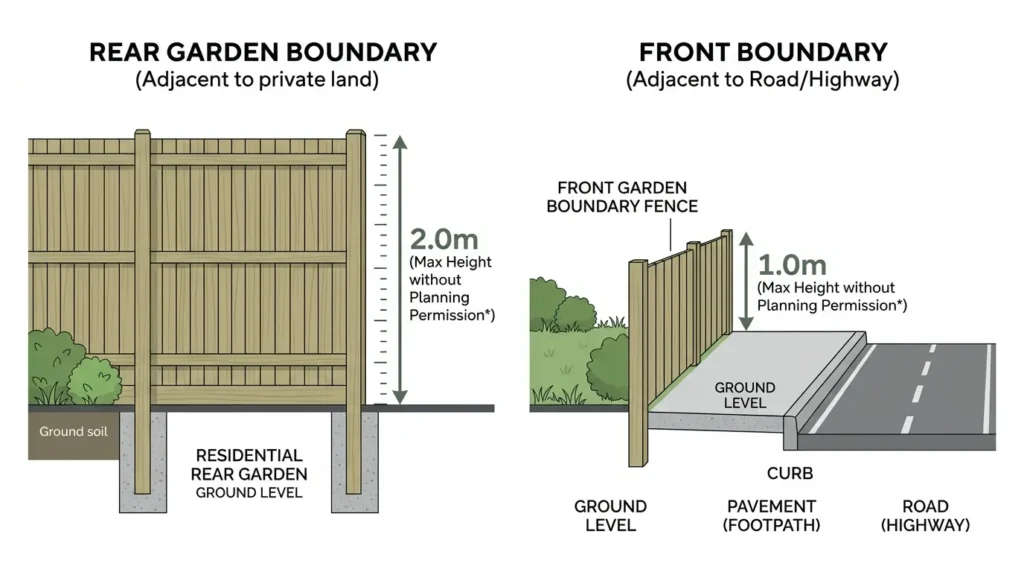
The exact wording matters more than most guides let on. “Highway used by vehicular traffic” means a road, and the pavement and verge alongside that road count as part of it. That is why a front garden fence is nearly always capped at 1 metre even though the fence itself faces a footpath. A public footpath running through fields, with no vehicular traffic anywhere near it, is a different case and does not trigger the 1 metre limit at all.
There is one narrow exception. State-funded schools can go to 2 metres alongside a vehicular highway, provided the part above 1 metre does not create an obstruction to sightlines.
Our guide to how high a fence can be in the UK works through the height question in more detail, and front garden fence height regulations deals with the road-facing boundary on its own.
Where the height is measured from
From ground level. Which sounds straightforward until the ground stops being level.
On a slope, height is measured from the ground immediately beneath each section of fence. So a fence that stands 1.8m at one end can be over 2m at the other without anyone intending it, and councils measure at the point of the alleged breach rather than taking an average.
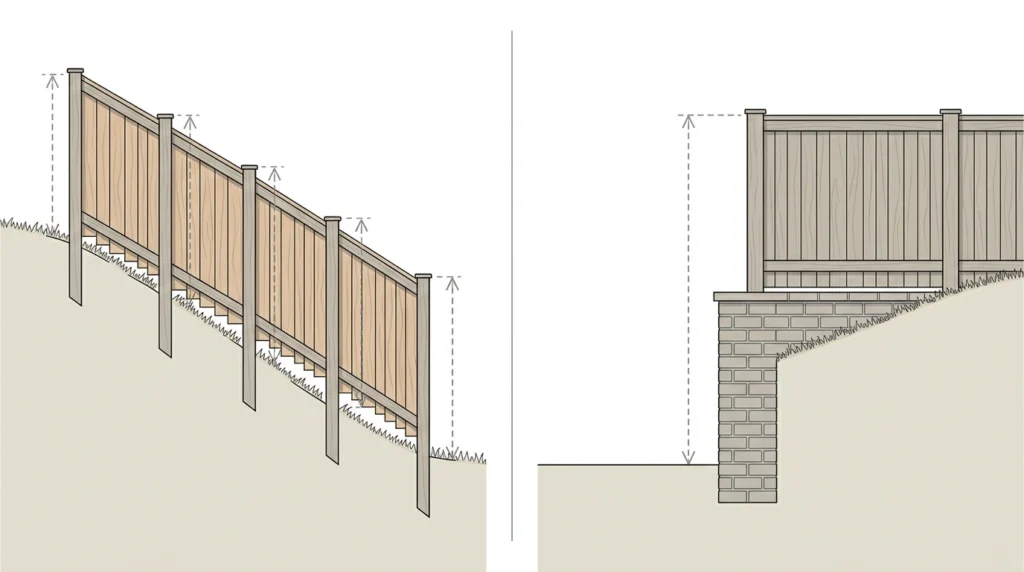
Where there is a retaining wall or a raised bed underneath, the measurement usually starts from the higher ground level, because the wall has changed what ground level means. Put a 1.8m fence on top of a 600mm retaining wall and the planning authority sees a 2.4m structure, not a compliant fence.
This is the most common reason a fence that looks fine turns out not to be.
Does trellis count towards the fence height?
Yes. Trellis, lattice and any other topping form part of the means of enclosure, and the total height is what gets measured. A 1.8m fence with 300mm of trellis on top is a 2.1m fence and needs permission.
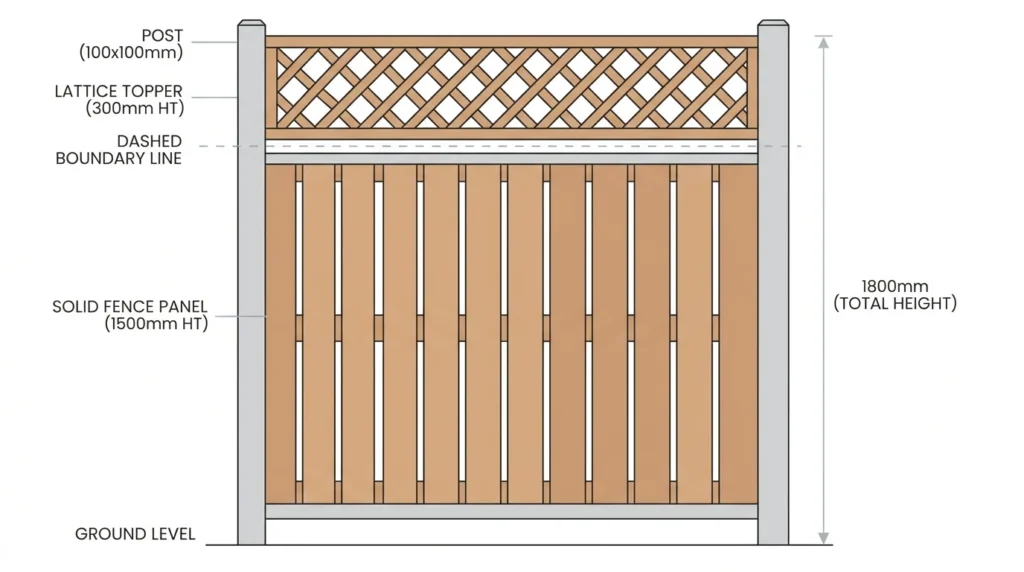
People add trellis specifically to gain privacy without “changing the fence”, which is understandable and still wrong. If you want the extra height, apply for it. And if you are fitting trellis within the limit, attach it properly rather than bolting it onto an existing fence, which weakens the whole structure.
Replacing a fence that is already over 2 metres
Permitted development covers the erection, construction, maintenance, improvement or alteration of a fence. Buried in that is a genuinely useful provision: where a fence already exists lawfully, you can maintain, improve or alter it up to its former height or the standard limit, whichever is greater.
In plain terms, if a 2.4m fence has stood lawfully for years, replacing it at the same height is generally permitted. Raising it is not. Keep photographs and dates if you plan to rely on this, because the burden of proving the fence was lawful sits with you.
Can you go higher than 2 metres?
You can apply. Councils weigh up the effect on neighbouring amenity, the street scene and highway visibility, and outcomes vary a lot between authorities.
Applications tend to succeed where there is a specific reason behind them: noise from a main road, a real privacy problem, security after a break-in. They tend to fail where the reason is simply preference. We have set out the practical alternatives in ways around fence height restrictions, and most of them involve planting rather than building.
When you need planning permission for a fence
Four situations remove your permitted development rights outright.
- The property is a listed building, or the fence sits within its curtilage. No exceptions and no height threshold. You need listed building consent as well as planning permission.
- The fence forms a boundary with a neighbouring listed building or its curtilage. This one catches people whose own house is not listed.
- An Article 4 direction applies. Councils use these to withdraw permitted development rights in specific areas, most often conservation areas and estates of architectural interest. Your council’s planning map will show whether one covers you.
- A planning condition on the property removes the right. Common on newer developments, where the original consent was granted on the basis of open-plan frontages.
Conservation areas cut both ways
Being in a conservation area does not automatically stop you putting a fence up. What catches people is the reverse. You may need consent to take an existing fence, wall or gate down.
Demolishing a boundary structure in a conservation area can need permission in its own right. If you are in one, ask the council before you clear the old fence rather than after. In our experience it is the most common enforcement problem in conservation areas, and it is completely avoidable.
New-build estates and open-plan conditions
If your house was built in the last thirty years, look at the original planning permission for the estate. Plenty were approved on the basis of open-plan front gardens, with a condition preventing boundary enclosure at the front. That condition runs with the land and binds every owner who comes after.
Which brings us to the restriction that catches far more people than planning law ever does.
Restrictive covenants beat planning permission
Permitted development tells you what the council will allow. It says nothing at all about what your deeds allow.
A restrictive covenant is a private obligation written into the transfer deed when the land was originally sold, and it binds you regardless of what planning law permits. On estates built since the 1980s they are routine. The ones affecting fencing usually read something close to “not to erect any fence, wall or other structure forward of the building line”, or they cap boundary structures at 1 metre.
Three things are worth knowing about them.
They are enforced privately, usually by the developer, a management company or a neighbour who has the benefit of the covenant. The council has nothing to do with it, so nobody stops you at the point of building. The problem tends to surface later, often when you come to sell.
They do not expire simply through age, although enforceability weakens if a covenant has been widely ignored for a long time without anyone objecting.
Indemnity insurance is the usual practical route where a breach has already happened and gone unchallenged for years. Your conveyancer will know where you stand.
Check your title register for covenants before you order a fence for a front boundary. It costs a few pounds from HM Land Registry and takes about five minutes.
Who owns the fence?
How to find out properly
Get your title plan and title register from HM Land Registry. The plan often carries T-marks along the boundaries, and the T sits inside the land of whoever is responsible for that boundary. Two Ts joined into an H mean shared responsibility.
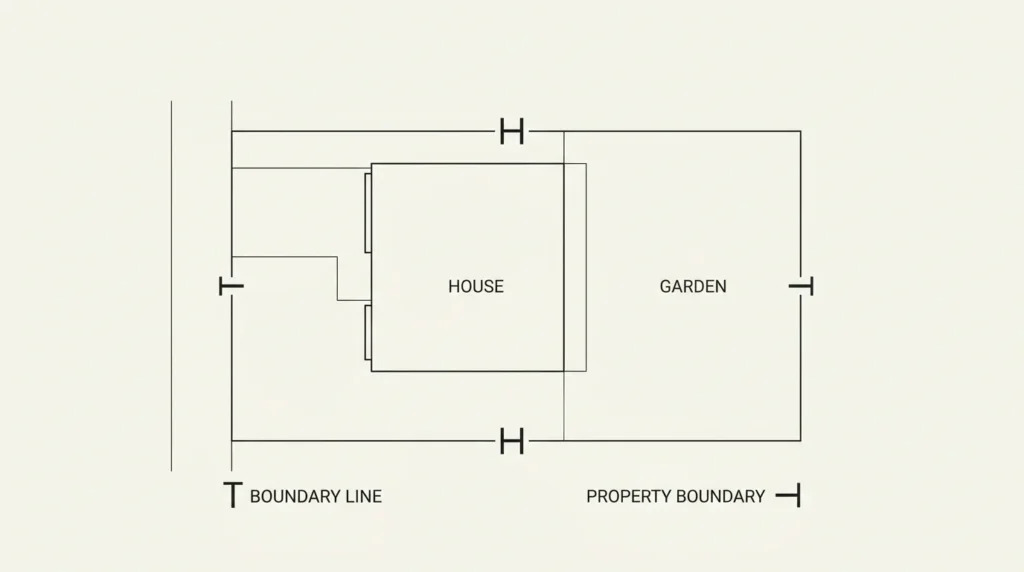
If there are no T-marks, and frequently there are none, look at the transfer deed. It may contain a fencing covenant naming the responsible party. Failing that, the position may simply never have been recorded, in which case the boundary gets treated as shared in practice even though nothing formally says so.
One caveat worth knowing. Land Registry plans are drawn under the general boundaries rule, so they show roughly where a boundary runs rather than its exact line. For precision, you need a determined boundary application or a surveyor.
Two myths worth retiring
“The left-hand boundary is always yours.” There is no such rule anywhere in English law. It is a folk belief, repeated confidently, with no legal effect whatsoever.
“The posts and rails face the owner’s side.” This is a convention, the “good side out” custom, not a legal test. It is often true, because most people fit a fence that way, and on its own it proves nothing. Plenty of fences have been rebuilt the other way round by a previous owner who did not know or did not care.
If you are replacing a boundary fence and are not certain whose it is, our guide to the shared boundary fence replacement law sets out the position.
Do you have to maintain a boundary fence?
Usually not. There is no general duty in English law to fence your land or to keep an existing fence in repair. A neighbour whose fence has collapsed can, in most cases, simply leave it lying there.
The exceptions are narrow.
- An express covenant in the deeds requiring you to put up and maintain a boundary fence. This is the main one, and it is another reason the title register matters.
- Livestock. You can be liable if animals stray onto a neighbour’s land or onto the highway, so a working fence becomes necessary in practice even without a duty to build one.
- A fence that has become dangerous. Local authorities have powers over dangerous structures, and you may be liable in negligence if a collapsing fence injures someone.
- Easements and rights of way where an obligation to fence has been attached to the right.
This is the honest answer to “my neighbour will not fix their fence”. Frustrating, and usually not something the law will help with. The practical solution is to build your own fence just inside your own boundary.
Fences and neighbours: what the law allows
Do you need your neighbour’s permission?
No, not if the fence is yours and every part of the work happens on your land. You do not need consent for the style, the height (within the limits) or the timing.
What you do need is access, and that is the real constraint. If the job means standing on their side, they are entitled to say no.
Telling them anyway is worth the ten minutes it takes. Most boundary disputes start with surprise rather than disagreement.
Can a neighbour attach things to your fence?
No. If the fence sits on your land, it is your property. A neighbour has no automatic right to fix trellis, hooks, lights, hanging baskets or planters to it, or to stack materials against it.
There is a practical reason as well as a legal one. Weight on the panels and moisture trapped against the boards are two of the quickest ways to shorten a fence’s life. We have gone into the detail in whether a neighbour can lean things on your fence.
The same works in reverse. If the fence is theirs, you need their permission before you fix anything to it.
Painting your side of a neighbour’s fence
You need their consent. Their fence, their property, both sides of it. Painting it without asking is technically damage to property, however reasonable the colour.
Getting access to repair
If your fence can only be reached from your neighbour’s side and they refuse, the Access to Neighbouring Land Act 1992 lets you apply to the county court for an access order covering basic preservation works.
It does work. It is also slow and costs a good deal more than most fences. Treat it as a last resort and try the conversation first.
Encroachment and building over the line
Building even slightly over a boundary is trespass, and doing it accidentally does not change that. A neighbour can require removal, and in a minority of cases long-standing encroachment can lead to an adverse possession claim under the Land Registration Act 2002.
Centimetres genuinely matter here. If the line is unclear, sort it out before building rather than after.
The Party Wall Act does not apply to fences
This one needs saying plainly, because it appears on a great many UK fencing pages and it is wrong.
The Party Wall etc. Act 1996 does not cover wooden fences. Section 20 of the Act defines a “party fence wall” as a wall (not being part of a building) which stands on lands of different owners and is used or constructed to be used for separating such adjoining lands. A wall. Masonry, brick or block, standing astride the boundary line.
A timber fence is not a wall, and no part of the Act touches it. There is no notice to serve, no party wall surveyor to appoint and no award to obtain.
Where the Act does bite is worth knowing, because garden boundaries sometimes involve masonry.
- A brick or block boundary wall built astride the boundary line is a party fence wall, and works to it are notifiable.
- Building a new wall at the line of junction requires notice under section 1.
- Excavating near a neighbour’s structure, within three or six metres depending on depth, can be notifiable.
So a brick wall may involve the Act. A closeboard fence never does. Our page on what the Party Wall Act actually covers sets out the notice procedure for the cases where it applies.
Hedges, trees and other boundary features
The high hedge rules
Fences have no legal height limit beyond the planning threshold. Hedges are treated differently.
Under Part 8 of the Anti-social Behaviour Act 2003, you can complain to the council about a high hedge, defined as a line of two or more mostly evergreen or semi-evergreen trees or shrubs, over 2 metres tall, which is affecting the reasonable enjoyment of a home or garden.
The route runs like this. You have to try to resolve it informally first, and be able to show that you did. Then you complain to the council, usually on a form and usually for a fee. If the complaint is upheld, the council can issue a remedial notice requiring the hedge to be cut back, and ignoring that notice is an offence.
What it does not cover: single trees, deciduous-only hedges, anything under 2 metres, and anything blocking a view rather than light or access. Scotland works under the High Hedges (Scotland) Act 2013, Northern Ireland under the High Hedges Act (Northern Ireland) 2011.
Overhanging branches
You may cut back branches or roots that cross your boundary, as far as the boundary line and no further. The cuttings stay your neighbour’s property, so strictly speaking you should offer them back rather than bin them.
Check first for a Tree Preservation Order or conservation area status. Both restrict what you can cut, and breaching a TPO carries a substantial fine.
Walls, gates and driveways
Boundary walls and gates fall under the same 2 metre and 1 metre limits as fences. A gate across a driveway that swings outwards over a pavement can raise a separate highway obstruction issue, and councils will look closely at visibility where a gate meets a road.
Barbed wire, electric fencing and security features
Barbed wire on land adjoining a highway is dealt with under section 164 of the Highways Act 1980. Where it causes a nuisance to people or animals lawfully using the highway, the council can serve notice requiring the occupier to deal with it. On a domestic boundary it is rarely appropriate anyway. It creates liability and achieves very little.
Electric fencing is common on agricultural land and needs clear signage at regular intervals. It should not be used on any boundary the public can reach.
Anti-climb toppings such as spikes, rollers and anti-climb paint are lawful in principle, but occupiers’ liability applies. You must warn about them with clear signs, and precautions that go beyond what is reasonable to protect your property can leave you liable for injuries, including injuries to trespassers.
Scotland, Wales and Northern Ireland
Wales runs a broadly similar permitted development regime to England, with its own General Permitted Development Order and the same 2 metre and 1 metre thresholds in most situations.
Scotland has separate planning legislation. Fence and wall heights come under the Scottish permitted development rules, with a general 2 metre limit and a lower limit next to a road. Boundary ownership works differently again, through title deeds and burdens rather than T-marks, with the records held by Registers of Scotland.
Northern Ireland has its own planning system and its own high hedges legislation.
Outside England, treat the detail on this page as indicative and check with your local authority.
What happens if you break the rules
Enforcement
A council can serve an enforcement notice requiring a fence to be reduced or removed. You have a right of appeal to the Planning Inspectorate, and the notice is suspended while that appeal is decided.
Councils are not obliged to take enforcement action and often do not bother for minor breaches, particularly where nobody has complained. That is not a reason to rely on it. Retrospective problems tend to surface at the point of sale, when a buyer’s solicitor asks for a lawful development certificate you cannot produce.
There is also a time limit on enforcement against unauthorised operational development such as a fence, running from substantial completion. The period has changed in recent years, so check the current position with your council rather than assuming.
Boundary disputes
The realistic order of escalation:
- Conversation. Resolves most of them.
- Title documents. Both parties get their plans and compare.
- A RICS boundary surveyor. An independent measured plan, often enough on its own to settle it.
- Mediation.
- A determined boundary application to HM Land Registry, fixing the exact line on the register.
- Court. Last resort, and rarely proportionate.
One blunt warning is worth more than any of the legal detail above. Boundary litigation regularly costs many times the value of the fence in dispute. Legal fees well into five figures over a strip of land a few centimetres wide is a common outcome, not a rare one. Almost any settlement beats the third year of a boundary case.
Getting it right before you build
Before we quote a boundary job we check the same five things: the title plan, any restrictive covenants, whether the property is listed or in a conservation area, whether an Article 4 direction applies, and where the highway boundary actually sits. It takes half an hour, and it is the difference between a fence that stays up and a fence that gets a letter.
If you would like that checked properly before anything is ordered, have a look at our fencing work in Nottingham or get in touch. If you are still deciding on the fence itself, our guides to the strongest type of fencing and what fencing costs in the UK cover the specification side.
Frequently asked questions
Do I need permission to replace a fence with the same fence?
Not usually. Maintaining, improving or altering an existing fence is permitted development, and you can rebuild to its former height or the standard limit, whichever is greater. Keep photographs and dates, because you would need to show the original fence was lawful.
Can I be made to take down a fence that is already built?
Yes. A council can serve an enforcement notice requiring removal or reduction, and you can appeal to the Planning Inspectorate. A neighbour with the benefit of a restrictive covenant can also seek removal through the civil courts, which is a separate route entirely.
Who pays for a shared boundary fence?
Whoever chooses to build it, unless the deeds say otherwise. There is no legal mechanism forcing a neighbour to split the cost of a boundary fence, so any contribution is voluntary. Agree it in writing before work starts if money is changing hands.
Does a fence need building regulations approval?
No. Building regulations do not apply to garden fences, walls or gates. They can apply to a retaining wall depending on its height and what it holds back, and to any structure supporting or affecting a building.
Can I put up a fence while a boundary dispute is ongoing?
Legally possible on land that is clearly yours, but rarely sensible. Building during a live dispute hardens positions and can count against you if the matter reaches court. Wait for the line to be agreed or formally determined.
Does home insurance cover a boundary dispute?
Sometimes, through legal expenses cover, but many policies exclude boundary disputes specifically or cap the cover well below what a contested case costs. Read the wording before you rely on it.
