
What are preliminaries in construction in the UK?
Preliminaries are the costs of establishing, running and closing down a construction site, as opposed to the cost of building anything. They cover site management, accommodation, welfare, temporary works, plant, insurance, security and everything else a project needs in order to function.
The simplest test is this. If it does not form part of the finished building, but the job cannot proceed without it, it is a preliminary.
Prelims sit in their own section at the front of a bill of quantities or pricing document, separate from the measured works. You will also see them called general conditions, project overheads or site overheads. They are all the same thing.
They are also, on most projects, one of the largest single lines in the tender, and one of the least examined.
Table of Contents
What do preliminaries include?
The list is long, and it is easier to hold if it is grouped the way NRM2 groups it rather than read as forty unconnected items.
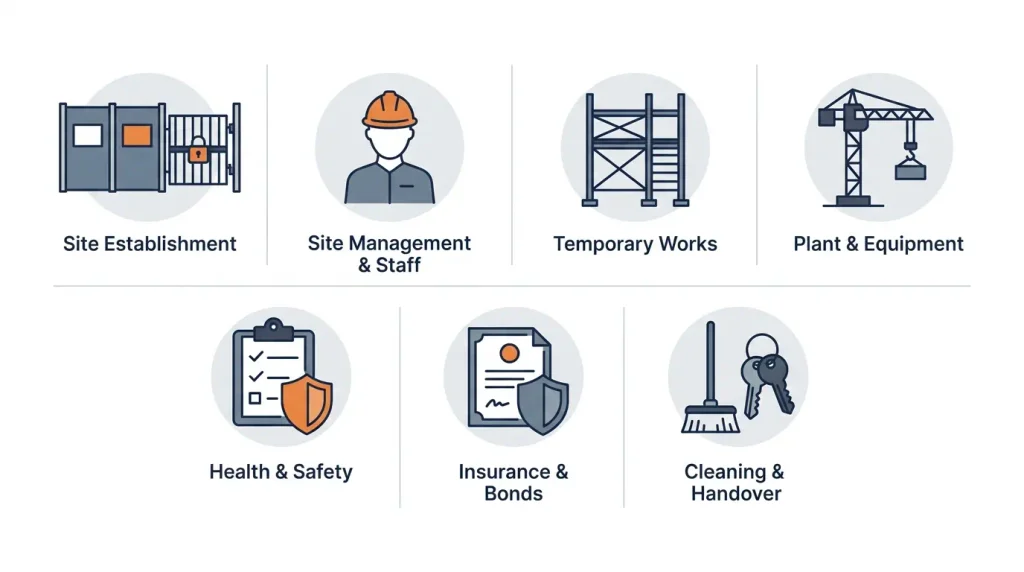
Site establishment
Hoarding, fencing and gates. Site accommodation, offices and meeting space. Welfare facilities, meaning toilets, drying rooms and canteen. Temporary connections for water, power and drainage. Signage, site access, parking and any traffic management.
Site management and staff
Project manager, site manager, site engineer, quantity surveyor, planner and health and safety officer, at whatever proportion of their time the project takes.
On most projects this is the single largest prelims line, often more than half the total. It is also the one most worth checking against the programme, because staffing is where an unrealistic tender usually hides.
Temporary works
Scaffolding, propping, needling, temporary roofs, edge protection and crash decks. Formwork and falsework where it is not measured against a work section. Temporary works design, which is a designer’s fee rather than a materials cost and is often forgotten.
Plant, equipment and services
Tower cranes, hoists and mast climbers. Telehandlers and small plant. Power, water, lighting, heating and telecoms for the duration. Skips and waste removal, which on a refurbishment can be substantial, and which is worth planning alongside any effort to minimise construction waste on site.
Health, safety and compliance
CDM duties under the 2015 Regulations, the construction phase plan, risk assessments and method statements, inductions, PPE, first aid provision, and the testing and inspection regime.
Insurance, bonds and warranties
Contractor’s all risks and public liability. Performance bonds and parent company guarantees. Collateral warranties. Professional indemnity where the contractor carries design responsibility.
Cleaning, handover and demobilisation
Progressive cleaning through the job and the builder’s clean at the end. O&M manuals and the health and safety file. Support during snagging. Taking down the site accommodation, removing hoarding and reinstating whatever was disturbed.
How preliminaries are priced
This is where most explanations stop, and it is where the useful part begins.
The NRM2 structure
Under the RICS New Rules of Measurement, preliminaries split into two sections.
The first is information and requirements. It is descriptive, covering the drawings, the site, its constraints, the employer’s requirements and how the project is to be run. Nothing in it is priced. It exists so that the contractor understands what they are pricing against.
The second is the pricing schedule. This is where the money goes, under headings that separate the employer’s requirements from the main contractor’s own cost items, and it requires each item to be priced as either a fixed charge or a time-related charge.
That last distinction is not a formality. It determines who carries the cost when a programme moves.
What is the difference between fixed and time-related charges?
A fixed charge is a one-off cost that does not change with the length of the job. Setting up the site, erecting the hoarding, connecting temporary services, and demobilising at the end all cost the same whether the project runs for twenty weeks or thirty.
A time-related charge runs for as long as the site does. The site manager, the accommodation hire, the scaffolding, the welfare units, the power and the skips are all charged weekly or monthly, and every additional week adds another instalment.
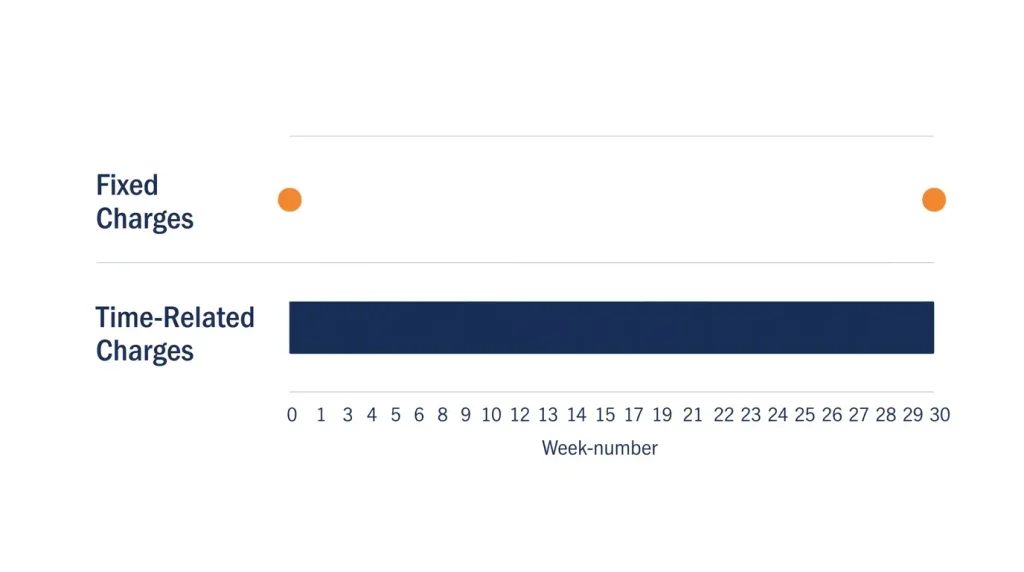
The split matters for two reasons. It is how a delay converts into a number, and it is where an over-cautious tender shows itself. A contractor who loads costs into fixed charges is protecting themselves against finishing early, since fixed charges are recovered in full whatever happens. A client reviewing a tender should look at the split as closely as the total.
A worked example
Take a 30 week refurbishment with a contract value of around £850,000.
Fixed charges
| Item | Cost |
| Site set-up, hoarding and signage | £6,000 |
| Temporary services connections | £2,500 |
| Insurance and performance bond | £4,000 |
| Demobilisation, clean and reinstatement | £3,500 |
| Subtotal | £16,000 |
Time-related charges
| Item | Weekly rate | 30 weeks |
| Site manager | £1,400 | £42,000 |
| Site accommodation and welfare | £350 | £10,500 |
| Scaffolding hire | £600 | £18,000 |
| Power, water and telecoms | £180 | £5,400 |
| Skips and waste removal | £250 | £7,500 |
| Small plant and equipment | £300 | £9,000 |
| Subtotal | £3,080 per week | £92,400 |
Total preliminaries: £108,400, or roughly 12.8% of contract value.
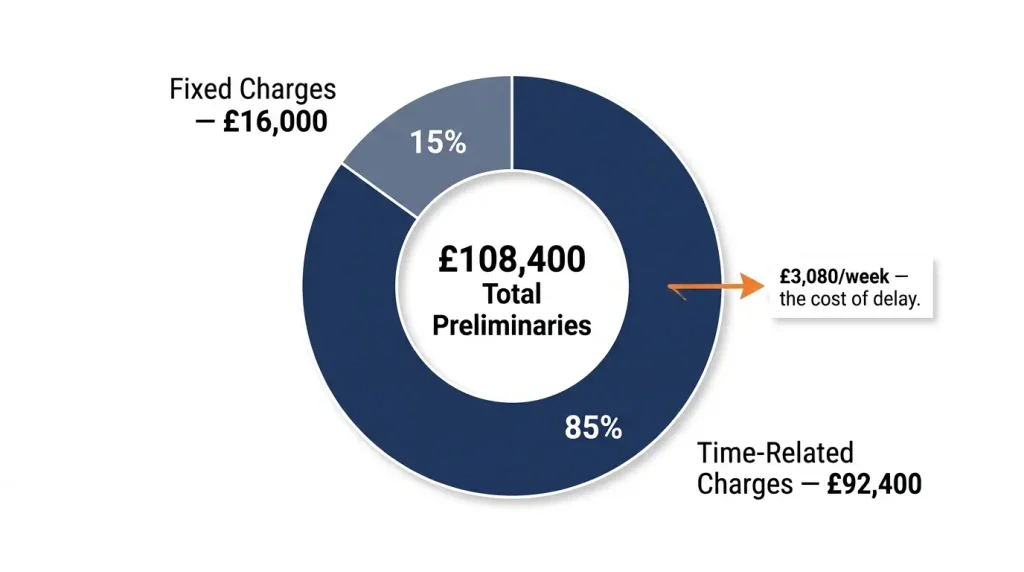
The number that matters most in that table is £3,080. That is what a week of delay costs on this project before anyone has argued about anything else. A four week overrun is £12,320 of time-related prelims, and the question of who pays it is the question that ends up in dispute.
Pricing prelims as a percentage is a sense-check, not a method
Preliminaries should be built up from resources and programme duration, the way the table above does it. Applying a flat percentage to contract value is a way of checking whether the result looks sensible, not a way of arriving at it.
Price by percentage and you systematically underprice long, low-value, constrained jobs and overprice short, high-value, simple ones. The refurbishment above needs the same site manager for thirty weeks whether the contract is worth £850,000 or £1.5m.
What percentage of a contract are preliminaries?
Preliminaries typically fall between 8% and 15% of contract value. Published sources quote figures as wide as 5% to 20%, and the range is that broad because the percentage is an output rather than an input.
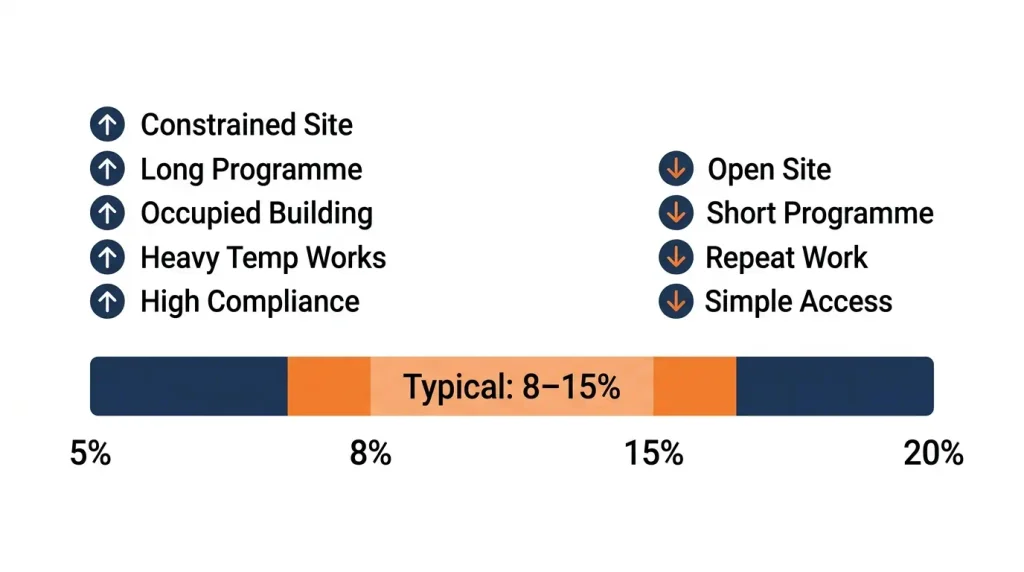
What pushes prelims up:
- Constrained sites, city centre locations, restricted access or working hours
- Long programmes, since most of the cost is time-related
- Occupied or phased buildings, where work happens around people
- Heavy temporary works, scaffolding or craneage
- High compliance and security requirements
What brings them down:
- Large, simple new build on an open site
- Short programmes
- Repeat or standardised work
- Straightforward access and storage
The point worth holding on to is that preliminaries are driven by duration and site constraint, not by the value of the work. A £500,000 refurbishment in an occupied city centre building can carry a higher prelims percentage than a £2m new build on a clear site, and both figures can be entirely reasonable. If you are benchmarking, compare against build costs per square metre for a similar project type rather than against a percentage from a different kind of job.
Preliminaries compared with the terms they get confused with
Four terms sit near preliminaries in a tender and get mixed up with them constantly.
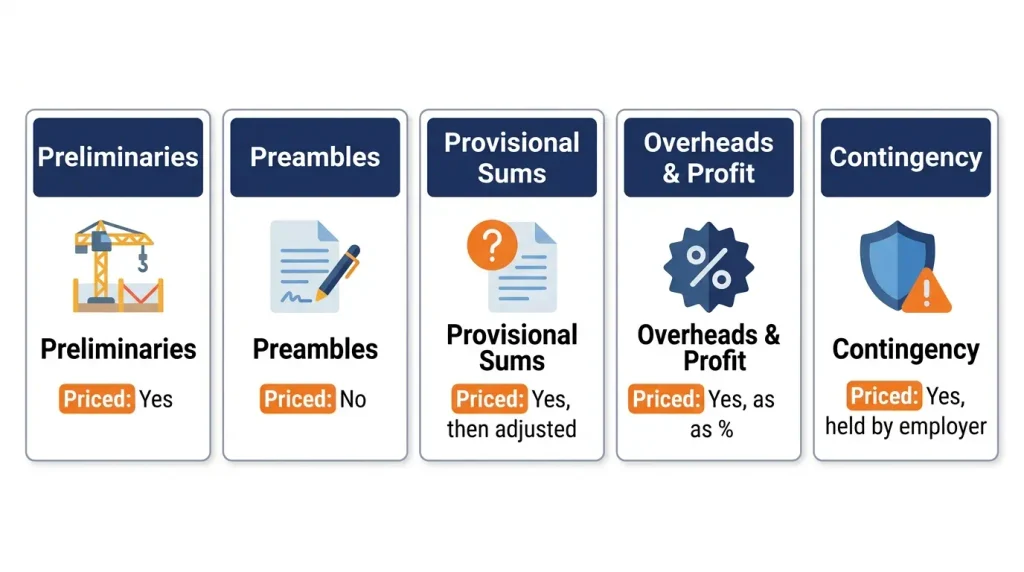
| Term | What it is | Priced? |
| Preliminaries | Cost of establishing and running the site | Yes |
| Preambles | Description of standards, workmanship and materials | No |
| Provisional sums | Allowance for work not yet fully defined | Yes, then adjusted |
| Overheads and profit | Head office costs and margin | Yes, usually as a percentage |
| Contingency | Allowance for risk and the unknown | Yes, held by the employer |
Preliminaries and preambles
Preambles describe how the work is to be done and to what standard. They set out materials, workmanship and testing requirements. They carry no money against them.
Preliminaries carry money. The two often sit next to each other at the front of the same document, which is why they get conflated.
Preliminaries and provisional sums
A provisional sum is an allowance for work that has not been fully designed or defined at tender stage. It gets expended and adjusted as the work becomes known.
There is one detail worth knowing here, because it directly affects prelims. NRM2 distinguishes defined from undefined provisional sums. Where a sum is defined, the contractor is deemed to have made allowance in their programme and preliminaries for the work described. Where it is undefined, they are not, and additional prelims may follow when the work is instructed.
That single distinction is the source of a great many arguments, and it turns on wording in the tender documents that most people never read.
Are preliminaries the same as overheads and profit?
No, and this is the most common error on the client side.
Preliminaries are site-specific. They are the cost of running this particular project. Overheads and profit is a separate addition covering the head office behind the site, meaning the estimating department, the accounts team, the directors, the offices, plus the contractor’s margin.
A tender should show both. If a document has a prelims figure and no separate overheads and profit line, ask where the margin sits, because it is somewhere.
Preliminaries and contingency
Contingency is money set aside for things that might happen. Preliminaries are money for things that certainly will. Site accommodation is not a risk, it is a certainty, and it belongs in prelims rather than in a risk allowance.
What happens to preliminaries when a project overruns?
This is the question most people are actually asking when they look up preliminaries, and it is the one almost nobody answers.
Entitlement depends on the contract and the facts, so what follows is general background rather than advice on any particular project.
Time-related prelims are what delay costs
Go back to the £3,080 per week in the worked example. That figure does not stop when the programme slips. The site manager still attends, the accommodation is still on hire, the scaffolding is still standing and the insurance still runs.
Delay on a construction project is expensive because of time-related preliminaries, more than because of anything else. The measured works cost what they cost whenever they happen. The prelims meter runs regardless.
Extensions of time and loss and expense
Under a JCT contract these are two separate things and they are frequently confused.
An extension of time is granted for a relevant event, and its effect is to move the completion date so that liquidated damages do not bite. It grants time. It does not, by itself, grant money.
Loss and expense is claimed for a relevant matter, meaning something that is the employer’s responsibility. That is the route by which additional prelims may be recovered.
Some causes are both. Exceptionally adverse weather is generally a relevant event but not a relevant matter, which is why a contractor can be granted more time for weather and still carry their own prelims for those weeks. NEC4 handles the same territory differently, through compensation events, but the underlying principle that time and money are separate questions holds in both.
What is thickening of preliminaries?
Thickening is where the programme length does not change but the resource on site has to be intensified. It happens when work is accelerated, when two areas have to be run at once instead of sequentially, or when out of hours working is introduced to hold a completion date.
The site is not open any longer, so a straightforward time-related claim does not describe what happened. The cost is real, because more supervision, more plant and more welfare capacity were needed over the same period.
It is a recognised head of claim and it is rarely explained anywhere, which means it is also rarely priced or recorded properly at the time. Contemporaneous records are what make or break it.
Preliminaries in variations
Whether a variation carries additional preliminaries depends on how the contract deals with it.
Many contracts state that the rates are deemed to include preliminaries, in which case a variation valued at those rates carries no separate prelims addition. Where a variation extends the programme, or is significant enough that the original prelims allowance no longer reflects the work, a separate claim may follow.
The practical point is that this is decided by wording agreed before anyone started, not by argument afterwards. It is worth reading that wording at tender stage rather than at month eight.
How to review a preliminaries figure in a tender
If you are client side and looking at a prelims total, six things are worth doing.
Ask for the build-up, not the total. A single figure cannot be assessed. A schedule showing items, rates and durations can.
Check the fixed and time-related split. Heavy loading into fixed charges suggests a contractor protecting against an early finish. It also means you pay the same if the job finishes ahead of programme.
Cross-check staffing against the programme. A full-time site manager for thirty weeks is a defensible line. A full-time project manager, site manager and QS on an £850,000 refurbishment is not, and it is the most common place for a tender to be inflated.
Look for double counting. Scaffolding in prelims and scaffolding in the rates. Cleaning in both. It happens more often than it should.
Confirm who provides what. If the employer is providing power, welfare or security, that should be reflected. If it is not stated anywhere, it will be argued later.
Compare like with like. Prelims on a constrained refurbishment and prelims on an open new build are not comparable percentages, and treating them as such produces the wrong conclusion.
Buon Construction works on residential and commercial projects across Nottingham and the wider East Midlands. If you want a tender priced with a preliminaries build-up you can actually read rather than a single line at the bottom, get in touch.
FAQs
Who pays for preliminaries in a construction contract?
The employer, through the contract sum. Preliminaries are a contractor cost that is priced into the tender and recovered from the client like any other item. The question people usually mean is who pays for additional prelims when a project overruns, and that depends on the cause of the delay and what the contract says about it.
Are preliminaries included in a fixed price contract?
Yes. A fixed price or lump sum contract includes preliminaries in the total, whether or not they are shown separately. Asking for them to be broken out is reasonable and most contractors will provide it. A fixed price does not mean the prelims figure cannot change, since variations and extensions of time can still affect it.
How are preliminaries valued in an interim payment application?
Fixed charges are usually claimed as the work they relate to is done, so site set-up is recovered early and demobilisation at the end. Time-related charges are claimed by elapsed time, typically a proportion each month based on weeks passed against the programme. Claiming time-related prelims faster than time has actually passed is a common source of dispute.
Are preliminaries subject to retention?
Usually yes. Retention is normally applied to the whole value of the works including preliminaries, unless the contract says otherwise. It is worth checking, because some negotiated contracts exclude certain prelims items such as bonds and insurance from retention.
Do subcontractors have their own preliminaries?
Yes, though they are usually smaller and narrower. A subcontractor’s prelims cover their own supervision, their own plant and equipment, and their share of any facilities they provide themselves. What the main contractor provides, such as welfare and scaffolding, should be stated clearly in the subcontract so it is not priced twice.
Do preliminaries apply to small residential projects?
They exist on every project, but on domestic work they are rarely separated out. Skip hire, scaffolding, welfare provision, insurance and the builder’s time managing the job are all preliminaries, and they are usually absorbed into the quoted price rather than listed. On a larger extension or a full house renovation, asking for them separately makes a quote much easier to compare.

One Response