A method statement is a written document explaining exactly how a specific task will be carried out safely, step by step, from setting up to clearing away. It names the sequence of work, the people, the plant, the controls and the emergency arrangements for one job on one site.
Most people meet it as half of a pair. The risk assessment says what could go wrong. The method statement says how the work will be done so that it does not. Together they are called RAMS, and on almost every UK construction site a contractor will not get through the gate without them.
Here is what belongs in one, when you actually need it, who writes it, and why so many get rejected on first submission.
Table of Contents
What Is a Method Statement?
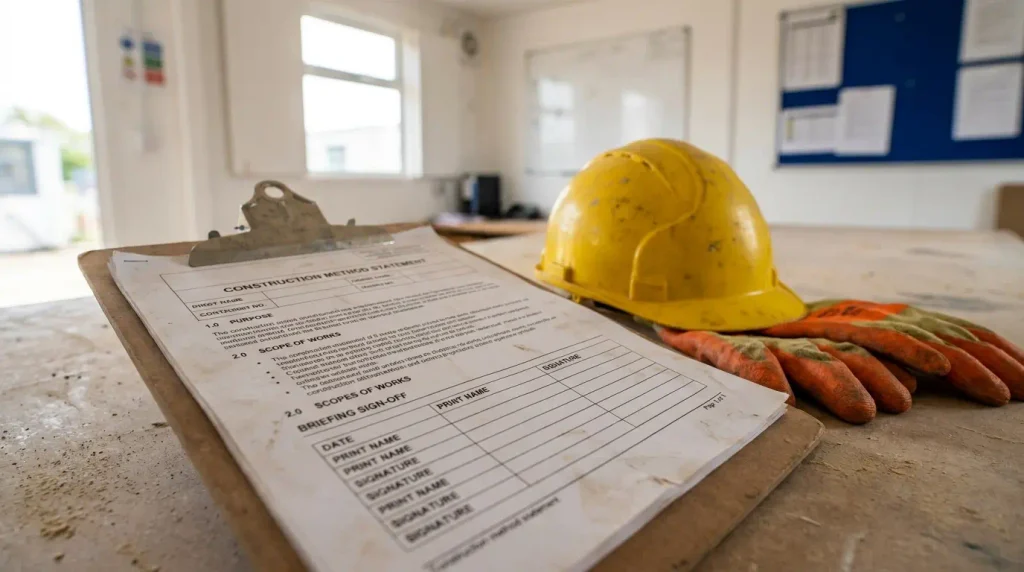
A method statement is a task-specific safe system of work, written down. It covers one activity, on one site, for one contractor.
Read properly, it should let someone who has never seen the job understand what will happen and in what order. A supervisor should be able to brief a crew from it on Monday morning without adding anything from memory.
It is written before work starts, briefed to everyone doing the work, and updated when the method changes.
What a method statement is not
It is not a risk assessment, though it depends on one. It is not a quality plan, a programme, or a set of specifications. It is not a generic document you reuse across sites with the address swapped out, though plenty of people try.
It is also not a substitute for supervision. A method statement filed and never briefed has no safety value at all.
Method Statement vs Risk Assessment: What Is the Difference?
A risk assessment identifies hazards, judges who might be harmed and how badly, and sets out the controls needed. A method statement takes those controls and builds them into a working sequence for the task.
| Risk assessment | Method statement | |
| Question it answers | What could go wrong? | How will the work be done? |
| Format | Hazards, risk ratings, controls | Numbered sequence of operations |
| Legal driver | MHSWR 1999, regulation 3 | No single named regulation |
| Written for | Compliance and planning | The people doing the work |
| Used by | Managers, safety advisers | Supervisors and operatives |
The two only work as a pair. A risk assessment saying “use edge protection” means nothing until the method statement says when the edge protection goes up, who installs it, who inspects it, and at what point in the sequence anyone is allowed near the edge.
What RAMS means
RAMS stands for Risk Assessment and Method Statement. It is the combined document pack a contractor submits before starting on site. Principal contractors, clients, insurers and framework operators all use the term, and asking for “your RAMS” means both documents together, not one or the other.
Are Method Statements a Legal Requirement in the UK?
There is no single regulation that says “you must write a method statement”. Risk assessment is the part written into law, and the method statement is how you show the controls are actually being applied.
Management of Health and Safety at Work Regulations 1999. Regulation 3 requires a suitable and sufficient assessment of risks to employees and to anyone else affected by the work. Employers with five or more staff must record the significant findings. In practice, everybody records them.
Construction (Design and Management) Regulations 2015. CDM 2015 requires the principal contractor to plan, manage and monitor the construction phase, and to make sure the principles of prevention are applied consistently across everyone working on site. Contractor method statements are the evidence that this is happening at task level. On larger projects they feed straight into the construction phase plan.
Contract. This is the one that bites day to day. Principal contractors make RAMS a condition of access. No approved RAMS, no start date. It does not matter whether a specific regulation names the document when the contract does.
So the honest answer is that method statements are legally expected rather than legally named, and commercially non-negotiable.
When Do You Need a Method Statement?
Write one whenever the work carries significant risk, involves more than one trade, or takes place somewhere other people can be affected.
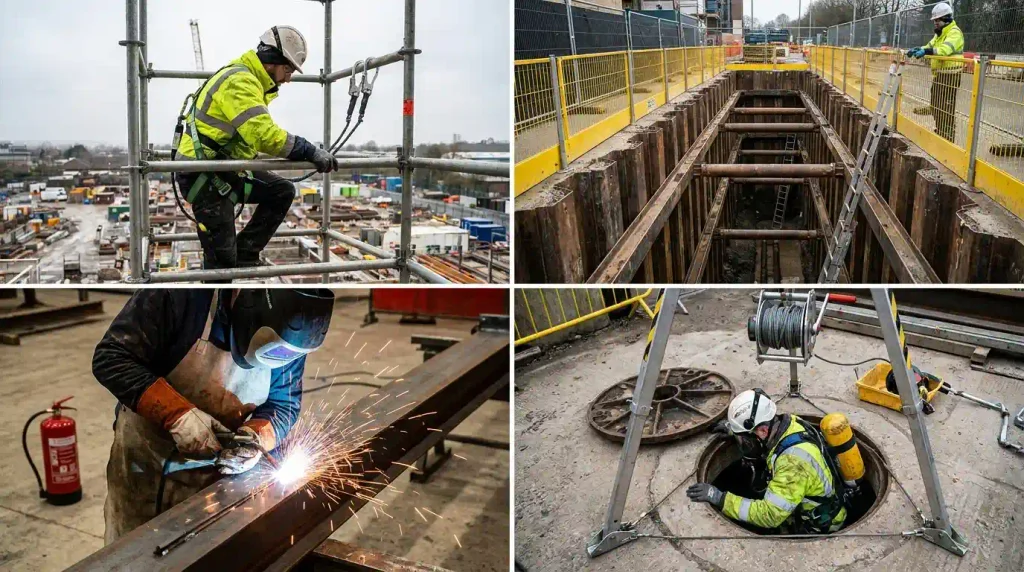
Work that always needs one:
- Working at height, including scaffolding, roof work and suspended ceiling installation
- Structural alteration, demolition and removing load-bearing walls
- Excavation and groundworks, including anything near buried services
- Lifting operations and use of cranes, hoists or telehandlers
- Hot works, including welding, grinding and torch-on roofing
- Confined space entry
- Work with asbestos, lead paint or other hazardous substances
- Electrical work involving isolation or live testing
- Any work in an occupied building, home or public space
Work that usually does not: low-risk single-trade tasks with no public exposure and no plant, such as second-fix carpentry in an empty domestic property, or painting at ground level.
The test is not the size of the job. It is whether the sequence of the work is what keeps people safe. If doing steps three and four in the wrong order would put someone in hospital, write the method statement.
What Goes in a Method Statement
Nine sections cover almost every job. Larger or more unusual work adds to them rather than replacing them.
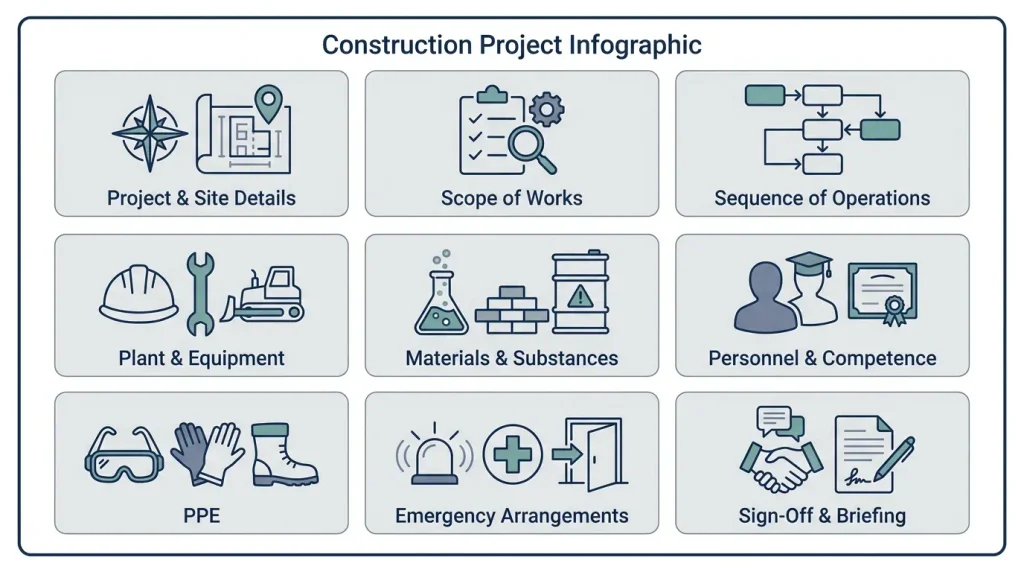
1. Project and site details. Site address, client, principal contractor, contractor’s own details, document reference, version number and date. Access arrangements, permitted working hours and any site restrictions belong here.
2. Scope of works. One short paragraph naming exactly what this document covers, and what it does not. “Removal of a load-bearing internal wall at ground floor and installation of a 203 x 133 UB” is a scope. “Building works” is not.
3. Sequence of operations. The core of the document. Numbered steps in the order they will happen, each one cross-referenced to the relevant risk assessment control. This section is covered in detail below.
4. Plant and equipment. Every item of plant and access equipment, with inspection and certification requirements. Tower scaffolds, podium steps, props, breakers, cut-off saws, extraction. State who is trained to operate what.
5. Materials and substances. What is being used, how it is delivered, where it is stored, and any COSHH assessments required. Resins, adhesives, cement products, solvents and paint strippers all belong here.
6. Personnel and competence. How many people, their roles, and the qualifications each one holds. CSCS cards, PASMA, IPAF, Gas Safe, Part P scheme registration, asbestos awareness. Name the supervisor and say who they report to.
7. PPE. Task-specific, not a generic list. If respiratory protection is needed, state the type and the face-fit test requirement. If it is only needed for one step, say which step.
8. Emergency arrangements. First aider names, nearest A&E, fire assembly point, spill procedure, rescue plan for work at height or in confined spaces. It must reflect the actual site, not a template site.
9. Sign-off and briefing record. Author, reviewer, approval date, review date, and a briefing sheet signed by everyone carrying out the work. The signature page is what proves the document was communicated rather than filed.
How to Write the Sequence of Operations
Most rejected method statements fail here, so it is worth doing properly.
Write the steps in the order they physically happen, starting before anyone touches the work and finishing after the area is clear. Number them. Keep each one to a single action.
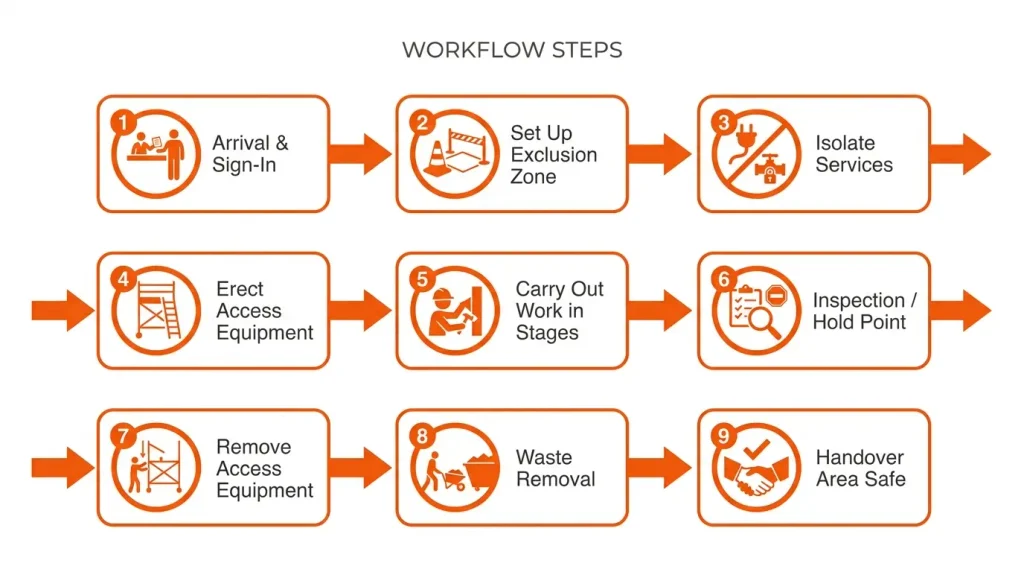
Cover, in order:
- Arrival, sign-in, site induction and permit to work if one applies
- Setting up: exclusion zones, barriers, signage, protection of finishes and adjoining property
- Isolation of services, and how isolation is proved
- Access equipment erected and inspected
- The work itself, broken into stages rather than described as one block
- Inspection or testing at each hold point
- Removing access equipment
- Waste segregation and removal
- Handover and area left safe
Two habits separate a usable method statement from a rejected one. Write in the active voice, saying who does what: “the supervisor confirms isolation using a proving unit” rather than “isolation will be confirmed”. And put the control alongside the step it protects, not in a general paragraph at the end.
A Worked Example: Removing a Load-Bearing Wall
Take a common domestic job and see how the detail changes the document.
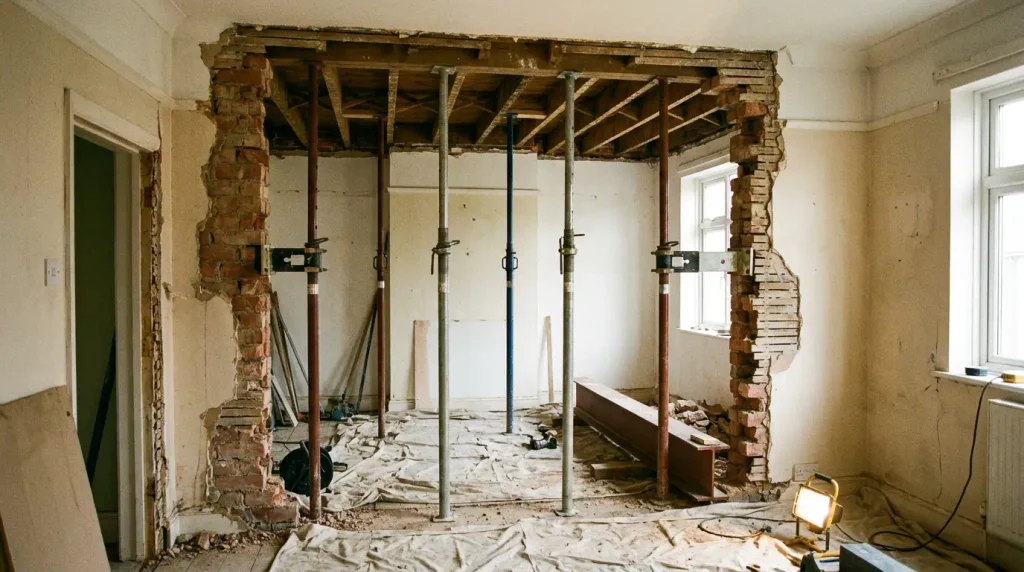
Scope. Remove a load-bearing internal wall between kitchen and dining room at ground floor, install steel beam to structural engineer’s design, make good.
Sequence, abbreviated:
- Confirm structural engineer’s calculations and beam schedule are on site and current
- Confirm building control notification submitted and inspection stages booked
- Where the property is semi-detached or terraced, confirm party wall notices have been served and the award is in place, following the Party Wall etc. Act
- Isolate and prove dead all electrical circuits in the affected area; cap and drain any pipework
- Protect floors, seal doorways, set up dust extraction and establish the exclusion zone
- Install temporary support: strongboys and acrow props to engineer’s spacing, both sides, checked by the supervisor before any masonry is removed
- Cut and remove masonry above the proposed beam position in controlled sections
- Install padstones, allow specified curing time
- Lift and seat beam, mechanical lifting aid for beams over the manual handling limit
- Pack, pin and grout beam bearings
- Building control inspection at open-beam stage before any covering up
- Remove temporary support in the order specified by the engineer
- Remove remaining masonry below the beam
- Fire protect the steel, make good, clear waste
Why the detail matters. Steps 6, 11 and 12 are the ones that hurt people or fail inspection when they are done out of order. A generic template would compress all fourteen into “remove wall and install beam”, and a principal contractor would send it straight back.
Who Writes and Approves a Method Statement?
Each contractor writes their own, covering their own work. A groundworker does not write the roofer’s method statement.
The author should be someone who understands the task in practice, usually a contracts manager, site manager or the supervisor who will run the job. Health and safety advisers review and challenge, but a document written entirely by someone who has never done the work reads like it.
A competent person reviews and signs before submission. On CDM projects, the principal contractor then checks that each contractor’s RAMS align with the site-wide arrangements and pull them into the construction phase plan.
The client’s role varies. Commercial clients often review RAMS as part of their own duty of care. Domestic clients rarely see them, though anyone commissioning renovation work is entitled to ask, and it is a reasonable question to put to a contractor at quotation stage. Our list of questions to ask before hiring a renovation company covers what else to check at the same point.
Why Method Statements Get Rejected
Principal contractors reject submissions for a short list of predictable reasons.
Generic wording. Template text with the site address changed. A reviewer spots it immediately, usually because the emergency arrangements reference a hospital forty miles away.
No real sequence. Steps written as a description of the trade rather than an order of operations. If the document does not tell you what happens first, it is not a method statement.
Competence claimed but not evidenced. Saying operatives are “suitably trained” without naming the qualification or attaching the cards.
Plant listed without inspection records. A tower scaffold in the equipment list and no PASMA certificate or inspection regime anywhere in the document.
Emergency arrangements that are not site-specific. Assembly points, first aiders and rescue plans copied from the last job.
Out-of-date references. Superseded regulations, withdrawn British Standards, or CDM 2007 cited instead of CDM 2015. It signals the document has not been reviewed in years.
No briefing record. The document may be perfect, but without signatures there is no evidence anyone doing the work has read it.
How Long Should a Method Statement Be?
As long as the job needs and no longer. A single-trade task might run to one page. Structural work in an occupied building might run to six.
Length is not the measure. Usability is. If the supervisor cannot brief the crew from the document without filling gaps from memory, it is too short. If nobody on site will read past page two, it is too long.
Write it for the person holding it in a doorway with a coffee, not for a filing cabinet.
Keeping it live
A method statement is a working document, not a submission you make once. Review and reissue it when the method changes, when new plant or a new substance is introduced, when the work moves to a different part of the site, after any incident or near miss, and when new people join the crew.
Reissue with a new version number and rebrief. An amended method that nobody has been told about is worse than no amendment at all, because the signed briefing record now proves the wrong thing.
How Method Statements Fit the Wider Project
On any project running under CDM 2015, contractor RAMS are the ground level of a larger structure. Each contractor’s documents feed into the principal contractor’s construction phase plan, which coordinates how everyone’s work interacts.
That coordination is the point. One contractor’s safe method can create a hazard for another: scaffolding erected across a fire escape route, an isolation that takes out lighting for a different trade, a delivery that blocks the only vehicle access. The principal contractor reads the RAMS pack precisely to catch those clashes before they happen on site.
Method statements also sit alongside the commercial documents that shape a project. If you are pricing work rather than delivering it, our explainer on preliminaries in construction covers where site set-up, welfare and supervision costs belong, and our construction company checklist covers what else needs to be in place before a start on site.
Working With a Contractor Who Documents Properly
Buon Construction produces task-specific RAMS for renovation, structural and fit-out work across Nottingham, from single-trade jobs to whole-house projects with several trades running in sequence. If you want to see how a job would be planned and documented before committing to it, get in touch and we will talk it through.
FAQs
Do I need a method statement for work in someone’s private home?
Not by regulation, in most cases. Domestic clients pass their CDM duties to the contractor, and no statutory instrument names the document. But the risk assessment duty applies exactly as it does commercially, and an occupied home adds dust, access, children, pets and neighbours. Anything structural or involving hazardous materials should have one.
Does a sole trader need RAMS?
A self-employed person with no employees has a narrower recording duty, but the same duty of care to anyone affected by the work. In practice, most sole traders need RAMS anyway because principal contractors, letting agents, housing associations and commercial clients all ask for them before granting site access.
Can I use a method statement template?
A template is a reasonable starting structure and a poor finished document. Use one for the section headings, then write the sequence, competence, plant and emergency arrangements from the actual job and the actual site. Templates submitted unedited are the most common reason for rejection.
How long is a method statement valid for?
Until the method changes. There is no fixed expiry, though many principal contractors set an annual review date as a housekeeping rule. Reissue with a new version number whenever the sequence, plant, substances, location or crew change, and rebrief everyone affected.
What happens if you do not have a method statement and something goes wrong?
The HSE will ask how the work was planned and how controls were applied. Without documentation, demonstrating a safe system of work is very difficult, which exposes the business to improvement or prohibition notices, prosecution under the Health and Safety at Work etc. Act 1974, and disputed insurance claims.
How much does it cost to have RAMS written?
Expect roughly £75 to £250 for a single task-specific document from a consultant, and more for complex or multi-stage work. Larger contractors write them in-house. The cost worth weighing is the alternative: a rejected submission usually costs a start date, and a start date usually costs more than the document.

One Response