
Dark, muted colours make a garden look bigger. Charcoal, deep grey, dark green and near-black all recede visually, so the boundary stops announcing itself and the eye reads the space as carrying on past it. Pale and orange-toned fences do the opposite. They advance, they draw attention to the edges, and they make a garden feel enclosed.
That’s the reverse of what most people expect, which is why so many small gardens are ringed in golden brown. The reasoning is worth understanding before you buy anything.
Table of Contents
Why dark fence colours make a garden look bigger
Dark colours recede, light colours advance
This is simple physics doing something useful. Pale, warm and saturated colours reflect more light back at you, so your eye registers them as closer than they are. Dark, cool, muted colours absorb light and register as further away.
Paint a boundary charcoal and it stops reading as a wall. It reads as shadow, and shadow suggests depth. Your brain fills in space that isn’t there.
A boundary you don’t notice stops feeling like a limit
The bigger effect is about attention rather than distance. A bright fence is the first thing you see when you step outside, and once the eye lands on the edge of a space, that’s where the space ends.
Make the boundary quiet and the eye goes elsewhere: to the planting, the seating, the tree in the corner. The garden feels bigger because you’re no longer looking at how small it is.
Why this works differently indoors
Everyone knows pale colours make a room feel larger, so the outdoor version sounds wrong.
Indoors you’re working with limited light inside an enclosed box, and pale walls bounce what light there is around, lifting the whole space. Outside you have unlimited daylight and no ceiling. Reflection stops being the useful thing and recession takes over instead. Same eye, different problem.
What it does to your planting
The unexpected bonus. Foliage looks dramatically better against a dark backdrop than a pale one.
Greens read richer. Silver and variegated foliage lifts off the fence instead of getting lost against it. Pale flowers glow. A dark boundary behaves like a gallery wall, and everything in front of it looks more considered than it did last week.
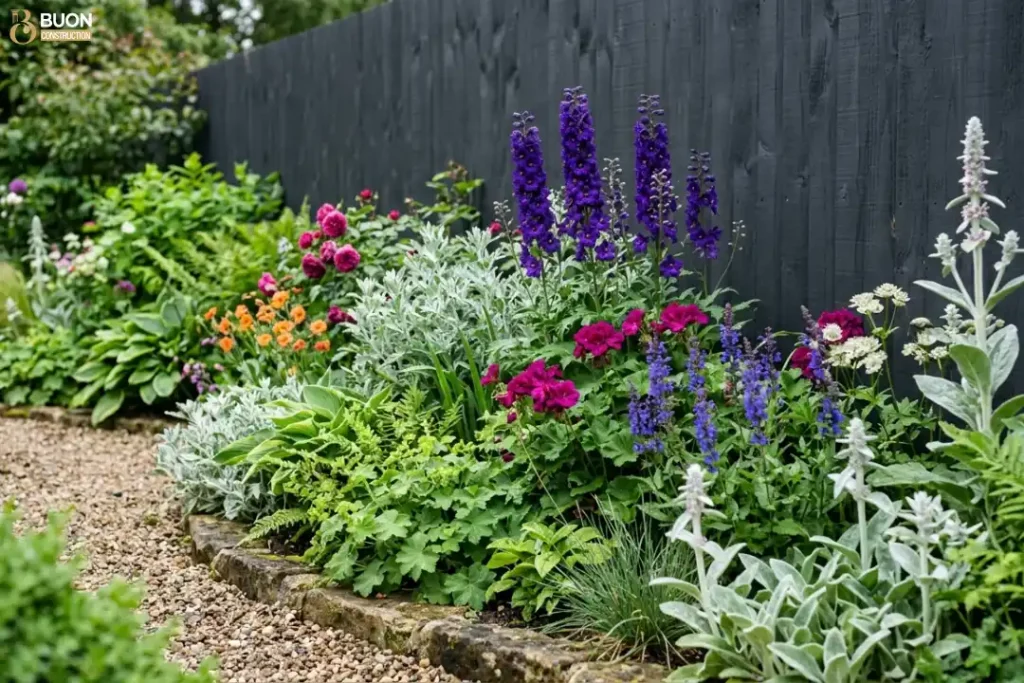
The best fence colours for making a garden feel bigger
Charcoal and dark grey
The safest choice, and the one that suits the widest range of gardens. Dark enough to recede properly, neutral enough not to fight with anything you plant, and comfortable against both red brick and render.
Cuprinol Garden Shades in Urban Slate is the most widely used version in the UK and does the job well. Thorndown’s Bergamot Grey is a slightly softer alternative.
Deep, muted green
The most natural-looking option, and arguably the best of the lot in a planted garden. A dark, greyed green disappears behind foliage almost entirely, so the boundary becomes hard to separate from the planting.
Look for greens with grey or brown in them rather than clean, bright ones. Forest Green in the Cuprinol range works. Farrow & Ball Studio Green is superb and costs several times as much.
Black and near-black
The most dramatic, and it does the recession trick better than anything else. In the right garden it looks sharp and expensive, and planting against it is genuinely striking.
Two cautions. Pure black can look severe where there’s little planting to soften it. And it shows dust, pollen and bird mess more than any other colour. Black Ash in the Cuprinol range is a softened near-black that keeps the effect without the harshness.
Dark green-brown and olive
An underused middle ground. A deep, muddy green-brown recedes like charcoal but feels warmer, which suits a cottage-style garden or an older house where black would look imposed on it.
It also sits particularly well against reclaimed brick, worth knowing if you have a Victorian or Edwardian property.
Deep blue-green
Teal, petrol and dark blue-greens are having a moment, and they work provided they stay muted rather than vivid. They read as sophisticated against green planting and they’re distinctive without being loud.
Test this family properly before committing, since blue-greens shift more than any other colour under changing light.
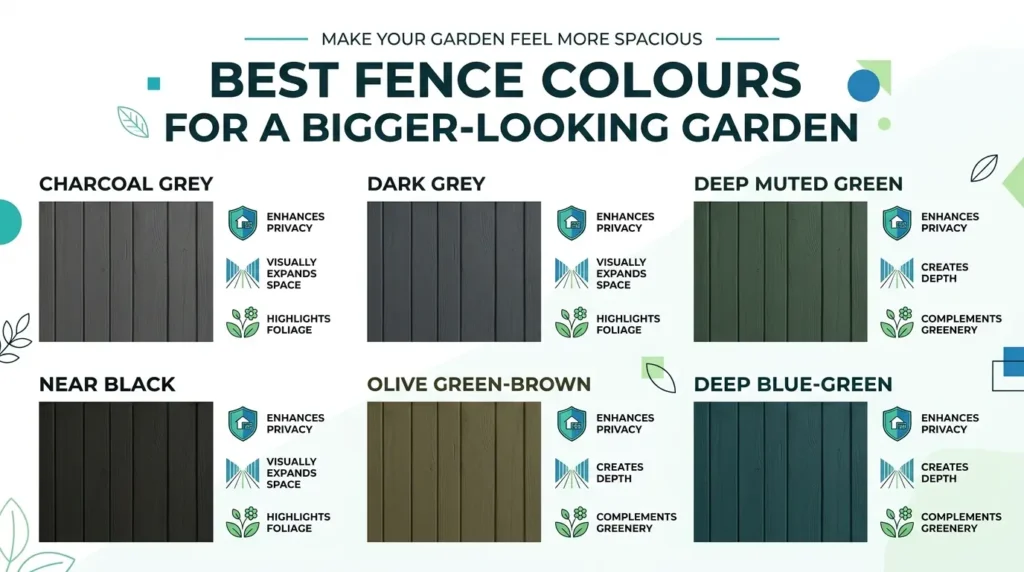
A note on brands
Cuprinol Garden Shades is the default for good reason: wide colour range, easy to apply, widely stocked, around £30 to £40 for five litres. Ronseal’s garden range is comparable. Thorndown is a British water-based paint with excellent colours at a slightly higher price. Farrow & Ball Exterior Eggshell is the premium option, and while the colours are lovely, you’re paying two to three times as much for a fence that will still want repainting in four years.
Matt, satin or gloss? Sheen matters as much as colour
The finish changes the result as much as the shade, and almost nobody mentions it.
Matt absorbs light and recedes furthest. It’s the right choice for a boundary you want to disappear, and it hides imperfections in old timber, which most fences have plenty of.
A slight sheen has its uses, just not on the main boundary. Save it for a gate, a trellis panel or a planter you actually want noticed. A little contrast in finish is a nice touch when it’s deliberate.
Gloss works against you outdoors. It reflects light, which advances the surface, and it draws the eye to every ripple and cupped board along the run. A glossy dark fence loses most of the benefit of being dark.
Most garden paints are matt or low sheen by default. Check the tin rather than assuming.
Fence colours that make a garden look smaller
Orange and golden brown
The default, and the worst offender. Standard treatments in cedar, golden brown and chestnut are warm, light and saturated, which is precisely the combination that pushes a boundary forward.
They also clash with green. Orange sits opposite green on the colour wheel, so an orange fence maximises contrast with every plant in front of it, and maximum contrast means maximum attention on the edges.
If your garden feels cramped and the fence is orange, that’s most of your answer.
Brilliant white
Tempting, because of the indoor logic, and it backfires. Bright white is the most advancing colour available outdoors. It grabs the eye, bounces light hard, and turns the boundary into the brightest thing in the garden.
It shows every mark, too, and outdoors there are a lot of marks.
Bright and saturated colours
Sky blue, sage, duck egg and heritage blue-greys all have their fans, and there’s nothing wrong with any of them if the fence is meant to be a feature. Just be clear that’s the trade you’re making. A fence you can see is a fence that marks where the garden stops.
Mixing colours across boundaries
The quickest way to shrink a space. Different colours on different sides give the eye three places to stop instead of none, and the garden reads as a set of walls rather than an open space.
Pick one colour and use it on everything, shed and gate included.
Does a dark fence work in a small or shady garden?
Yes, and it’s usually the best thing you can do. This trips people up, because the instinct in a dark space is to lighten it.
It works because you aren’t trying to brighten the garden, you’re trying to lose the boundary. A dark fence in a shady garden blends into shadow that’s already there, and the space reads as open rather than boxed in. A pale fence in the same garden looks grey and grubby within a season, since shade brings algae and damp and both show badly on light colours.
The one situation where a paler colour wins
A very small enclosed courtyard, north-facing, high walls on three sides, almost no planting.
There you have so little light and so little to look at that recession has nothing to work with. A soft, greyed off-white or pale stone can genuinely lift the space and stop it feeling like a well. Two conditions apply: it has to be a muted, warm off-white rather than brilliant white, and you need something growing in front of it or the result turns clinical.
Keeping a dark garden from feeling closed in
Dark boundaries need something to contrast against. Pale paving, light gravel, silver and variegated foliage, pale flowers. The garden wants to feel like a dark frame around a bright picture, not a dark frame around more dark.
What else makes a garden look bigger
Paint every boundary the same colour. Repeat it on the shed, the gate, the bin store and any trellis. Continuity is what makes a boundary disappear, and one different-coloured shed undoes a whole weekend’s work.
Make the far fence the darkest. If you’re using more than one shade, put the deepest at the far end with something slightly lighter on the sides running towards you. It exaggerates perspective. The effect is subtle rather than dramatic, and it costs nothing beyond a second tin.
Think about the direction of the lines. Horizontal boards draw the eye sideways and make a narrow garden feel wider. Vertical boards draw it upward, which helps a garden that feels squat. Neither is better. It depends which dimension you’re short of.
Plant in front of the boundary, not against it. Leaving even 40cm between the fence and the back of a border creates a layer of shadow that reads as depth. Planting flat against the fence flattens everything into a single plane.
Give the eye somewhere to go. A tree, a bench, a pot at the far end. A garden feels bigger when there’s a reason to look into it rather than around its edges. Our project gallery shows how much difference boundary treatment makes to how a space reads.
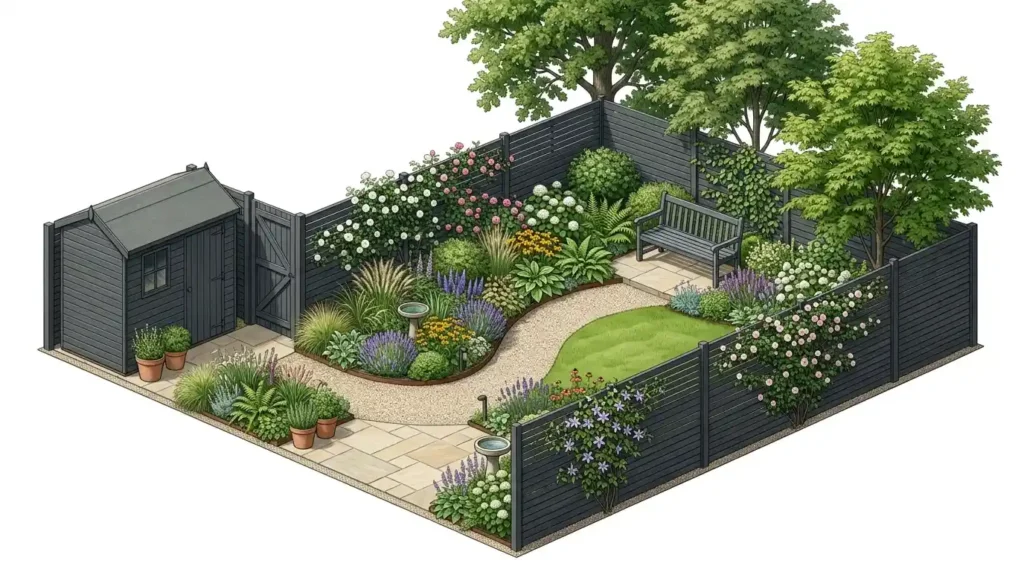
Can you actually paint your fence yet?
More people get this wrong than any other part of the job, and the paint usually gets blamed for it.
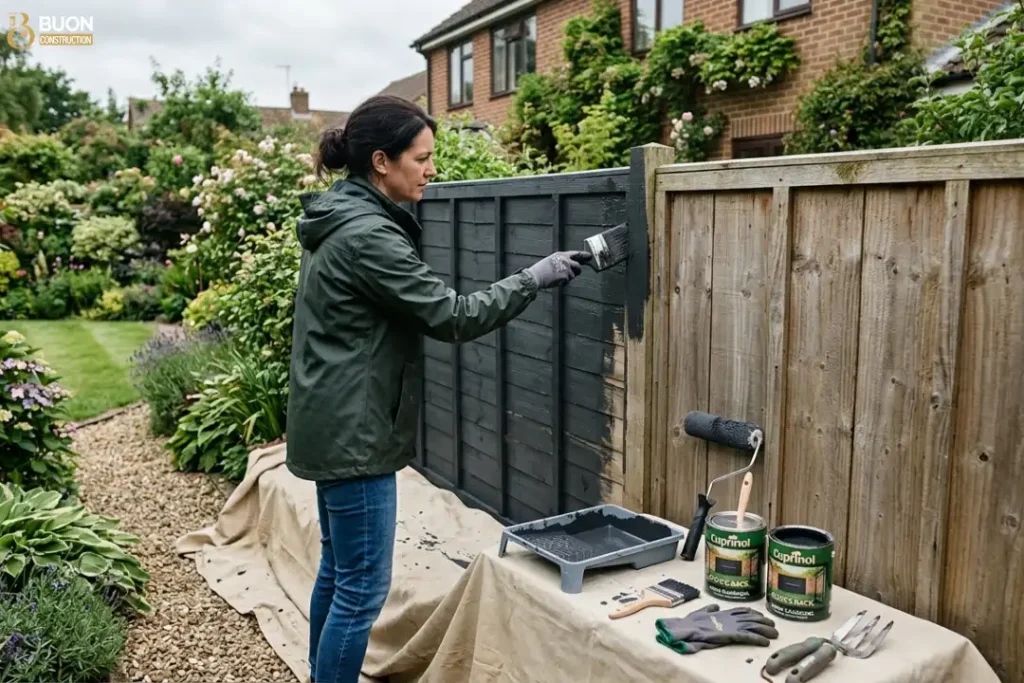
New pressure treated timber needs to weather first
Pressure treated timber has preservative forced into it under pressure, and it arrives holding a lot of moisture. Paint it straight away and the finish sits on a wet surface, never bonds properly, and lifts or peels within a season.
Leave a new pressure treated fence six to twelve months before painting. Frustrating when you’ve just had it built, but it’s the difference between a finish lasting four years and one failing in four months. There’s more on how pressure treated timber behaves in our guide to wooden fencing.
How to tell whether it’s ready
Sprinkle water on the timber. If it beads and sits on the surface, the wood is still saturated and won’t take paint. If it soaks straight in and darkens the timber, you’re ready.
Test in a few places along the run, because a fence dries unevenly depending on which parts catch the sun.
Painting over an old oil-based treatment
Most modern garden paints are water-based, and water-based paint doesn’t bond reliably to an oil-based finish. If your fence has been treated with a traditional oil-based preservative, test a small patch and leave it a fortnight before committing to the whole run.
If it lifts, you either need an oil-based paint or a proper clean back to bare timber.
Painting over an existing stain
Usually fine, as long as it’s sound. Opaque garden paint covers most translucent stains in two coats, and dark over dark is easiest of all.
Where it gets awkward is going from a very dark fence to a paler one, which can take three or four coats. Another argument for going dark in the first place.
What to clean off first
Algae, green growth, moss and loose flaking material all have to come off, or the paint takes them with it when it eventually fails. A stiff brush and a proprietary fence cleaner handles most of it. A pressure washer works, but go carefully, since it will shred soft old timber.
Let the fence dry completely afterwards. Two or three dry days is about right.
If large parts of the fence are rotten, painting is the wrong job. Paint over a failing panel and you’ve spent a weekend delaying a replacement by one season. Where more than a third of the posts are moving, price up a new fence before you buy any paint.
How much paint you need, and how long it takes
Coverage
| Timber type | Coverage per litre, per coat |
| Rough sawn timber | Around 5 m² |
| Smooth or planed timber | Around 10 to 12 m² |
Rough sawn drinks paint, and most fence panels are sawn, so plan on the lower figure.
Working out your area
Length in metres multiplied by height in metres gives you one side. A 20 metre run at 1.8 metres high is 36 m².
At 5 m² per litre that’s roughly 7 litres per coat, or 14 litres for two coats, which is three five-litre tins. Doing both sides doubles it.
How many coats
Two, on bare or previously stained timber. One coat looks patchy on sawn wood whatever the tin claims, and it’s the second coat that gives you the depth a dark colour needs to work.
Brush, roller or sprayer
A brush gives the best finish and gets into the overlaps. It’s also slow. Budget a full weekend for 36 m² across two coats.
A sprayer is three or four times faster and the obvious answer on a long run. It uses roughly 20 to 30 per cent more paint and needs proper masking, since overspray travels further than you’d think. Cover the plants, the paving and anything of your neighbour’s within reach.
Most people do best with a sprayer for the panels and a brush for posts, edges and the gate.
Cost
Around £30 to £40 for five litres of a mainstream garden paint. A typical 20 metre fence painted on one side comes to £90 to £120 in materials, plus cleaner and a brush or a hired sprayer.
Weather
Dry timber, dry forecast, ideally between 10°C and 20°C. Avoid direct hot sun, which dries the surface before it can soak in, and don’t paint below about 5°C or with rain due inside 24 hours.
Late spring and early autumn are the sweet spots. Early spring has a practical advantage too, since you can get it done before the borders have grown up against the fence.
Can you paint your neighbour’s fence?
Not without asking. If the fence belongs to your neighbour, painting it, even on your side, is technically altering their property.
In practice most people say yes to a dark colour on a side they’ll never see. Ask anyway. It takes one conversation and it heads off a genuinely tedious dispute.
Working out whose fence it is
There’s no rule that you own the fence on the left, however widely that’s believed. Responsibility comes from your title deeds, shown as T-marks on the Land Registry title plan. We cover how to work out which boundary is yours in more detail in our fencing guide.
If it’s a shared or unmarked boundary
Agree the colour together. It’s the one situation where the choice genuinely isn’t yours alone, and a fence painted two different colours along its length is worse than either colour would have been on its own.
FAQs
Does a black fence make a garden look smaller?
No, the opposite. Black recedes more than any other colour, so the boundary becomes less noticeable and the space reads as larger. The risk with black is that it can look severe in a garden with little planting, which is why softened near-blacks usually work better than pure black.
How long does fence paint last before it needs redoing?
Opaque garden paint typically lasts three to five years before it needs refreshing, less on a south or west-facing boundary taking direct sun and driving rain. Dark colours hold up well, though they can fade slightly on the most exposed runs.
Do I need to prime a fence before painting?
Not usually. Most garden paints go straight onto bare or previously treated timber without a primer. Some manufacturers suggest thinning the first coat slightly on very absorbent sawn wood, which helps it soak in rather than sitting on the surface.
Is fence paint the same as decking or shed paint?
Shed and fence paints are generally interchangeable, and many products are sold for both. Decking paint is different, formulated for foot traffic and standing water. Don’t put fence paint on a deck, though decking paint on a fence is simply an expensive way of doing it.
Will a dark fence get hotter and damage the timber?
Dark surfaces absorb more heat, and a black fence in full sun will run warmer than a pale one. Modern water-based garden paints are flexible enough to cope with the movement that causes, so it isn’t a practical concern on domestic fencing.
Can you paint a composite fence?
Generally no. Most composite manufacturers advise against it and painting usually voids the warranty, since the surface isn’t made to hold a coating. Concrete posts and gravel boards can be painted with exterior masonry paint, which is worth doing to match the timber.
How do I stop fence paint getting on my plants?
Cut back anything growing against the fence, lay dust sheets or cardboard along the border, and use a brush rather than a sprayer near planting. Painting in early spring, before the borders fill out, avoids most of the problem altogether.
Should the fence match the house or the garden?
The garden. A fence is a backdrop for planting rather than an extension of the building, and colours chosen to match brickwork or render usually end up too light. Pick the shade that makes your planting look best and it will sit fine against the house.
