
Extension Costs 2026 – Quick Numbers
- Per square metre: £1,800 – £3,000
- 20m² single-storey: £40,000 – £60,000
- 40m² double-storey: £70,000 – £100,000
- Professional fees: Budget an extra 15-20%
- Build time: 12-16 weeks on site
These figures don’t include VAT. Costs shift depending on where you live.
Table of Contents
What Will Your Extension Actually Cost?
Let’s cut to the chase. You’re here because you want to know what you’ll actually pay for an extension in 2026, not vague estimates that don’t match reality.
Here’s the honest answer: most single-storey extensions run between £1,800 and £3,000 per square metre. A decent-sized 20m² rear extension? You’re looking at £40,000 to £60,000 once you add professional fees. Slap on VAT and you’re north of £50k for something pretty standard.
But those numbers can swing wildly. A mate in Newcastle might pay 30% less than someone in Surrey for the exact same extension. Your choice of doors alone could add £10,000 to the bill. And don’t get me started on what happens when builders hit clay soil or discover dodgy drains.
This guide gives you the real numbers what different extensions cost, why prices vary so much between regions, and where your money actually goes. No fluff, just the figures you need to budget properly.
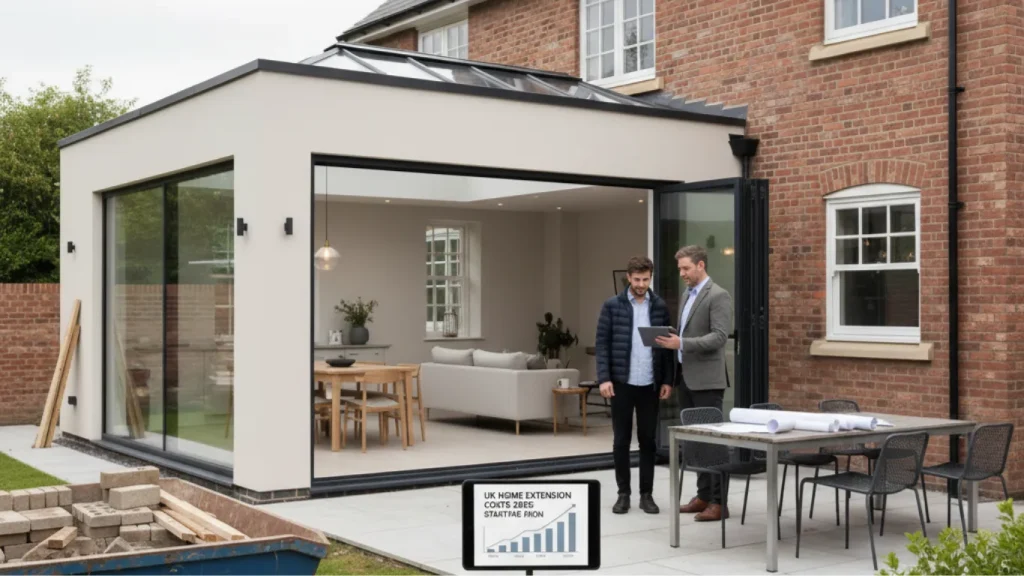
2026 Extension Prices by Type
What Do Builders Actually Charge?
| Extension Type | Size | Basic Spec | Good Spec | High-End |
| Rear single-storey | 20m² | £36,000 | £50,000 | £70,000 |
| Rear single-storey | 30m² | £54,000 | £75,000 | £105,000 |
| Double-storey | 40m² | £70,000 | £95,000 | £140,000 |
| Side return | 12m² | £30,000 | £42,000 | £60,000 |
| Wrap-around | 35m² | £63,000 | £87,500 | £122,500 |
These are build costs with standard finishes. You’ll need to add 15-20% for architects, engineers and the rest. VAT comes on top.
Breaking Down Those Spec Levels
Basic spec (around £1,800/m²) gets you the job done. Think uPVC doors, standard plaster finish, laminate floors. Nothing fancy but perfectly functional.
Good spec (around £2,500/m²) is where most people end up. Aluminium bi-folds, engineered wood floors, decent kitchen units. Looks good, works well.
High-end (£3,500/m² and up) means bespoke everything. Natural stone, custom joinery, the works. This is where budgets balloon if you’re not careful.
Here’s the thing most people start out saying “we’ll keep it simple” and end up somewhere in the middle. Those bi-fold doors look so much better than basic patio doors. Underfloor heating isn’t that much extra, is it? Before you know it, you’ve jumped from budget to mid-range.
That’s exactly why working with someone experienced matters. Companies like Buon Construction will walk you through what different choices actually cost before you commit stops you getting a nasty shock halfway through.

Costs for Different Extension Types
Single-Storey Rear Extensions
Still the most popular choice, and for good reason. Rear extensions give you that open-plan kitchen-diner everyone wants, often without needing planning permission.
You’ll pay: £1,800 – £3,000 per m²
| Size | What You Get | Cost Range |
| 15m² | Modest kitchen extension | £27,000 – £52,500 |
| 20m² | Kitchen-diner | £36,000 – £70,000 |
| 30m² | Proper living space | £54,000 – £105,000 |
One thing catches people out: glazing. Everyone wants those big sliding doors opening onto the garden. Fair enough they look brilliant. But a 4-metre set of decent aluminium bi-folds runs £8,000 to £15,000 fitted. That single choice can push you from budget into mid-range territory.
Double-Storey Extensions
Need a bigger kitchen AND another bedroom? Going up makes more financial sense than building two separate single-storey extensions. You’re only paying for one lot of foundations and one roof.
You’ll pay: £1,900 – £3,200 per m²
| Floor Space | Layout | Cost Range |
| 30m² total | Kitchen below, bedroom above | £52,500 – £96,000 |
| 40m² total | Kitchen-diner plus bedroom and bathroom | £70,000 – £128,000 |
The catch? You’ll almost certainly need full planning permission. And there are rules about how close you can build to boundaries usually 7 metres minimum from your rear boundary for two storeys.
Also worth knowing: sticking a bathroom upstairs adds proper money. All that plumbing, drainage work, and ventilation can add £5,000 to £10,000 beyond what you’d expect.
Side Return Extensions
Got a Victorian or Edwardian terrace? That narrow passage down the side of your kitchen is dead space you’re probably ignoring. A side return extension reclaims it.
You’ll pay: £2,200 – £3,500 per m²
Costs run higher per square metrer because the work is fiddly narrow access, structural steel to open things up, complex roof details. But you’re gaining space that was basically useless before.
Typical spend: £25,000 – £60,000 for 10-15m²
Adding a Kitchen
Most rear extensions include a new kitchen, so budget for that separately:
| Kitchen Level | What It Costs | What You Get |
| Basic | £8,000 – £15,000 | Standard units, laminate tops, normal appliances |
| Mid-range | £15,000 – £30,000 | Better cabinets, composite stone tops, good appliances |
| Top-end | £30,000 – £60,000+ | Bespoke design, natural stone, premium everything |
Other Ways to Add Space
| Option | Typical Cost | Notes |
| Garage conversion | £8,000 – £25,000 | Cheapest route—walls already exist |
| Loft conversion | £25,000 – £75,000 | Depends on roof type |
| Basement | £3,000 – £5,500/m² | Expensive but sometimes the only option |
Why Location Changes Everything
Where you live makes a massive difference. Same extension, same spec but wildly different prices depending on your postcode.
| Area | Cost per m² | Compared to Average |
| London | £2,500 – £4,500 | 30-50% more |
| South East | £2,200 – £3,500 | 15-25% more |
| South West | £2,000 – £3,200 | 5-15% more |
| Midlands | £1,800 – £2,800 | Baseline |
| North West | £1,700 – £2,700 | About average |
| North East | £1,500 – £2,500 | 10-15% less |
| Yorkshire | £1,600 – £2,600 | 5-10% less |
| Scotland | £1,700 – £2,800 | About average |
| Wales | £1,600 – £2,600 | 5-10% less |
Why such big gaps? Tradespeople in London charge way more than a chippy might want £350-£500 a day versus £200-£300 up north. City sites are harder to work on too. Try getting a skip permit in central London or finding somewhere to park the van.
Where Does the Money Actually Go?
Breaking down a £75,000 extension budget:
| What | Percentage | Actual Money |
| Building work | 55-60% | £41,000 – £45,000 |
| Kitchen or bathroom | 15-20% | £11,000 – £15,000 |
| Professionals | 12-15% | £9,000 – £11,000 |
| Site costs (scaffolding, skips, etc) | 5-8% | £4,000 – £6,000 |
| Contingency | 10% | £7,500 |
Professional Fees
| Who | What They Charge | Do You Need Them? |
| Architect | 7-15% of build cost | Not legally, but usually worth it |
| Structural engineer | £500 – £2,500 | Yes, pretty much always |
| Planning consultant | £1,000 – £3,000 | Only for tricky applications |
| Party wall surveyor | £700 – £1,500 each neighbour | If you share walls or are building close |
| Building control | £500 – £1,200 | Mandatory—no way around it |
Costs That Catch People Out
Nobody tells you about these until you’re already committed:
Party wall hassle: Building near your neighbour’s boundary? You’ll need to serve notice. If they get their own surveyor (which they’re entitled to do), you pay for both. That’s £2,000-£4,000 gone.
Moving stuff around: Gas meter in the way? Drains under your new extension? Electrics need upgrading? Each of these can add £500-£2,000.
Fixing up the garden: Builders will trash your lawn and patio. Putting it right costs £1,000-£5,000 depending on what state they leave it in.
Making the old house match: Once your shiny new extension is done, the existing kitchen or living room looks shabby. Most people end up redecorating more than they planned.

What Pushes Costs Up or Down?
Shape matters. A simple rectangle is cheaper than an L-shape. Corners cost money—more labour, more materials, more fiddly details.
Ground conditions. Clay soil (half of southern England sits on it) means deeper foundations. Trees nearby? Potential root damage means even more foundation work. Bad ground can add £5,000-£20,000.
Those doors everyone wants. Premium bi-folds or big sliding doors look amazing. They also cost £10,000-£18,000 for a decent-sized opening. That’s often the single biggest cost decision you’ll make.
Roof choice. Flat roofs cost less upfront but don’t last as long. Pitched roofs add £2,000-£5,000 but look better on most houses and need less maintenance.
Access. Terraced house with no side access? Everything comes through your hallway. That slows the job down and pushes costs up 10-25%.
Buon Construction does proper site surveys before quoting they’ll spot drainage issues, access problems and ground conditions before they become expensive surprises. That’s the kind of thing that separates good builders from cowboys.
Extending vs Moving: The Numbers
Should you add space or just buy somewhere bigger? Here’s roughly how the costs stack up:
| What You’re Paying For | Extending (30m²) | Moving to Bigger House |
| The actual work/extra cost | £75,000-£100,000 | £100,000 (bigger house) |
| Stamp duty | Nothing | £5,000-£15,000+ |
| Estate agent | Nothing | £4,000-£8,000 |
| Solicitors | £500-£1,500 | £2,500-£4,000 |
| Removals and surveys | Nothing | £2,000-£3,000 |
| Hidden transaction costs | £500-£1,500 | £13,500-£30,000 |
Moving costs you an extra £15,000-£30,000 in fees before you’ve even paid more for the bigger house. Plus you’re leaving your neighbourhood, maybe moving your kids’ schools, starting again.
Extending usually wins on pure economics unless you need loads more space or want to live somewhere different anyway.
Cutting Costs Without Cutting Corners
Keep the shape simple. Every corner and angle costs money. A plain rectangle saves thousands.
Use standard sizes. Off-the-shelf windows and doors cost way less than custom sizes. Design around what’s readily available.
Get proper quotes. Three minimum, all pricing the same specification. Vague quotes are impossible to compare.
Pick your battles. Spend on what matters (structure, insulation, waterproofing) and save on what doesn’t (you can upgrade worktops later, you can’t upgrade foundations).
Don’t even think about skimping on:
- Foundations and structural work
- Damp proofing and insulation
- Electrics and gas
- Building regs compliance
Bodge any of these and you’ll pay way more to fix them later. Or worse, you won’t be able to sell your house.

Planning Permission and Building Regs
When You Don’t Need Planning Permission
Single-storey extensions often fall under “permitted development”—meaning no planning application needed.
| House Type | How Far Back You Can Go |
| Detached | 4m (or 8m with prior approval) |
| Semi or terrace | 3m (or 6m with prior approval) |
But loads of things can still trigger a planning requirement: conservation areas, listed buildings, previous extensions that used up your allowance, height restrictions. Always check with your council first.
Building Regulations
These are non-negotiable. Every extension needs building regs approval—no exceptions. This covers:
- Structural safety
- Fire safety
- Energy efficiency
- Drainage
- Ventilation
Budget £500-£1,200 for building control fees. Skip this process and you’ll have serious problems when you try to sell.
Even if you don’t need planning permission, get a Lawful Development Certificate (£129). It’s official proof that your extension is legal your buyers’ solicitors will want to see it.
How Long Does It All Take?
Before building starts:
- Designing what you want: 4-8 weeks
- Planning permission (if needed): 8-12 weeks
- Building regs approval: 2-4 weeks
- Getting quotes, picking a builder: 3-6 weeks
The actual build:
| Extension Type | Time on Site |
| 20m² single-storey | 10-14 weeks |
| 30m² single-storey | 12-16 weeks |
| Double-storey | 16-24 weeks |
Reality check: Start to finish, you’re looking at 6-10 months. Most people underestimate this.
Delays happen. Weather stops groundwork. Materials get held up. Builders find problems nobody knows about. Don’t book that housewarming party too early.

Picking a Builder You Can Trust
This is where projects succeed or fail. Get it right and the whole thing runs smoothly. Get it wrong and you’re in for months of stress, arguments and extra costs.
Check These Things Properly
- Insurance: Public liability (£2m minimum) and employer’s liability. Ask to see certificates.
- Trade bodies: FMB, Federation of Master Builders, Trust Mark membership shows some level of vetting.
- References: Get three from recent jobs. Actually phone them and ask how it went.
- Written quote: Detailed breakdown, not just a total. Payment stages tied to work completed.
- Fixed address: A proper business premises, not just a mobile number.
Warning Signs
- Wanting big money upfront (more than 10-15% deposit)
- Offering discounts for cash
- Pushing you to sign quickly
- Quotes way below everyone else’s
- Hard to get hold of before they’ve even started
How Payments Should Work
| Stage | How Much |
| Deposit | 10-15% |
| Foundations done | 20-25% |
| Roof on | 20-25% |
| First fix complete | 20-25% |
| Everything finished | 10-15% |
Never pay ahead of the work. Buon Construction uses staged payments tied to completed milestones you can see what you’re paying for at each step. That’s how reputable builders operate.
The Bottom Line
A decent extension in 2026 costs £1,800-£3,000 per square metre for the build, with total project costs of £50,000-£100,000+ once you add fees and VAT for something around 20-30m².
What to remember:
- Add 15-20% for professionals and 10% contingency on top of build quotes
- London and the South East cost 30-50% more than up north
- Your finish choices matter as much as the size that’s where budgets blow out
- Find a builder properly—check insurance, get references, use staged payments
- Allow 6-10 months from first plans to moving in
Get the planning right, choose your builder carefully, and be realistic about what you can afford. Do those three things and you’ll end up with extra space that’s worth more than you paid for it.
FAQ
What’s a 20m² extension going to cost me all in?
Realistically, £50,000-£100,000 once you add professional fees and VAT. The £36,000-£70,000 figures you see are build costs only.
What’s the cheapest way to get more space?
Converting a garage if you’ve got one £8,000-£25,000. If you’re building new, a basic single-storey with a flat roof costs least.
Do I definitely need planning permission?
Maybe not. Extensions within permitted development limits (3-4m depending on your house type) often don’t. But check first getting it wrong is expensive.
How long before I can use my new extension?
The build takes 12-16 weeks typically. Add design and approvals and you’re looking at 6-10 months total.
Will it add value to my house?
Usually, yes. A good extension typically adds more than it costs. Kitchen-diners and extra bedrooms add the most value 5-15% isn’t unusual.
Should I extend or just move?
Extending usually works out cheaper when you factor in stamp duty, agent fees and all the other moving costs. You’re looking at £15,000-£30,000 in transaction costs avoided.
Can I stay in the house during work?
Most people do, though it’s disruptive. If your kitchen’s out of action for weeks, you’ll need somewhere else to cook. Some people move out for the worst bits.

One Response
Great guide, I’ve worked with a few local contractors recently and it’s amazing how many homeowners don’t realize these kinds of projects can vary so much in cost.