
Wooden fencing is still the default in British gardens for three reasons: it costs less than every alternative, it suits almost every house, and you can repair it a panel at a time rather than replacing the lot. Installed, expect £90 to £180 per metre, depending on panel type and what the posts are made of.
The drawback is just as simple. Timber rots where it meets the ground, and a fence built without allowing for that will be leaning inside eight years however good the panels looked on delivery.
Both halves are worth understanding before you spend anything.
Table of Contents
Why wooden fencing is still the default
It costs less than everything else
A standard overlap panel is £20 to £50. Closeboard sits at £50 to £70. Composite starts around £70 and climbs past £150 for the systems worth having, and a brick wall belongs in a different budget altogether.
Over a typical 20 metre boundary, choosing timber instead of composite saves somewhere between £1,000 and £2,500 up front. That gap closes over 25 years once maintenance is counted, but most people are budgeting for this spring rather than for 2051.
It suits British houses
Timber weathers into something that looks like it belongs there. Composite doesn’t really weather, it just gets older. Behind a Victorian terrace or a 1930s semi, which covers a good share of Nottingham, close-boarded timber reads as correct in a way a moulded panel rarely manages.
You can repair it a panel at a time
The most undervalued advantage on the list. A tree comes down, someone reverses into the boundary, one post rots. With timber you swap the affected section for £60 to £150 and carry on. Proprietary systems mean tracking down a matching component years later, and matching gets harder every year that passes.
Privacy without a planning application
Up to two metres, permitted development generally covers you. That’s a properly private garden with no drawings, no fee and no waiting. Anything taller, or anything next to a road, is a different conversation, and it’s covered further down.
The practical advantages that matter on site
It handles sloping ground. This is the one that catches people out. Timber fencing can be stepped, so panels sit level with a gap underneath, or raked, so the panel follows the ground line. Closeboard built board by board rakes cleanly to almost any gradient. Most panel systems, composite included, can only be stepped, and on a steep garden that leaves awkward triangular gaps you then have to deal with.
It’s easy to alter. Adding a gate. Cutting a panel to fit an odd bay. Running the line around an inconvenient tree. Routine in timber, fiddly in anything else.
It’s genuinely sustainable when certified. FSC or PEFC softwood comes from managed forests and stores carbon while it stands. Fencing is one of the highest-volume uses of timber in domestic work, so specifying certified stock is a real choice rather than a gesture. On softwood it usually costs nothing extra.
Disposal is straightforward. Untreated offcuts burn or compost. Treated timber goes to the tip as ordinary waste rather than needing a specialist route, which is more than can be said for composite at end of life.
The honest drawbacks of a wooden fence
Most articles on this subject stop before this section. They shouldn’t.
Maintenance is not optional
Treat it every two to three years, more often on a south or west-facing boundary taking the weather. Skip it and nothing happens for four years, then everything happens at once in year six.
Doing 20 metres takes most of a Saturday and about £60 of stain. That’s the genuine cost of choosing timber, and it comes round again and again.
Ground contact is where fences die
Fences almost never fail in the middle of a panel. They fail at the bottom, where timber sits in wet soil and stays wet.
A timber post set straight into the ground is in permanent contact with moisture, and even pressure-treated softwood eventually gives up. The first symptom is usually a slight lean after a windy week. By that point the post has already gone below ground level, whatever it looks like above.
That single failure mode explains most of the difference between a fence lasting eight years and one lasting twenty-five.
Wind load, and why panels blow out
Solid panels are sails. In an exposed garden a run of solid closeboard puts real force into every post during a storm, and something gives eventually, usually the post or the fixings.
Hit and miss fencing, with boards alternating front and back, lets wind through while still blocking sightlines. It costs a bit more and it’s the right answer on any open or elevated site. Nobody pushes it, because it isn’t the cheapest thing on the shelf.
Timber moves
Wood takes on and loses moisture, so it warps, cups and twists. Panels shrink in a dry summer and swell in a wet winter. Gaps open up. Boards cup away from the frame.
Well-dried timber, properly fixed, moves far less than cheap wet softwood. You can’t tell the difference standing in a merchant’s yard, which is unhelpful but true.
Cheap panels are a false economy
A £20 overlap panel is thin slats stapled into a light frame. It looks fine on day one and starts coming apart within a few seasons, usually as the staples rust.
The difference between a budget lap panel and a decent closeboard one is around £30. Across 20 metres that’s roughly £330, and it typically doubles the life of the fence. As clear a case as you’ll find in domestic building where spending more is simply cheaper.
Wood against composite, metal and concrete
| Timber | Composite | Metal railings | Concrete post and panel | |
| Cost per metre installed | £90 to £180 | £180 to £320 | £150 to £300 | £120 to £220 |
| Realistic lifespan | 8 to 25 years, spec dependent | 25 years plus | 30 years plus | 40 years plus |
| Maintenance | Treat every 2 to 3 years | Occasional wash | Repaint every 5 to 10 years | Effectively none |
| Privacy | Full | Full | None | Full |
| Repairability | Excellent, panel by panel | Moderate, needs matching parts | Good | Poor, heavy components |
| Appearance over time | Weathers naturally | Stays uniform, can fade | Traditional | Utilitarian |

When composite genuinely wins
Three situations. A boundary you can’t easily reach to maintain, backing onto a ditch or an alleyway. A rental or holiday property where nobody will ever get round to treating it. And a garden you’re staying in for twenty years and would rather pay for once.
Outside those, timber usually wins on cost per year lived with.
Where concrete posts beat both
Concrete posts and concrete gravel boards carrying timber panels is the most practical fencing specification available in this country, and it’s what we’d recommend on most boundaries. You keep the look and repairability of timber and lose the ground-contact rot entirely, because the only thing sitting in wet soil is concrete. Panels drop into the posts, so swapping one takes ten minutes and no tools.
It costs more up front and looks slightly less refined than a full timber build. It also routinely doubles the life of the fence. If you’re having fencing installed, ask about this specification before anything else.
What a wooden fence costs in the UK
Panel prices
| Panel type | Typical cost per 1.83m panel |
| Overlap / lap | £20 to £50 |
| Closeboard / featherboard | £50 to £70 |
| Hit and miss | £55 to £90 |
| Slatted / contemporary | £50 to £100 |
| Decorative and premium timber | £100 to £200 |
Posts add £15 to £30 in timber, £25 to £45 in concrete. Gravel boards run £10 to £20 in timber, £15 to £30 in concrete.
Installation
£90 to £180 per metre covers most standard timber installations including materials and labour, with the average landing around £110 to £120. Labour alone is roughly £40 to £60 per panel, or £150 to £250 a day per fitter.
A 20 metre boundary in closeboard with concrete posts and gravel boards usually comes in between £2,200 and £3,200 fitted.
Taking out the old fence
Around £35 per panel to remove and dispose of what’s there. On a full replacement that’s a real line rather than a rounding error, and it’s the item most often quietly missing from a cheap quote.
What pushes the price up
Old posts set in concrete that have to be broken out. Access that means carrying everything through the house. Sloping or uneven ground, which needs more setting out and more cutting. Tree roots and buried services, since you can’t dig a post hole through either. Anything above 1.8 metres, which needs bigger posts and deeper holes. And wet clay, common across much of Nottingham, which slows digging considerably.
Types of wooden fence panel explained
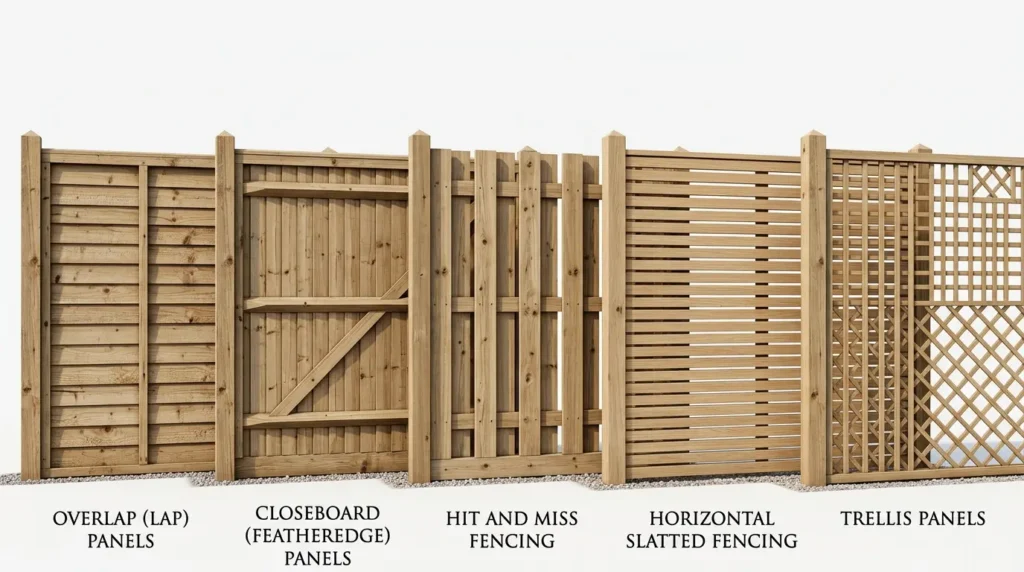
Overlap (lap). Horizontal slats overlapping in a light frame. Cheapest, quickest to fit, shortest life. Fine for a low-priority boundary, not for a main garden.
Closeboard (featherboard). Vertical feather-edge boards fixed to arris rails, bought as panels or built on site. Stronger, heavier and longer lasting, and the standard for a boundary you care about. Built on site it follows any ground line you like.
Hit and miss. Boards alternating front and back of the rails. Wind passes through, it looks identical from both sides, and it gives near-total privacy from any normal viewing angle. The right call on an exposed site.
Slatted. Horizontal boards with deliberate gaps. Contemporary, popular on newer houses, less private by design, and it costs more per metre than it looks like it should.
Picket and post and rail. Front gardens and rural boundaries. Marks a line without enclosing anything.
Trellis. Adds height and greenery above a solid panel, and counts towards your overall height for planning purposes, which people forget constantly.
Most of these appear across our recent projects if you want to see how they read in a real garden rather than a brochure.
Choosing timber, treatment and posts
Timber
Most UK fencing is treated softwood, usually pine or spruce, and for the money that’s the sensible default. Larch is denser and better grained at a premium. Western red cedar is naturally rot resistant, weathers to silver, needs no treatment and costs a good deal more. Oak lasts decades and is priced accordingly.
Pressure treated against dip treated
This decision matters more than any other on the list, and almost nobody explains it.
Dip treated timber has been dunked in preservative. The coating is superficial and protects for perhaps two to three years, after which the timber is effectively untreated. It’s usually the cheap brown-stained stuff.
Pressure treated timber has preservative forced into the cells under pressure, so protection runs through the section rather than sitting on the surface. It tends to be green-tinged when new, weathering to honey brown.
The price difference is modest. The lifespan difference is not.
Use classes, and why UC4 matters
Treated timber is graded by use class. UC3 covers external timber above ground. UC4 covers timber in ground contact or permanently damp conditions.
Panels can be UC3. Anything going into the ground, posts above all, should be UC4. A UC3 post set in soil is a post that fails early, and merchants sell plenty of them to people who didn’t know to ask.
Concrete posts against timber posts
Timber posts look better. Concrete posts last far longer, because nothing organic is sitting in the wet.
If appearance matters more, use pressure-treated UC4 timber set in concrete, with the top weathered so water runs off instead of soaking into the end grain. If longevity matters more, use concrete. There isn’t a third option that does both.
Why gravel boards matter more than the panels
A gravel board is the horizontal board at the very bottom, between the ground and the panel. It’s the sacrificial layer. It takes the soil contact, the splash-back and the rot, and it costs £10 to £30 to replace when it eventually goes.
Leave it out and the panel itself sits in the wet and rots from the bottom edge up, which means replacing a whole panel rather than one board. Concrete gravel boards never rot at all.
About £20 a bay, and it changes the economics of the entire fence. Any quote without gravel boards on it is a quote worth querying.
How long does a wooden fence last?
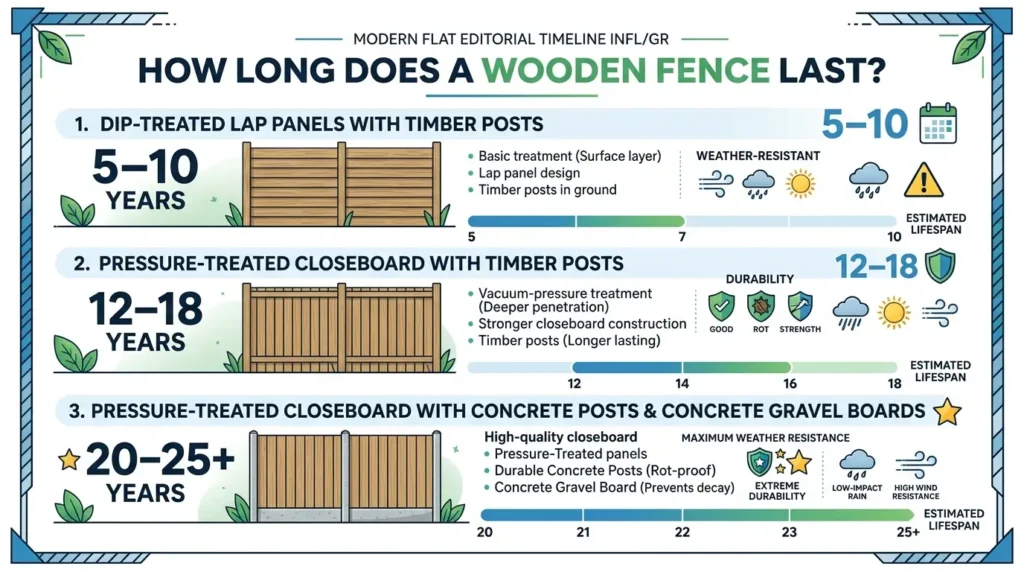
Between 8 and 25 years, and the specification decides where you land.
| Specification | Realistic lifespan |
| Dip treated lap panels, timber posts, no gravel board | 5 to 10 years |
| Pressure treated closeboard, timber posts, timber gravel board | 12 to 18 years |
| Pressure treated closeboard, concrete posts, concrete gravel boards | 20 to 25 years plus |
Keeping it going
Treat it every two to three years with a proper fence stain rather than a thin colour wash, picking a dry spell so the timber actually absorbs it. Keep soil, compost and borders pulled back from the base, because heaped soil against a gravel board defeats the point of having one. Cut back ivy and climbers, which trap moisture against the boards and pull fixings out as they thicken.
Once a year, in autumn, push firmly at the top of each post. Any movement means that post is going, whatever the timber above ground looks like.
Repair or replace?
Swap individual panels and posts as they fail and a fence stays serviceable years past the point most people rip it out. Replace the whole run once more than about a third of the posts are moving, since beyond that you’re paying labour over and over for the same job.
Fence height rules and planning permission
You can generally build up to 2 metres without planning permission under permitted development. Where the fence borders a highway used by vehicles, or a footpath running alongside one, the limit drops to 1 metre.
Height is measured from ground level on the higher side, and it includes anything sitting on top. A 1.8 metre fence with 300mm of trellis is a 2.1 metre fence as far as the rules are concerned. That’s the most common way people end up in breach without knowing it.
Listed buildings need consent for a fence within the curtilage. Conservation areas rarely restrict rear boundaries but can affect front ones, so check before ordering.
Covenants are the ones people miss altogether. New-build estates frequently ban fencing to front gardens or dictate a type and height. They sit in your title deeds and are enforceable regardless of what planning allows.
If you’re unsure, a call to the local planning department costs nothing and takes ten minutes.
Who owns the fence? Boundary responsibility explained
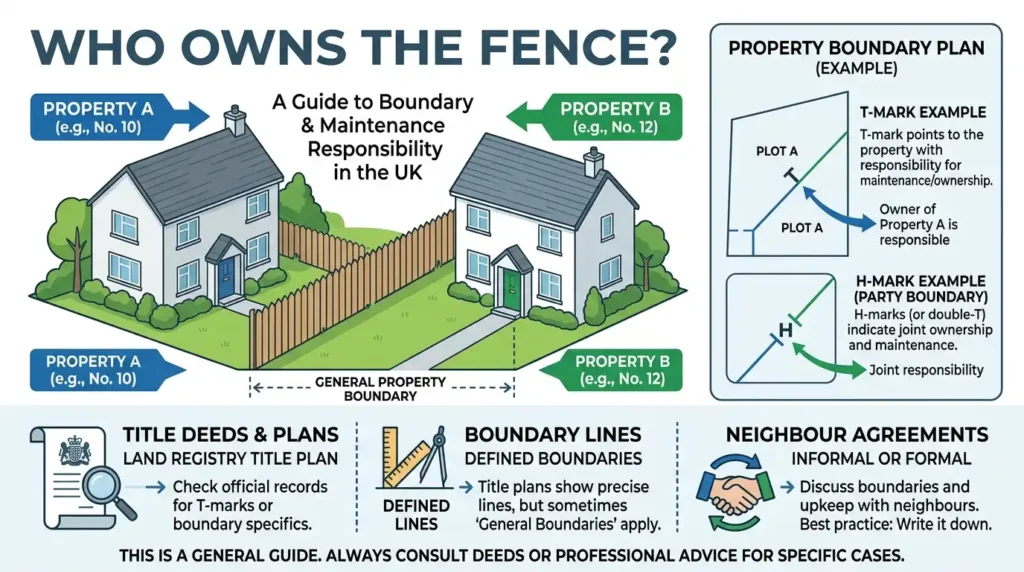
There is no rule that you own the fence on the left. It is one of the most widely believed pieces of property folklore in Britain and it has no basis in law at all. Responsibility comes from your deeds and nowhere else.
How to check
Look at your title plan, available from the Land Registry for a few pounds. Boundaries carrying a maintenance responsibility are marked with a T-mark, a small T drawn perpendicular to the boundary line, sitting inside the property that’s responsible for it.
Two Ts joined together into an H indicates a party boundary, shared between both properties.
One caveat worth knowing: Land Registry plans show general boundaries only. They establish who maintains what, not the exact line to the centimetre. For that you’d need the original conveyance or a surveyor.
If there are no T-marks
Then nobody carries a recorded obligation, which happens more often than people expect. In that case there’s usually no legal duty to fence at all, unless a covenant creates one. A boundary can simply be left open.
In practice, whoever wants the fence pays for it, and whoever pays for it owns it.
Which side faces the neighbour?
Convention puts the smooth side outward, posts and rails facing in. It’s a courtesy, not a law. If you’re paying, it’s your call, though facing the rails at a neighbour is a decision you’ll be living with for a long time.
Before you start
Tell your neighbour, even where you have no obligation to. The work means noise, access and usually a full day with the boundary open. A conversation beforehand heads off most disputes, and if you need to step onto their land to fix panels you’ll need their agreement anyway.
And never move a boundary line while replacing a fence, not even by 50mm. Reinstating on the existing line is simple. Shifting it, deliberately or by accident, is how a fencing job turns into a legal one.
Getting a fence installed
A proper quote shows the panel type and height, the post material and how they’re being set, whether gravel boards are included, removal and disposal of the existing fence, the number of bays, and a clear total with VAT stated either way.
Four questions worth asking before you book. Are the posts UC4 treated? Are gravel boards included? How are you setting out on the slope? And what happens if a post hole hits a root or a service? The answers tell you quickly whether you’re dealing with someone who fits fences properly or someone who fits them fast.
If you’re replacing a boundary anywhere around Nottingham, we install fencing both as standalone work and as part of wider garden and property renovation. There’s finished work in the project gallery, or get in touch and we’ll come and measure up properly.
FAQs
How much does it cost to replace a garden fence in the UK?
Replacing a garden fence costs £90 to £180 per metre installed, including materials and labour. A 20 metre boundary in closeboard with concrete posts typically runs £2,200 to £3,200. Removing and disposing of the old fence adds around £35 per panel.
How long does a wooden fence last?
A wooden fence lasts between 8 and 25 years depending on specification. Dip treated lap panels with timber posts manage 5 to 10 years. Pressure treated closeboard with concrete posts and gravel boards regularly reaches 20 to 25 years with routine treatment.
Do I need planning permission for a garden fence?
Not for fences up to 2 metres high under permitted development, or 1 metre where the fence borders a highway used by vehicles. Height includes any trellis on top. Listed buildings require consent, and estate covenants can restrict fencing regardless of planning rules.
Who is responsible for repairing a boundary fence?
Responsibility is set by your title deeds, not by which side of the house the fence sits on. T-marks on the Land Registry title plan show which property maintains which boundary. Where no T-marks exist, there is usually no legal obligation to fence at all.
Is wood or composite fencing better value?
Timber costs roughly half as much up front and can be repaired panel by panel. Composite lasts 25 years or more with minimal maintenance, which makes it worthwhile on boundaries that are hard to reach, on rental properties, or where you plan to stay long enough to recover the difference.
Can I paint or stain a pressure treated fence straight away?
No. Pressure treated timber holds moisture from the treatment process and needs to dry before it will take a finish, usually 6 to 12 months. Applying stain too early gives a patchy result that peels. Some water-based treatments can go on sooner, so check the product guidance.
Do I need to tell my neighbour before replacing a fence?
There is no legal requirement if the boundary is your responsibility and the work stays on your land. Telling them is still sensible, since the job involves noise, access and an open boundary for a day. You will need their permission to step onto their property.
Are concrete posts better than wooden posts?
For longevity, yes. Concrete posts don’t rot at the ground line, which is where most fences fail, and panels slot in so replacements take minutes. Timber posts look better and suit traditional settings, but they need UC4 treatment and careful setting to come anywhere close on lifespan.
