
The purpose of a green roof is to put a living layer of vegetation over a building’s waterproofing, so the roof does more than keep water out. Green roofs slow rainwater run-off, shield the waterproof membrane from UV and temperature swings, add a layer of insulation, and create habitat for insects and birds.
That’s the short answer. The longer one is more useful, because green roofs do some of those jobs far better than others, and the marketing around them rarely bothers with the distinction.
Table of Contents
What is a green roof?
A green roof is a roof with plants growing on it, built up in layers over a waterproofed deck. From the bottom up:
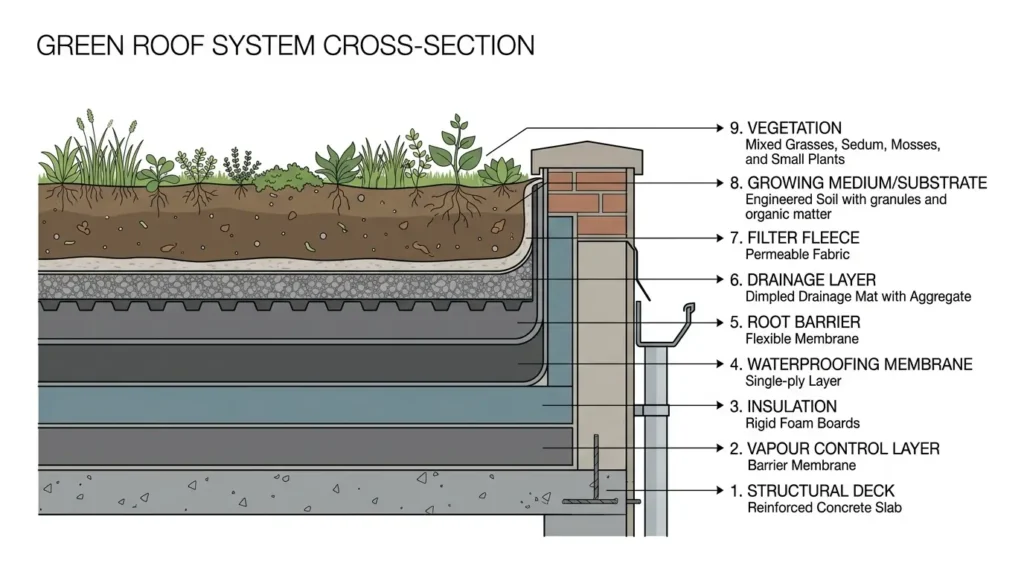
- Structural deck — timber, concrete or metal
- Vapour control layer
- Insulation, on a warm roof build-up
- Waterproofing membrane — the layer that actually keeps water out
- Root barrier — stops roots reaching the membrane
- Drainage layer — holds some water, releases the rest
- Filter fleece — keeps substrate out of the drainage layer
- Growing medium — engineered substrate, not garden soil
- Vegetation — sedum, wildflower, grasses or planting
The order matters. Waterproofing does the waterproofing; the plants sit on top and protect it. A green roof is not a waterproofing system, and anyone selling it as one has the layers the wrong way round.
What a green roof actually does
Slows rainwater run-off
The strongest and best-evidenced function of the lot. Substrate absorbs rainfall and lets it go slowly, so a downpour that would have hit the drains in minutes drains away over hours instead.
UK monitoring studies have recorded green roof test beds retaining roughly half of annual rainfall. Performance falls off in winter, when the substrate stays saturated and there’s little evaporation to shift it. That seasonal swing matters in a British climate, and it’s routinely left out of the sales literature.
On a drainage-constrained site, or where there’s a planning condition on surface water, this is the benefit that carries real weight.
Protects the waterproofing
Ultraviolet light and thermal cycling are what kill a membrane. An exposed flat roof can move through an enormous temperature range in one summer day. Put 100mm of substrate and vegetation over it and most of that disappears.
The lifespan gain gets quoted as a doubling. Take that as indicative rather than a promise, since it depends on the membrane, but the mechanism behind it is sound and well understood.
Insulates, and cuts summer overheating
Honesty helps here. A green roof does add thermal performance, but in the UK its real strength is summer, not winter.
Substrate gives you thermal mass and evaporative cooling, and the room underneath is noticeably cooler in July for it. Against winter heat loss, though, a green roof is nowhere near a substitute for insulation. If the goal is a smaller heating bill, insulate first and add the green roof for everything else it does.
Creates habitat
Specified well, a green roof supports pollinators, invertebrates and ground-nesting birds. Wildflower and biodiverse systems do this far better than a plain sedum blanket, which is closer to a green carpet than an ecosystem.
If biodiversity is genuinely the aim, design for it: varied substrate depths, some deliberately bare patches, deadwood and log piles, native species in the mix. It costs very little extra and the difference is measurable.
Cools the area around the building
Dark, hard roof surfaces soak up heat and give it back, which is much of why towns run hotter than the countryside. Vegetated roofs absorb less and cool themselves through evapotranspiration.
On one house the effect is marginal. Across a development or a town centre it isn’t, which is why this benefit tends to show up in planning policy rather than in a homeowner’s reasoning.
Improves solar panel output
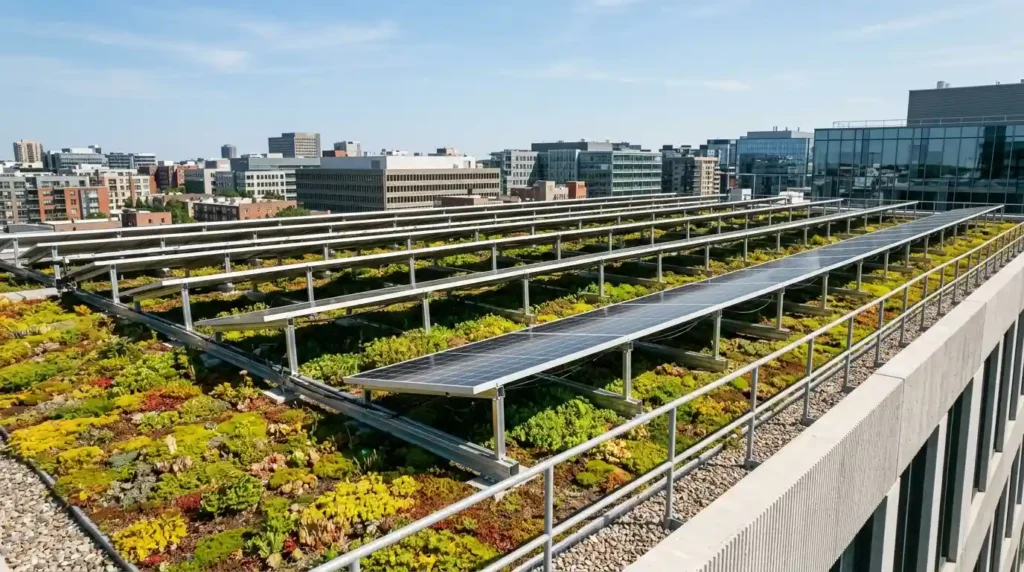
Biosolar roofs put PV panels above vegetation. Panels lose efficiency as they heat up, and the cooler surface beneath a green roof lifts output by a few percent compared with bare membrane.
The vegetation doubles as ballast, which can reduce the need for fixings that penetrate the waterproofing. GRO published a dedicated Biosolar Best Practice Design Guide in 2024 covering how the two systems should be designed together.
Reduces noise
Substrate absorbs sound and the added mass cuts transmission. Genuinely useful under a flight path or beside a busy road. Marginal anywhere else.
In short, a green roof:
- Slows and reduces rainwater run-off
- Extends the life of the waterproofing beneath it
- Keeps the space below cooler in summer
- Creates habitat for insects and birds
- Lowers surface temperatures locally
- Lifts solar panel efficiency on biosolar systems
- Dampens noise
Types of green roof
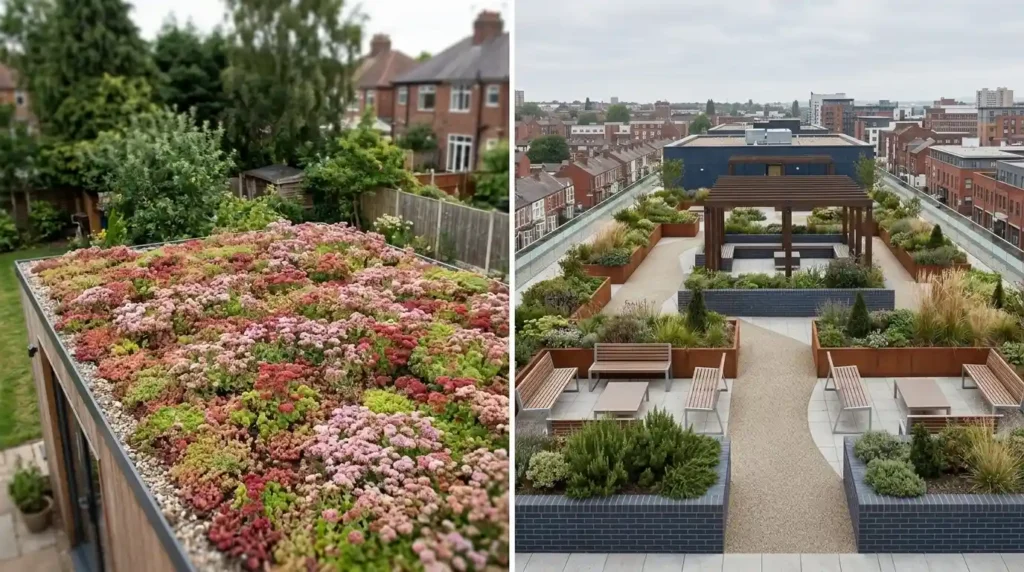
| Type | Substrate depth | Saturated weight | Cost per m² | Maintenance |
| Extensive (sedum, moss) | 50 – 150mm | 60 – 150 kg/m² | £50 – £130 | 1–2 visits a year |
| Semi-intensive | 100 – 200mm | 120 – 200 kg/m² | £80 – £180 | 2–4 visits a year |
| Intensive (roof garden) | 200mm+ | 200 – 500 kg/m² | £120 – £300 | Ongoing, like any garden |
| Biodiverse / brown roof | Varied by design | 60 – 180 kg/m² | £70 – £180 | 1–2 visits a year |
| Blue-green roof | Varies, plus storage | Higher again | £160 – £350 | Specialist |
Nearly all domestic green roofs in the UK are extensive sedum systems. Lightest, cheapest, and much the least demanding to look after.
What a green roof won’t do
Worth being straight about, because this subject attracts a lot of enthusiastic marketing.
It won’t fix a roof that already leaks. It makes a leak considerably harder to trace, because you can no longer see the membrane. Any existing roof needs its waterproofing sorted, tested and signed off before a single tray of sedum goes near it.
It won’t replace insulation. The winter thermal gain is modest. Insulation is what reduces heat loss.
It isn’t maintenance-free. Low maintenance, yes. None, no. Drainage outlets in particular need clearing, and a blocked outlet on a flat roof is a real problem rather than a cosmetic one.
It won’t sit happily on a steep pitch. Past roughly 20 degrees you need extra measures to stop the substrate and vegetation slipping, which adds cost and complexity.
It probably won’t pay for itself. People fit green roofs for drainage, biodiversity, planning conditions, roof longevity, and because they’d rather look at plants than at grey membrane. A straightforward financial return isn’t usually on the list.
All of which raises a question that ought to come first and almost never does.
Can your roof take one? The structural question
Most people researching green roofs start with plants. Start with load instead.
An extensive sedum system weighs 60 to 150 kg/m² fully saturated. An intensive roof garden runs 200 to 500 kg/m².
For context: a typical flat roof is designed for an imposed load of around 0.6 kN/m², or roughly 60 kg/m². Even the lightest green roof system therefore sits at or beyond what many existing decks were designed to carry, before you add snow or the weight of anyone walking on it.
None of which means it can’t be done. It means a structural engineer assesses the roof before anything gets specified. On a new extension or garden room that’s simple, because the structure is designed for the load from the start. On a retrofit it may mean strengthening, and occasionally the honest answer is no.
Anyone who quotes you for a green roof without asking about the structure isn’t the person to use.
Green roofs on UK homes: extensions, garages and garden rooms
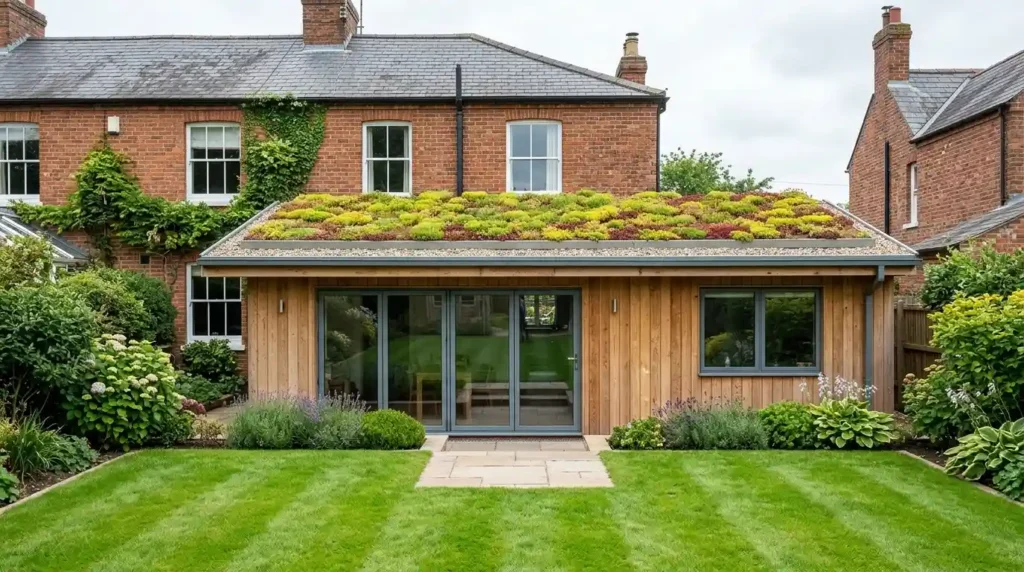
Almost everything written on this subject is aimed at commercial development. For UK homeowners the reality is smaller and a good deal more practical.
The usual candidates are flat-roof extensions, garages, garden rooms, porches, bin stores and bike stores. A sedum blanket over a garden room is comfortably the most common domestic green roof in Britain, and it’s a sensible way in: light, cheap, low risk, and visible from the house so you actually enjoy it.
The biggest saving available is timing. Designing a green roof into a new extension costs far less than retrofitting one, because the structure, the falls, the drainage outlets and the edge upstands are all sized properly from the outset. Retrofit means working around decisions taken for a different roof.
If an extension is already on your plans, that’s the moment to decide.
Planning permission and Building Regulations
When you need planning permission
Most green roof retrofits fall under permitted development, governed by the General Permitted Development Order 2015. Permission is usually needed for a listed building, in a conservation area, or where the work meaningfully changes the building’s height or appearance.
The height point catches people out. Adding 150mm of build-up can push a roof past a permitted development limit, particularly on an extension already sitting close to it. Check before you commit to anything.
What Building Regulations cover
Three things:
- Structure — can the roof carry the saturated load
- Fire — the system must meet current fire performance requirements
- Drainage — outlets, falls and overflow provision, sized for the build-up
Re-covering like for like rarely needs approval. Adding a green roof usually does, because the loading changes.
The GRO Green Roof Code
The Green Roof Organisation publishes the GRO Green Roof Code, which is the UK industry reference for green roof design and installation. The current version dates from June 2023 and covers blue roofs and biosolar applications alongside conventional green roofs, with guidance on structure, waterproofing, wind uplift, fire and long-term maintenance.
If a contractor hasn’t heard of it, that tells you something worth knowing.
Green roofs and Biodiversity Net Gain
For self-builders and small developers, green roofs picked up a second purpose when Biodiversity Net Gain became mandatory in England: contributing towards the 10% gain a development has to demonstrate.
A green roof can generate habitat units under the DEFRA metric, but how many depends enormously on specification. A thin monoculture sedum mat scores poorly. A properly designed biodiverse roof, with varied substrate depths and native planting, scores considerably better. If BNG is the reason you’re looking at one, that distinction is the entire point.
The rules are still developing, with further changes taking effect from November 2026. Check the current position on GOV.UK before relying on any of it in an application.
Maintenance: what’s actually involved
An extensive sedum roof needs one or two visits a year:
- Clear drainage outlets, gutters and gravel margins
- Pull tree seedlings and unwanted weeds before they root properly
- Check edge details, flashings and upstands
- Feed once a year with a slow-release fertiliser
- Water through the first summer while the vegetation establishes, then during any prolonged drought
Intensive roofs are gardens, and want looking after like gardens.
Get the waterproofing and drainage right and the system will comfortably see out thirty years or more. The vegetation handles its own renewal.
Is a green roof worth it?
Yes, if you have a flat-roof extension, garage or garden room; you’re building new and can design it in; you’re dealing with a drainage constraint or a planning condition; you want habitat; or you’d simply rather look at plants than at membrane.
Think harder if the existing roof is at all suspect, the structure is marginal and strengthening is costly, the pitch is steep, or your main aim is a lower heating bill — in which case insulation is the better purchase.
Talking to a builder in Nottingham
Buon Construction builds the part of a green roof that has to be right before anything grows on it: structure, deck, falls and drainage, and the waterproofing beneath the system, on extensions, garages and garden rooms across Nottingham and Nottinghamshire. For the planting build-up itself we work alongside green roof specialists.
If you’re weighing one up for an extension or outbuilding, get in touch and we’ll tell you honestly whether the structure will take it. There’s more on the full range of what we do as well.
Frequently asked questions
Do green roofs leak?
Not because of the vegetation. Leaks come from the waterproofing underneath, which is why it has to be installed correctly and tested before the green roof goes on. The genuine drawback is that a leak becomes much harder to locate once the membrane is covered.
Do green roofs need planning permission in the UK?
Usually not. Most retrofits fall under permitted development. Permission is needed for listed buildings, in conservation areas, or where the work changes the building’s height or appearance significantly. The added build-up depth is the detail that most often pushes a project over a permitted development limit.
How much weight does a green roof add?
An extensive sedum roof adds 60 to 150 kg per square metre when saturated. Intensive roof gardens add 200 to 500 kg per square metre. Since many existing flat roofs are designed for around 60 kg/m² of imposed load, a structural assessment comes before anything else.
Can you put a green roof on a shed or garage?
Yes, and it’s one of the most common domestic applications in Britain. The structure needs checking first, because a standard shed roof will not carry a saturated sedum system without strengthening. Garages and garden rooms with a proper timber deck are usually more straightforward.
Are green roofs worth it?
They’re worth it for drainage, habitat, roof longevity, summer comfort and planning compliance. They’re rarely worth it as a financial investment, and they’re not a substitute for insulation. Whether that adds up depends on why you want one.
How long does a green roof last?
Thirty years or more where the waterproofing and drainage are properly specified. The vegetation regenerates itself. The membrane underneath is the limiting factor, and it generally lasts longer under a green roof than it would exposed.
What’s the difference between a sedum roof and a green roof?
A sedum roof is one type of green roof. “Green roof” covers everything from a thin sedum blanket through to a full roof garden. Sedum systems are the lightest and cheapest, which is why they dominate domestic installations.
Do green roofs need watering?
Through the first summer while the plants establish, and during extended dry spells afterwards. Sedum is drought-tolerant once settled. Wildflower and intensive systems need more, and larger roofs sometimes justify an irrigation system.
Can you put solar panels on a green roof?
Yes. Biosolar roofs combine the two, and the cooler surface beneath the panels lifts their output slightly. The vegetation can also act as ballast, reducing the need for fixings that penetrate the membrane. GRO published a Biosolar Best Practice Design Guide in 2024 covering how the two should work together.
What roof pitch can a green roof go on?
Flat and shallow-pitched roofs are the straightforward cases. Above roughly 20 degrees you need extra measures to stop the substrate and vegetation slipping, which adds both cost and specification complexity.
