
Last updated: February 2026 | Written by the team at Buon Construction, Nottingham
Our credentials: 15+ years building porches across Nottingham | SafeContractor Approved | Part P & Part L Certified Team
Legal Note (Read Before You Build)
This guide is general information, not legal advice. Planning rules can change, and councils can apply them differently even within the same city. Always verify your exact address constraints with Nottingham City Council’s planning department before spending money on materials or contractors.
The information below reflects the rules as of February 2026, including the current £548 planning application fee and the 10-year enforcement rule that came into effect in 2024.
Table of Contents
Quick Answer: Do I Need Planning Permission for a Porch in England?
In England, you usually do not need planning permission for a porch if:
- Your property is a house (not a flat or maisonette)
- The porch meets the 3-3-2 rule (explained below)
- Your permitted development rights have not been removed by an Article 4 Direction, planning conditions, or listed building controls
If you fail any one of those tests, planning permission becomes likely.
For those specifically asking “Do I need planning permission for a porch in Nottingham?, the answer depends on your street’s planning history and whether your address appears on the Nottingham Article 4 list (covered in detail below).
The 5-Minute Compliance Check (Do This Before You Spend Money)
Use this checklist to get a quick yes/no answer:
Quick Check Before You Commit Money:
- Is your property a house (not a flat or maisonette)?
- Will the porch be 3.0m² or less using external wall dimensions?
- Will it be 3.0m high or less from ground to the highest point?
- Will every part be more than 2.0m from any boundary that fronts a highway (road, pavement, or footpath)?
- Have you checked listed status, conservation area boundary, and any Article 4 Direction for your exact address?
If every box is YES: It’s likely permitted development under Class D, but keep reading because Building Regulations, restrictive covenants, and Party Wall rules can still apply.
If any box is NO or you’re unsure: Planning advice is likely needed before you build.
Next Steps If You Failed a Check:
- Do a map check for your exact address (listed status, conservation boundary, Article 4 coverage) using the Nottingham City Council planning portal
- Get a measured sketch plan showing external footprint, height, and distance to the highway boundary
- If still unclear, book pre-application advice before you order frames, bricks, or doors
Buon Construction Deal: Book a “Ready-to-Build” Site Survey, and we’ll provide a digital footprint measurement for your Nottingham home to ensure your design hits the 3-3-2 rule perfectly before you spend a penny on materials. Contact us for a free quote.
What Counts as a Porch for Planning Purposes?
A porch is a small structure built outside an external door, usually at ground level. It can be:
- Enclosed (with walls, a door, and a roof) – creating a lobby space
- Partly open (with a dwarf wall and open sides)
- A canopy (roof projection with minimal or no enclosure)
Planning rules care less about what you call it and more about what you’re building in physical terms:
- External footprint (measured to the outside face of walls)
- Height (ground level to highest point)
- Distance to boundaries that front a highway
- Visual impact in sensitive conservation or heritage areas
Is a Canopy Porch Treated the Same as an Enclosed Porch?
Not always.
A canopy is often easier to keep within the 3.0m² footprint limit and can avoid some edge cases that enclosed porches trigger. However, the 2.0m highway boundary rule can still catch you if your front garden is shallow.
An enclosed porch is the classic UK type: brick or uPVC walls (often a dwarf wall plus glazing above), a door, a pitched or flat roof, and a small internal floor area that acts as an airlock. This is the type most likely to trigger planning edge cases and building regulation issues because the external footprint adds up quickly once you account for wall thickness.
Professional Tip: If you’re trying to stay inside permitted development, design around compliance first and aesthetics second. If the measurements fail, the design won’t rescue it.
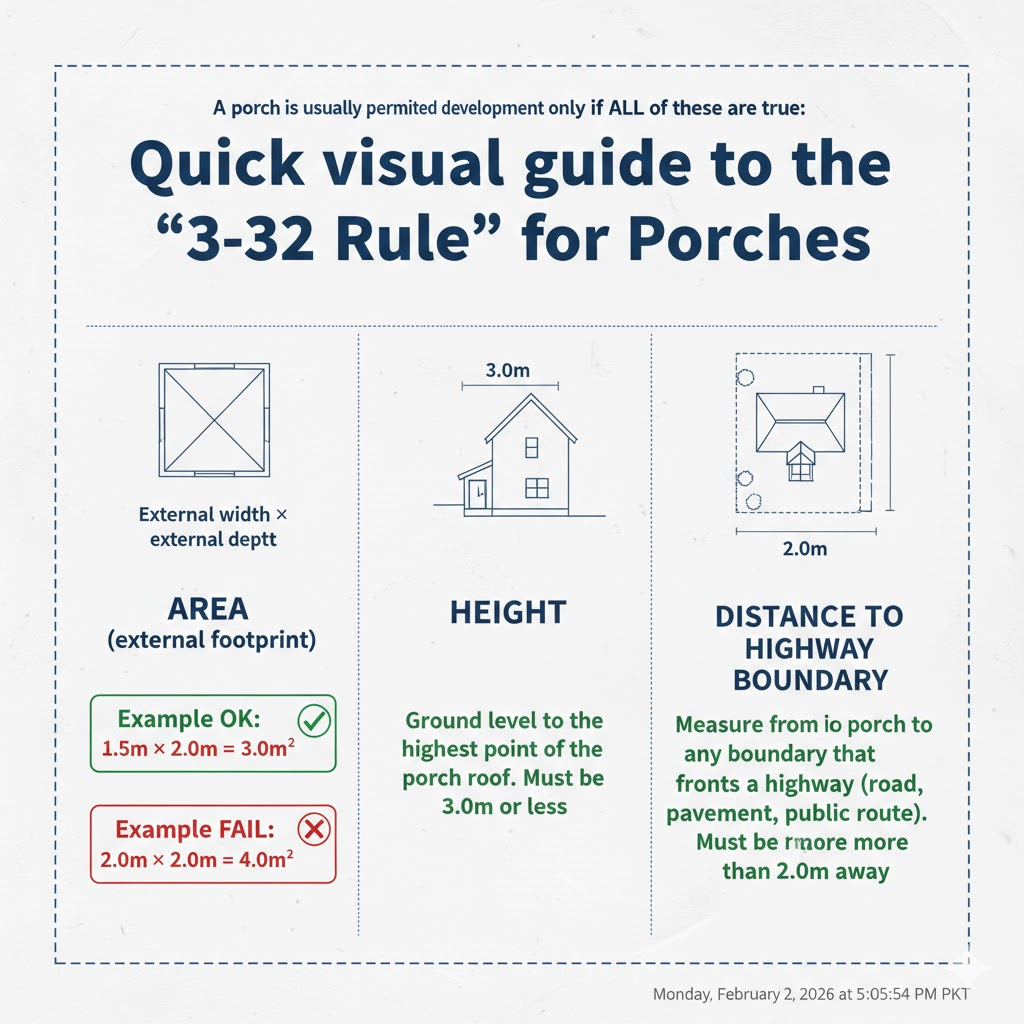
What Is the 3-3-2 Rule for Porches? (3m², 3m High, 2m from Highway Boundary)
The “3-3-2 rule” is shorthand that homeowners and builders use for the permitted development limits that keep most porches out of the planning system.
To build a porch under permitted development rights in England, your porch must meet three quantitative thresholds:
1. External Ground Area Is 3.0 Square Metres or Lless. This is the footprint measured to the outside face of the walls, not the internal floor space.
Real measurement examples:
- 1.5m × 2.0m = 3.0m² (This can fit the area limit if the shape is simple)
- 2.0m × 2.0m = 4.0m²(This fails the area limit)
The trap that catches people: A porch that feels small inside can still fail the 3.0m² rule because thick brick walls, deep piers, or chunky reveals increase the external footprint significantly.
2. Maximum Height Is 3.0 Metres or Less
Measured from ground level to the highest point of the roof (ridge for a pitched roof, parapet for a flat roof).
3. No Part of the Porch Is Within 2.0 Metres of a Boundary That Fronts a Highway
The highway includes pavements, roads, and public footpaths. This is the rule that catches front gardens and corner plots.
Critical detail: This is about the boundary of your property where it fronts a road, pavement, or public footpath – not the kerb line. Many pavements sit on private land, which means your boundary could be closer to your house than you think.
Corner plot warning: If your property sits on a corner, treat both street-facing sides as “fronts.” The 2.0m rule applies to any highway boundary.
Additional Requirements (Often Overlooked):
- The property is a house. Flats and maisonettes normally do not benefit from these porch permitted development rights under Class D
- Your permitted development rights have not been removed or restricted – This can happen through local controls such as certain Article 4 Directions, planning conditions attached to previous approvals, or heritage constraints such as listed building designation
Professional Tip: Mark the proposed footprint on the ground with spray chalk or tape, then measure the outside dimensions with a tape measure or laser measure. Do it before you order frames, bricks, or roofing. A laser measure costs £20 and eliminates the classic “we measured inside” mistake.
Why Most Nottingham Porches Fail: Foundations & Clay Soil
A porch may be small, but in Nottingham, our expansive clay soils mean it still needs “Master Builder” groundworks. Many DIY porches crack within three years because they skip these two steps:
- Foundation Depth: While a porch is light, it must be deep enough to avoid seasonal “heave.” In clay-heavy areas of Nottingham, foundations should typically be at least 1.0m deep, or more if near trees.
- The Junction Detail: The most common cause of damp is a poor junction where the porch meets the house. We always specify a proper expansion joint and a damp-proof course (DPC) tie-in to prevent water ingress.
How Big Can a Porch Be Without Planning in 2026?
To remain lawful without an application, the footprint is measured externally, not the internal floor space.
If you’re wondering, “Does a porch count as an extension for my allowance?”, the answer is typically no. Porches are governed by Class D of the Town and Country Planning (General Permitted Development) Order, which is separate from your general extension rights under Class A. This means building a 3m² porch doesn’t “use up” your extension allowance.
However, if you’re asking “Can I build a porch on a flat or maisonette?”, be aware that these properties rarely benefit from the same “automatic” rights as a dwellinghouse. Flats typically require planning permission for any external structure.
What Counts as a “Principal Elevation” in Planning Law?
The principal elevation is usually the side of the house that faces the main road or primary street.
People often ask, “Can I build a porch on my back door?”
Yes, technically, Class D applies to any external door. However, a rear porch is much more likely to stay clear of the 2.0m highway boundary rule that catches front gardens, which makes it easier to build without permission in most cases.
A Clear Decision Tree: Do You Need Planning Permission?
Use this as your first-pass decision tool:
Step 1: Property Type Check
Is your home a flat or a maisonette?
- YES: Permitted development porch rights usually do not apply. Expect to need planning.
- NO (it’s a house): Continue to Step 2.
Step 2: Measurement Check
Does the porch pass all three measurements?
- 3.0m² or less (external footprint)
- 3.0m high or less
- More than 2.0m from any highway boundary
NO to any: You need planning permission.
YES to all: Continue to Step 3.
Step 3: Local Restriction Check
STOP POINT: If you cannot confidently answer the Article 4, listed building, or conservation boundary question for your exact address, pause the project and use pre-application advice before spending on frames, bricks, or doors.
Even if it passes the 3-3-2 rule, you may still need planning if:
- Your permitted development rights are restricted by an Article 4 Direction
- Your home is listed
- You’re in a conservation area where alterations are more tightly controlled
- Your estate has design codes or restrictive covenants that restrict front alterations
Step 4: Proof Check
If you’re selling soon or you want clean paperwork, consider getting a Lawful Development Certificate (LDC) even when planning is not required. This costs £548 as of February 2026 and provides written proof that the work is lawful.
Professional Tip: Paperwork confidence matters more than people expect. Many buyer-seller disputes aren’t about whether the porch is nice – they’re about whether it’s provably lawful. An LDC removes all doubt.
Conveyancing Proof: Don’t Let Your Porch Kill Your House Sale
In 2026, solicitors and mortgage lenders are more aggressive about “unauthorised structures.” When you eventually sell your home, the buyer’s solicitor will ask for your “Evidence Kit.” > Your Future-Proof Kit should include:
- LDC or Planning Approval: Written proof that it was lawful when built.
- Part P Electrical Certificate: For any lighting or sockets added.
- FENSA/Certass Certificate: For the glazing and door set.
- Photo Log: Photos of the open foundations and DPC before they were covered up.
Pros & Cons of Porch Installation in the UK
Pros of Porch Installation UK
- Improved security: A second door layer with high-performance composite doors makes forced entry much harder
- Energy-efficient airlock: Reduces draughts and heat loss at the main entrance
- Essential storage: Space for coats, shoes, bags, and deliveries
- Weather protection: Keeps rain and wind away from your front door
- Adds kerb appeal: A well-designed porch can increase property value in the Midlands market
Cons of Porch Installation UK
- Potential reduction in natural light: Enclosed porches can darken hallways
- Risk of the 10-year planning enforcement rule – If measurements are off and someone complains, the council can take action for up to 10 years\
- Cost: A quality brick porch typically costs £6,000–£12,000 in Nottingham in 2026
- Neighbour relations: Poor execution or lack of communication can cause disputes
What to Do:
- If your property is on a corner plot, treat both street-facing sides as “fronts” to avoid the 2.0m highway boundary rule
- Communicate with neighbours before starting work, especially on terraced streets
- Get professional measurements to avoid costly mistakes
What Not to Do:
- Don’t guess the boundary line – many pavements sit on private land, triggering the need for permission if you build within 2 metres
- Don’t remove the internal door if you want the porch to remain exempt from full Building Regulations approval
- Don’t skip Party Wall notices if you’re excavating near a boundary
Nottingham Address Checks That Actually Matter (Article 4, Conservation Areas, Listed Status)
Nottingham is not one uniform rule zone. Two houses that look identical can sit under different constraints because the map layers change from street to street.
Article 4 Direction in Nottingham
An Article 4 Direction is a local planning tool that can remove specific permitted development rights for defined areas or even specific properties.
In Nottingham, some Article 4 Directions are aimed at controlling “minor works” in sensitive locations, which can include:
- Changes to the frontage
- Window and door replacements
- Small extensions and porches
Key point: Article 4 is not one single citywide rule. Each Direction is specific about what it removes and where it applies.
What are the Article 4 areas in Nottingham for 2026?
Common Article 4 zones in Nottingham include:
- The Park Estate
- Mapperley Park and Alexandra Park
- The Arboretum area
- Lace Market
- Other designated conservation and character areas
However, these can change. The only reliable answer is an address-level map check using the Nottingham City Council planning portal.
Conservation Areas and Why People Get Confused
Being in a conservation area does not automatically mean “you cannot build a porch.”
It does mean the council will care more about:
- Design quality
- Materials that match the street scene
- How the change affects the character of the area
In some conservation locations, Article 4 Directions may remove minor works rights that would otherwise apply. That’s why you must check the map for your exact address, not just your neighbourhood name.
How to Check Your Address Properly in Nottingham (No Guessing)
Step 1: Check if the property is listed (search the National Heritage List for England or Nottingham planning portal)
Step 2: Check if the property sits inside a conservation area boundary (use the Nottingham planning map viewer)
Step 3: Check if an Article 4 Direction applies to your property or street, and what it removes (planning portal or pre-app)
Step 4: If you live on a modern estate, check the title deeds for restrictive covenants or design code conditions that control front alterations
Step 5: If any of the above is unclear, use pre-application advice or the Minor Works enquiry route before you design
Nottingham: Examples of Places Where These Checks Commonly Matter
Areas where frontage changes often face additional scrutiny:
- The Park Estate (strong design code expectations)
- The Arboretum area (conservation area status)
- Mapperley Park and Alexandra Park (Article 4 and conservation overlap)
- Lace Market (listed buildings and conservation)
- Modern estates with active developers or management companies
Professional Tip: Aim for an address-level answer. A porch decision is made on map boundaries, not on “city vibes.”
For visual benchmarks only: If you want to sanity-check what tends to look proportionate on Nottingham housing stock, use local project examples from a Nottingham contractor such as Buon Construction. Treat it as a visual benchmark only – it does not replace address-level checks for Article 4 coverage, conservation boundaries, or listed status.
Design Fit: Matching Your Nottingham Neighbourhood
To add real value, your porch shouldn’t look like an “add-on box.” Here is what works for our local housing stock:
- Victorian Terraces (e.g., Sneinton/The Meadows): Keep it slim. Use reclaimed-style bricks and a pitched slate roof. A common mistake here is building too deep and blocking the natural light of the neighbouring bay window.
- 1930s Semis (e.g., Wollaton/West Bridgford): These often had “recessed” porches originally. An enclosed porch works best when you match the herringbone brickwork or use a curved roof form that mirrors the original 1930s lines.
- Modern Estates (e.g., Edwalton): Focus on the Design Code. Use anthracite grey frames or composite cladding that matches the developer’s original palette to avoid covenant disputes.
Pre-Application Advice in Nottingham (When It’s Worth It, What It Costs, How Long It Takes)
Pre-application advice is a paid service where the council gives written planning guidance before you submit a formal application. It’s not a legal guarantee, but it’s often enough to stop you designing something that’s likely to be refused.
When It’s Worth Paying For:
- Your porch is close to the 3.0m² limit or close to the 2.0m highway boundary limit
- Your property is in or near a conservation area
- You suspect an Article 4 Direction applies
- Your street has a strong, uniform “street scene,” and your porch will be very visible
- You need written comfort before spending on bespoke frames or matching bricks
Typical Response Times in Nottingham:
- Smaller pre-applications: Typically answered in about 4 weeks
- Larger or more complex queries: Often around 5 weeks
- Backlogs can extend this, especially during busy periods
What to Submit So You Get a Useful Answer:
- Frontage photos taken from the street
- A simple plan showing external dimensions, height, and distance to the highway boundary
- Roof form and materials
- A short statement of why you want it (draught reduction, security, storage, accessibility)
- If relevant, notes on how you’ll match brick tone, mortar colour, and glazing style to the existing house
Professional Tip: Pre-app is cheap compared to redesign after refusal, or building something that later becomes an enforcement problem. The fee is typically £100–£200 for a simple porch query as of 2026.
If Planning Permission Is Needed: Timeframes, Refusal Risk, and Appeals
Typical Planning Timeframe for Householder Applications:
Householder planning decisions are commonly targeted within 8 weeks from validation, unless the council agrees to an extension or the case is unusually complex.
The practical reality is that validation delays, design revisions, and consultation issues can stretch the overall calendar. Budget 10–12 weeks from submission to decision in practice.
Application Fee (2026):
The current fee for a householder planning application in England is £548 (as of February 2026).
If Your Application Is Refused:
You can appeal, but the appeal has strict time limits:
- Householder appeals are typically subject to a 12-week deadline from the decision date
- Do not sit on a refusal for months while you decide what to do – the window closes fast
Why Porches Get Refused in the Real World:
It’s usually not because “porches are banned.” Refusals typically happen because:
- The design harms the street scene or character of a conservation area
- Materials clash with the host building (wrong brick bond, mortar colour, or roof tiles)
- The porch blocks important architectural details (original door surround, decorative stonework)
- It creates awkward relationships with neighbours, access, or parking
- The size or scale is out of proportion with the house
Professional Tip: If you’re in a sensitive Nottingham location, a simple, well-proportioned porch that looks like it belongs is easier to approve than a clever modern statement piece that ignores the existing house style.
Conservation Areas and Listed Buildings: Where Porches Get Serious Fast
Conservation Areas:
Some permitted development rights are more limited in conservation areas for certain types of work, but porch lawfulness still depends on what applies to your exact address and whether an Article 4 Direction removes the relevant rights.
Conservation area status does not automatically remove every permitted development right, but it does:
- Raise the bar on design quality and materials
- Increase scrutiny on how the porch affects the street scene
- Sometimes trigger additional Article 4 controls
What matters: The exact restriction map for your address, including whether any Article 4 Direction applies and what it removes.
Listed Buildings:
If your property is listed, assume you need Listed Building Consent for changes to the exterior and possibly internal changes connected to the entrance.
Porches on listed buildings can be very sensitive because they change the character of the principal entrance, one of the most important heritage features of the property.
Even small porches can be refused if they:
- Obscure original features
- Use inappropriate materials
- Alter the building’s symmetry or proportions
Materials in Heritage Areas, Including uPVC:
uPVC can be acceptable in some contexts, but can also be rejected where it harms the character of the area.
The safe way to approach it is to treat material choice as a planning risk decision, not just a maintenance decision.
In conservation areas:
- Timber is often preferred for traditional properties
- Brick tone, mortar colour, and glazing pattern matter enormously
- Roof form should align with the existing building
Professional Tip: In heritage-sensitive streets, brick tone, mortar colour, roof form, and glazing pattern often matter more than fancy finishes. Get samples, hold them against the existing brickwork, and photograph them in natural light before ordering.
Party Wall Act for Porches (England and Wales)
The Party Wall etc. Act 1996 is a separate legal framework from planning permission. It applies when you build on or near a boundary shared with a neighbour.
When Notices Are Commonly Needed for Porches:
Building on or near a boundary where the work affects a party wall or party fence wall
Excavating close to a neighbouring building for foundations, especially if you’re going deeper than the neighbour’s foundations
The 3 Metre and 6 Metre Excavation Concept (Practical Version):
- 3 metres: Excavation within 3 metres of a neighbouring structure can trigger a notice where you’re going deeper than the neighbour’s foundation level
- 6 metres: Excavation within 6 metres can trigger a notice where a deeper excavation could intersect a sloping line from the neighbour’s foundations (often described as a 45° test)
Typical Costs and Notice Timing (Practical Guide):
For a straightforward porch:
- Surveyor fees: Often in the £700 to £1,500 range when the process becomes surveyor-led
- Notice period: Often 1 to 2 months before work can legally start, depending on the notice type and whether there’s a dispute
Treat these as planning assumptions, then confirm for your exact job.
Professional Tip: Do not pour foundations until you’ve checked Party Wall requirements. Fixing it after the fact is how neighbour relations collapse and how projects get stop notices.
Restrictive Covenants and Title Deed Restrictions
Planning permission is public law. Covenants are private law, and they can still stop you even if planning is fine.
How to Check:
- Review your title register and title plan (available from Land Registry)
- Look for clauses restricting:
- Additions to the front elevation
- Changes to the appearance of the property
- Extensions without consent from a named party or management company
- Modern estates often include developer covenants and design codes that survive long after the estate is built out
Can You Insure Against Covenant Breach?
Sometimes, indemnity insurance is used for covenant risk, but it has conditions:
- It doesn’t fix defects or guarantee neighbour consent
- It typically only covers financial loss if someone enforces the covenant
- It may not be available if the beneficiary is identifiable and active
Professional Tip: If the covenant beneficiary is identifiable and active (e.g., an estate management company), insurance may not help. The best option is often seeking consent before building.
Building Regulations: The Rules That Can Bite Even When Planning Is Not Needed
Planning permission and Building Regulations are separate systems.
Even when Building Regulations approval is not required for a porch, the work must still be carried out in a way that complies with the relevant technical standards. “Exempt from approval” is not the same as “anything goes.”
When Are Porches Often Exempt from Building Regulations Approval?
A porch is often exempt when ALL of these are true:
- Ground-level porch (not raised significantly above ground)
- Internal floor area under 30 square metres (virtually all porches meet this)
- The existing external-quality door between the house and the porch stays in place (this is the critical one)
- Disabled access to the dwelling is not made worse
Why Keeping the Internal Door Matters:
Keeping the internal door usually keeps the porch outside the heated envelope of the home.
If you remove the internal door, the porch can become part of the dwelling, which increases the chance that energy performance, ventilation, and fire safety requirements apply more like a small extension.
Fire Safety Note:
If the porch changes how you exit the home, affects the front door arrangement, or creates a tighter escape route, treat it as a fire safety issue as well as a building control issue.
This matters more for:
- HMOs (Houses in Multiple Occupation)
- Conversions
- Any home where the entrance is part of the main escape path
Does a porch affect my HMO license in Nottingham?
If you operate an HMO, changing the entrance configuration (including adding a porch) can trigger a license review. Notify Nottingham City Council’s HMO team before starting work.
EPC Reality Check:
A porch can improve comfort by cutting draughts, but most porches make only a small difference to the headline EPC rating.
Treat EPC impact as a bonus, not the business case.
If you want the most common compliance failure point, read the “Electrical Work and Lighting” section below – missing certificates are a frequent deal blocker during sales.
Accessibility Beyond the Basics: Designing for Real Life
Even if full accessibility standards are not legally triggered, good porch design improves future-proofing and daily usability.
Design Features That Help:
- Step-free thresholds where possible (or very low threshold with clear contrast)
- Adequate clear opening width for doors (minimum 775mm clear width is a good target)
- Space to manoeuvre with bags, prams, wheelchairs, or mobility aids
- Lever handles instead of knobs
- Lighting that’s easy to operate and automatic at night (PIR sensor or dusk-to-dawn)
Professional Tip: A porch is the first and last space you use every day. A badly placed step or narrow opening becomes a daily annoyance for years.
Energy Performance and Part L: When Porches Affect Insulation Rules
If the porch remains thermally separated by the internal door, energy compliance demands are usually lighter.
If you remove the internal door or otherwise make the porch part of the heated home, you’re changing the thermal boundary. That’s when insulation standards, thermal bridging, and ventilation expectations become more important.
How a Porch Affects EPC in Practice:
A well-designed porch that reduces draughts can improve comfort and can have a positive effect on perceived performance.
If poorly designed and leaky, it can do the opposite – creating cold spots, condensation, and higher heating bills.
What is the 50% Rule in Part L Building Regulations?
When you extend or alter a building, Part L (Conservation of Fuel and Power) requires that:
- New thermal elements (walls, roofs, floors) meet minimum U-value standards
- If you’re replacing more than 50% of a thermal element, the entire element may need upgrading to current standards
For porches, this typically only becomes an issue if you’re removing the inner door and making the porch part of the heated space.
Professional Tip: The junction where the porch meets the house is where heat loss and condensation problems begin. Detail it properly with insulation continuity and a proper damp-proof course tie-in.
Heating in a Porch: What’s Allowed and What Creates Problems
You can heat a porch, but how you do it matters.
Lower-Risk Approach:
Independent electric heating (panel heater, infrared panel, or electric underfloor mat) with local control
Used occasionally for comfort, not to maintain constant warmth
Higher-Risk Approach:
Extending the main central heating system into the porch, especially if the inner door is removed
Treating the porch as a heated room
Why This Matters:
Heating ties into whether the porch becomes part of the home’s heated envelope. That can change:
- Building control expectations
- Insulation requirements
- Condensation risk
Can I put a radiator in a porch without building regs?
If the porch is unheated and separated by the internal door, adding a small electric heater is typically fine. If you’re extending wet central heating into the porch, you’re effectively making it part of the dwelling, which can trigger full Building Regulations compliance.
Professional Tip: Don’t decide on heating after plastering. Heating decisions affect design, wiring, insulation detailing, and compliance checks.
Electrical Work and Lighting: When You Need a Professional
Porches often need:
- Lighting (internal and external)
- Doorbell relocation
- A socket for vacuum, phone charging, or seasonal lights
- Video doorbell or CCTV power supply
If you’re adding circuits or doing notifiable work under Part P of the Building Regulations, you want certification by a competent electrician.
Missing electrical paperwork is a common sales blocker.
What “Competent Person Scheme” Means (Why It Matters):
Some installers can self-certify certain types of electrical work under recognised schemes (NICEIC, NAPIT, or similar).
In practical terms, this reduces delays and paperwork gaps because you get the correct compliance certificate without separately booking Building Control to inspect that element.
If your contractor cannot provide certification, treat that as a cost and a risk you must plan for.
Certification Requirements:
Do I need an electrician for porch lighting?
If you’re adding new circuits or extending existing ones, yes – and they must be Part P compliant. Simple light fitting replacements on existing circuits typically don’t require notification, but adding new circuits does.
Keep electrical certificates indefinitely and pass them to the next owner. They matter more during resale than the brand of light fitting you chose.
Professional Tip: Make “certificates handed over” a condition of final payment. Don’t release the retention until you have the paperwork.
Safety Glass and Security Glazing: Don’t Confuse Them
Safety glass protects against injury on impact.
Security glazing slows forced entry.
These are not always the same.
Do Porch Windows Have to Be Safety Glass?
In vulnerable positions – near doors, at low level, or where people could fall into glass – safety glass is typically expected under Building Regulations.
Options include:
- Toughened glass (shatters into small, blunt pieces)
- Laminated glass (holds together after impact and is better for security)
If security is a goal, laminated glass is often a better choice than toughened aglass lone because it holds together after impact, making forced entry much harder.
Professional Tip: State your intent in the spec. If the goal is security, specify security performance (BS EN 356 or similar), not just “double glazing.”
Security Design That Actually Reduces Risk
A porch can genuinely improve security if it’s designed as a secure barrier, not just a decorative addition.
High-Impact Security Choices:
- A good door set with robust multi-point locking and correct installation
- Laminated glazing in vulnerable panes (ground floor, accessible locations)
- Well-positioned external lighting, ideally motion-triggered
- Clear sightlines so the porch doesn’t create hiding spots near the door
- Smart doorbell positioning planned before wiring and plastering
Professional Tip: Security is mostly about the door set and installation quality. A weak door in a fancy frame is theatre, not security.
Smart Home Integration Without Ugly Retrofits
Plan this early to avoid surface-mounted cable trunking:
First Fix Planning:
- Power and data routes for a video doorbell (USB or low-voltage wiring)
- Cable routes for future cameras or external sensors
- A safe socket position if needed for charging, seasonal lights, or EV charging cables
- Sensor locations for lighting (ceiling-mounted PIR or external dusk sensor)
Can AI help me check my porch plans for code compliance?
Emerging AI tools can flag obvious compliance issues (measurements, setbacks, material conflicts), but they’re not a substitute for professional design or council approval. Use them as a first-pass sanity check, not as legal certainty.
Professional Tip: Retrofit wiring usually looks worse and costs more. First-fix planning during construction saves money and delivers a cleaner finish.
Electric Vehicle Charging Preparation
If your consumer unit or cable route runs near the hallway, it may be worth planning a clean future route for EV charging cables while the porch work is open.
Even if you don’t install a charger now, adding a sensible cable path (e.g., a spare conduit from the hallway to the front of the house) can avoid messy surface trunking later.
This is especially relevant if:
- You park on a driveway in front of the porch
- Your electricity meter is near the entrance
- You’re already upgrading the consumer unit for the porch electrics
Biodiversity Note:
If your porch build:
- Removes planting or affects hedges
- Involves roof voids where birds might nest
- Disturbs areas where bats could roost (rare but possible)
This can become a consideration in sensitive locations.
Practical approach:
- Check before work starts
- Time-disruptive work outside nesting periods (typically avoid March to August)
- If bats are suspected, get a survey before disturbing the roof voids
In most urban Nottingham locations, this is not a major issue, but it’s worth a quick check.
Foundations, Damp Proofing, and Why Porches Crack
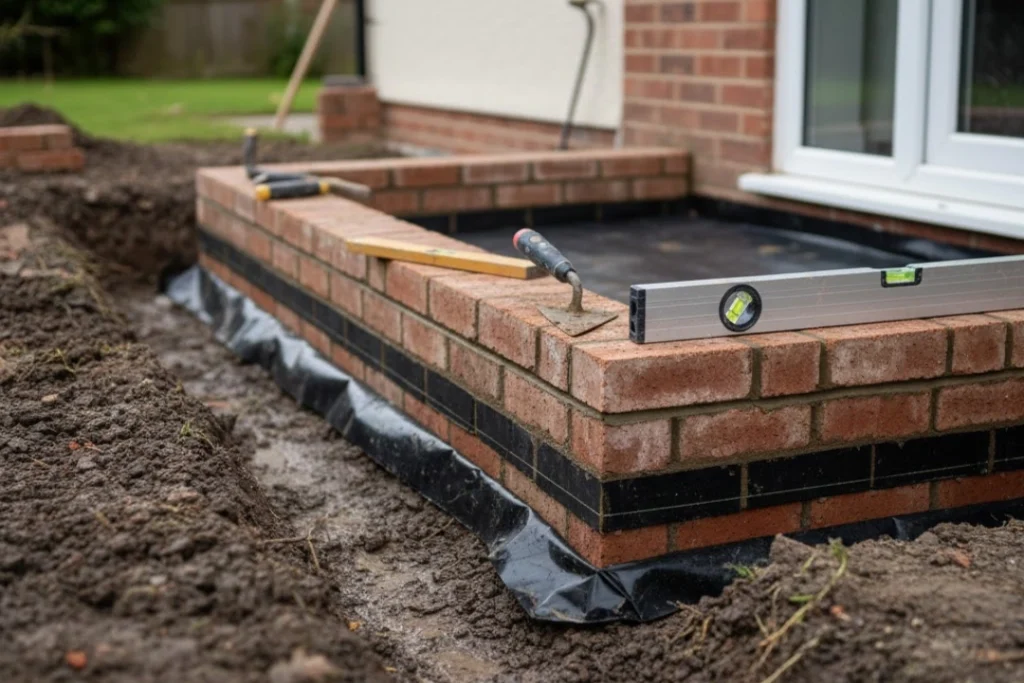
A small porch still needs proper foundations and damp protection.
Common Causes of Cracks and Damp:
- Inadequate foundation depth for the ground conditions
- Poor junction detailing where the porch meets the house
- Bridged damp-proof course due to high paving or render brought too low
- No damp-proof membrane under the floor
- Poor roof drainage that sends water toward the house wall
How Deep Should Porch Foundations Be?
Foundation depth depends on:
- Soil type (clay, sand, rock)
- Proximity to trees (roots and seasonal movement)
- Load from the porch structure
- Local frost line (typically 450mm minimum in the UK)
Typical depth for a small porch: 600mm to 1000mm, but clay soils near mature trees can require deeper or engineered solutions.
Professional Tip: Spend money on groundworks and damp detailing before you spend money on fancy tiles. A leaking porch or cracked walls ruin everything.
Trees, Roots, and Protected Trees in Nottingham
Trees affect foundation depth and ground movement risk, especially in Nottingham’s clay-rich soils.
Risks Near Trees:
Seasonal ground movement in clay soils (heave and shrinkage)
Roots influencing the moisture content near foundations
Restrictions if a tree is protected by a Tree Preservation Order (TPO) or conservation area controls
Practical Approach:
- Identify nearby mature trees early (especially oak, poplar, willow)
- If roots or protected trees are likely to be affected, plan for: Deeper or engineered foundations and possibly specialist structural input
- Check if any trees have TPOs (planning portal or council enquiry)
Professional Tip: A porch that cracks every winter is rarely a “bad bricklayer.” It’s often a ground movement story that starts with inadequate foundation depth near trees.
Drainage, Soakaways, and Surface Water in Nottingham
Porch roofs dump water somewhere. If that water spills onto a neighbour’s land, the highway, or causes flooding, you can trigger disputes and complaints.
Guttering and Discharge:
Ensure the porch roof connects to a suitable drainage route (existing downpipe, new connection to foul/surface water drain, or soakaway)
Check downpipe capacity – don’t overload an existing 68mm downpipe with additional roof area
Avoid discharging onto paths that freeze or create slip hazards
When a Soakaway May Matter:
If you’re adding hardstanding or redirecting water where there’s no suitable connection, a soakaway solution can be needed.
The details depend on:
- The site
- Ground conditions (percolation test)
- What already exists
Flood and Surface Water Note:
Some parts of Nottingham, closer to the Trent and low-lying areas, can be more sensitive to heavy rain and surface water.
If your entrance area already ponds after storms, treat drainage as a core design item, not a finishing detail.
Professional Tip: Water is one of the fastest ways to turn a simple porch into a neighbour dispute. Plan it properly from day one.
Condensation and Ventilation: The Unheated Porch Problem
Unheated porches often get condensation because warm, moist air from the house meets cold surfaces in the porch.
How to Reduce Condensation:
- Keep the inner door and keep it closed in cold weather
- Provide controlled ventilation (trickle vents in windows or a small air brick low down)
- Avoid sealing the porch perfectly without a moisture strategy
- Reduce cold bridges at junctions (insulated cavity closers, insulated lintels)
Why Wet Coats and Shoes Matter:
Storage in a porch adds moisture. Coats, shoes, umbrellas, and wet bags all release moisture into a small space.
Professional Tip: Storage needs ventilation, not just space. A sealed, unheated porch with no airflow becomes a condensation trap.
Acoustic Performance: When a Porch Helps with Noise
If you live near a busy road, train line, or high foot traffic area, a porch can reduce noise by adding a second door layer and creating an airlock.
What Actually Helps:
- A well-sealed door set (compression seals, threshold seals)
- Glazing chosen for acoustic performance (laminated glass is better than standard double glazing)
- Good sealing at the junctions between the porch and the house
- Minimising hard reflective surfaces inside the porch
Professional Tip: Noise reduction is mostly about airtightness. Gaps defeat expensive acoustic glazing. Focus on sealing details, not just glass thickness. Laminated glass is superior to standard double glazing for “dampening” traffic noise. It’s a small upsell that provides a massive lifestyle benefit.
Structural Calculations: When You Might Need an Engineer
Most small standard porches do not need an engineer.
You may need structural input when:
- You’re creating large openings in the existing wall
- The roof structure is unusual (long spans, heavy tiles, complex geometry)
- Ground conditions are tricky (clay heave, nearby trees, sloping sites)
- The porch interacts with existing structural elements in a complex way (e.g., tying into a steel frame, affecting a load-bearing wall)
Professional Tip: If a builder says “no need to calculate anything” while proposing unusual spans or cutting into main walls, pause. Get a second opinion or insist on structural input.
How Long Does a Porch Build Take in Nottingham
On-site build time can be as little as 2 weeks for a simple canopy porch, but the real project timeline includes design, approvals, ordering, and trade scheduling.
A Realistic Timeline Model:
| Phase | Time |
| Survey and design | 1–2 weeks |
| Planning check or application (if needed) | 8–12 weeks |
| Party Wall notices (if required) | 1–2 months |
| Ordering lead time for doors, glazing, and roofing materials | 2–6 weeks |
| Groundworks and foundations | 1–2 weeks |
| Structure and weatherproof shell | 1–2 weeks |
| First-fix electrics and finishes | 1 week |
| Snagging, certificates, documentation | 1 week |
Total realistic timeline: 3–6 months from initial enquiry to completion, depending on complexity and approvals.
How long does it take to build a porch from start to finish?
A straightforward uPVC porch with no planning issues can be completed in 4 to 6 weeks from order to handover. A bespoke brick porch with planning approval and bespoke joinery can take 3 to 6 months end-to-end.
Professional Tip: The schedule is often set by lead times and paperwork, not by bricklaying speed. Order long-lead items (doors, glazing, custom bricks) early.
Winter and Weather Guidance for Nottingham
Nottingham weather is often wet, with occasional hard frost and wind-driven rain.
Practical Winter Planning:
- Avoid excavations during the worst freeze periods where possible (December–February)
- Protect fresh concrete and mortar from frost (cover with insulated blankets, use frost-proofer additives if necessary)
- Plan a contingency buffer for weather delays (2–3 weeks)
- Avoid leaving exposed groundworks open longer than necessary
Best time to build in Nottingham: Late spring to early autumn (April–October) for reliable weather and faster curing times.
Professional Tip: The best time to build is when you can weatherproof quickly after the foundations. A porch shell left open over winter is a recipe for water damage and cracking.
Costs in 2026: How to Compare Quotes Without Getting Ripped Off
Porch prices vary because:
- Access and site logistics
- Groundworks complexity
- Roof detail and materials
- Door quality and security spec
- Glazing spec (safety, security, acoustic, thermal)
- Finish level and brickwork quality
Comparing headline totals is how people overpay or pick the wrong contractor.
Budgeting for 2026: What a Nottingham Porch Costs
Transparency is key. In 2026, here is the realistic price range for a 3.0m² porch in the Midlands:
| Porch Type | Price Range (Installed) |
| Basic uPVC Enclosure | £4,500 – £7,500 |
| Brick-Built (Tiled Roof) | £6,000 – £12,000 |
| Timber/Oak Frame | £10,000 – £18,000+ |
| Porch Type | Price Range (Installed) |
Red Flag Warning: If a quote is significantly lower, check if it excludes waste removal, electrical certification, or drainage. These “hidden” items can add £1,500 to a bill mid-project.
How much does a 3m² porch cost in 2026?
A standard 3m² brick porch in Nottingham typically costs £6,000 to £10,000, depending on specification. A uPVC equivalent might be £4,000 to £7,000.
These ranges assume:
- A standard small porch
- Reasonable access
- Normal ground conditions
Costs rise fast with:
- Difficult groundworks (drains in the footprint, shallow services, tree-affected foundations)
- Tight terraced street access (scaffolding, skip permits, material storage)
- Bespoke doors or premium security glazing
- Heritage brick matching or specialist roofing
A Simple Itemised Cost Breakdown You Can Demand from Every Quote:
- Groundworks and foundations
- Walls and structure (brick, blockwork, lintels)
- Roof and weatherproofing (including flashing, fascias, soffits)
- Door set and glazing
- Electrical work and certification
- Plastering and internal finishes
- Drainage connection and rainwater goods
- Waste removal and site protection
What Usually Drives Cost the Most:
- Groundworks complexity – Drains, shallow services, trees, poor ground conditions
- Door set quality and fitting – This is security and airtightness; cheap doors are a false economy
- Glazing spec – Safety, security, acoustic, thermal performance all add cost
- Brick matching and roofing detail – Heritage brick matching can double material costs
- Access and site logistics – Tight Nottingham terraced streets with parking restrictions
Red Flags for Overpricing or Bad Scope:
- A quote that’s not itemised
- A quote that’s “cheap” because it excludes electrics, drainage, flashing, or waste removal
- Large deposit demands (30%+) with vague scope
- No mention of certificates for electrics and glazing
- No plan for drainage discharge
- No mention of Party Wall requirements
What is the average day rate for a porch builder?
In Nottingham in 2026, expect:
- Bricklayer: £200–£300 per day
- General builder: £180–£250 per day
- Electrician: £200–£300 per day
- Roofer: £200–£280 per day
These are rough averages and can vary based on experience, complexity, and demand.
Professional Tip: When two quotes differ, it’s usually scope, not price. Ask what each quote excludes, in writing. For how to pay safely without losing leverage, see “Payment Structure and Stage Payments That Protect You” below.
Buon Construction Deal: Bundle your new porch with our External Rendering Service and save 15% on the total frontage cost – revitalise your entire kerb appeal in one go. Contact us for details.
VAT in 2026: Avoid Being Surprised
Most work to an existing home is standard-rated (20% VAT).
Some situations can qualify for reduced rates (5% VAT) when:
- A property has been empty for 2+ years (evidence required)
- Certain types of residential conversions or new builds
- Work for disabled persons (specific criteria apply)
Can I get a 5% VAT rate for a porch project?
In most cases, no. Adding a porch to an occupied house is standard-rated at 20% VAT. The 5% reduced rate typically only applies to renovations of long-term empty properties or specific conversions.
Professional Tip: Always confirm whether your quote includes or excludes VAT. Many disputes are just misunderstandings about VAT treatment.
Payment Structure and Stage Payments That Protect You
Typical Structure:
- Small deposit when a start date and scope are agreed (10–15% is reasonable)
- Stage payment after foundations and damp protection are complete and inspected
- Stage payment after the shell is weatherproof (roof on, door fitted, glazed)
- Final payment after snagging and after certificates are handed over
Red Flags:
- Large deposits (30%+) with vague scope
- Pressure to pay everything up front
- Refusal to provide itemised invoices
- Refusal to provide paperwork (electrical certificates, guarantees, insurance)
Professional Tip: Hold a retention for snagging (typically 5–10% of total cost). It keeps everyone focused on finishing properly and handing over clean paperwork.
Neighbours: Do You Need to Tell Them?
If you apply for planning permission, neighbour consultation is part of the council’s process.
If it’s permitted development, you may not be legally required to notify neighbours, but it’s still wise to communicate, especially:
- On terraced streets where access and disruption are shared
- If you’re excavating near a boundary (Party Wall requirements)
- If scaffolding or skips will affect shared access
Do I Need to Tell My Neighbours If I’m Adding a Porch?
Legally: Only if you need to serve a Party Wall notice or if planning permission triggers consultation.
Practically: A short conversation can prevent objections, complaints, work stoppages, and long-term bad relations.
Professional Tip: A porch build fails socially when logistics aren’t planned. Your neighbours care more about access, noise, dust, and disruption than your choice of roof tiles.
Site Logistics in Nottingham: The Practical Headaches to Plan For
Common constraints on terraced streets:
- Limited storage space for materials
- Skip placement and permits (if required by the council)
- Parking restrictions and neighbour access
- Working hours expectations (typically 8 am–6 pm weekdays, restricted weekends)
Scaffold access if needed
Practical Checklist:
- Arrange skip permits in advance if parking on the street
- Notify neighbours of the start date and expected duration
- Plan material deliveries for times when access is clear
- Arrange temporary bollards or cones if needed
- Check if scaffolding requires a license for highway obstruction
Professional Tip: A porch build fails socially when logistics aren’t planned. Clear communication and respect for shared space prevent most disputes.
Enforcement and Retrospective Applications (What Actually Happens)
Enforcement is usually triggered by a complaint, often from a neighbour.
The council can:
- Ask you to provide information about the work
- Investigate whether planning permission was required
- If the work is unauthorised, invite you to submit a retrospective planning application
What is the 10-year rule for planning enforcement?
The 10-year enforcement rule (introduced in 2024) means that councils can take action against unauthorised development for up to 10 years from the date of completion.
This replaced the previous 4-year rule for operational development, giving councils much longer to enforce breaches.
Retrospective Applications:
Retrospective does not mean automatic approval.
If it’s refused, an enforcement notice can require:
- Alteration to make it compliant
- Complete removal
If You Receive an Enforcement Notice:
There is usually a strict appeal window (typically 28 days).
Missing it removes your leverage and can escalate costs fast.
Selling with Enforcement Unresolved:
In practice, it becomes very difficult. Buyers and mortgage lenders dislike open-ended legal risk.
Even if the porch is structurally fine, the paperwork risk can kill the deal.
What happens if I build a porch without permission?
If planning permission was required and you didn’t get it:
- The council can issue an enforcement notice requiring removal or alteration
- You can submit a retrospective application, but approval is not guaranteed
- If enforcement action is taken and you don’t comply, the council can prosecute or carry out works in default and charge you
Professional Tip: If you suspect you need permission, get it first. Retrospective routes are slower, riskier, more stressful, and often more expensive than doing it properly upfront.
Buying or Selling: What Conveyancing Actually Cares About
If the Porch Was Built by a Previous Owner:
Start by asking for paperwork:
- Planning decision notice or proof that it was permitted development
- Building Control sign-off (if applicable)
- Electrical certificates for notifiable work
- Lawful Development Certificate (if claimed as permitted development)
If nothing exists, you may need:
- A Lawful Development Certificate (£548 in 2026)
- Building Control regularisation for certain works
- A retrospective planning route if it wasn’t lawful
- Indemnity insurance (can be an option in some cases, but doesn’t fix non-compliance)
When a Porch Is Involved, Buyers’ Solicitors and Lenders Commonly Ask For:
- Evidence planning permission was not required, or evidence it was granted
- Evidence Building Regulations compliance (if applicable)
- Electrical certificates for notifiable work
- Proof of lawfulness if the porch was permitted development, especially if the build is recent
If Paperwork Is Missing, Buyers Often Negotiate:
- Price reduction
- Requirement for regularisation or retrospective approval
- Indemnity insurance, where it’s appropriate and available
- Retention of completion funds until the paperwork is sorted
Professional Tip: Paperwork is leverage. If your documents are clean, you keep control in the negotiation. If they’re missing, expect delays and price reduction demands.
Insurance: Scenarios That Catch Homeowners Out
Does Building Insurance Automatically Cover a New Porch?
Not always in the way people assume. Policies vary, and insurers expect disclosure for material changes.
When You Should Disclose:
- Structural alterations
- Work that changes risk profile (increased value, glass, electrical work)
- Higher-value builds
- New electrics and security systems
What Happens If You Don’t Disclose and You Claim?
Insurers may reduce or refuse a claim if non-disclosure is material to the risk.
Storm Damage Scenario:
Porches take wind and water impact directly. Common failure points:
- Poor flashing (water gets behind the porch roof and into the house wall)
- Weak guttering (overflows and soaks brickwork)
- Door leaks (seals fail, water enters)
Keep evidence of proper installation and maintenance (photos, certificates, invoices).
Professional Tip: Ask your insurer what they want disclosed and keep their response in writing. If they say “no need to disclose,” you’re protected.
Disputes: What to Do When Things Go Wrong
Start with Documentation:
- Written scope agreed before work started
- Photos of progress at each stage
- Snag list in writing
- A clear timeline for fixes
If It Escalates:
- Use any dispute process available through a quality scheme the contractor belongs to (e.g., TrustMark, Federation of Master Builders)
- Consider mediation before legal action (faster and cheaper)
- Keep communication factual and calm – emotion rarely helps
Professional Tip: Most disputes are scope disputes. Write scope clearly before work starts and you remove half the future conflict.
Photography and Documentation Protocol: Your Future-Proof Kit
Take photos at:
- Excavation before concrete pour (shows depth, reinforcement)
- Damp-proof course alignment and membrane placement
- Insulation and wall ties before covering
- Roof junction and flashing detail before finishing
- Services and cabling before plastering
- Final certificates and sign-off documents
Why It Matters:
- Sales proof – Shows work was done properly
- Insurance claims – Evidence of what existed
- Dispute resolution – Objective record of what was agreed and built
- Warranty support – Required for many guarantees
Keep certificates indefinitely and pass them to the next owner. Missing paperwork causes sale delays far more often than actual construction defects.
Professional Tip: A five-minute photo habit can save you thousands later. Use your phone, date-stamp the images, and back them up.
Maintenance Schedule After Completion
Year One to Five Priorities:
- Check gutters and drainage yearly (clear leaves, check for blockages)
- Inspect sealants yearly, replace when gaps appear (around door frames, windows, flashings)
- Watch for damp marks after wind-driven rain (signs of flashing failure)
- Check for cracking at junctions and repair early (small cracks become big problems)
Repoint mortar if joints open up (prevents water ingress)
Professional Tip: Most porch failures are slow. Catch them early, and they stay cheap. Ignore them and you’re looking at structural repairs.
Common Porch Design Mistakes That Make It Look Bolted On
Mistakes That Ruin the Look:
- Porch too tall or too wide for the house scale
- Roof pitch that doesn’t relate to the existing roof
- Window pattern that clashes with the original style
- Brick bond and mortar colour mismatch
- Door style that conflicts with the era of the house
- Overly ornate details on a simple house
- Flat roof on a Victorian terrace with pitched roofs
Professional Tip: Aim for “it looks original.” If the porch looks inevitable, it adds value. If it looks like an add-on box, it can do the opposite.
Nottingham Housing Types: What Tends to Suit Each
Victorian and Edwardian Terraces:
Porches that work:
- Slim proportions that don’t dominate the frontage
- Brick and detailing that match the original (Flemish bond, red Nottingham brick)
- Traditional glazing patterns (small panes, not large modern sheets)
- Pitched roof in slate or clay tiles
Common mistake:
Oversized porch depth that eats the frontage and looks heavy
How do I match new bricks to an old Nottingham house?
Nottingham has distinctive brick types:
- “Bulwell Stone” – a creamy yellow brick common in older properties
- Red Nottingham brick – often with blue engineering brick detailing
- “Accrington” style red brick – harder, more uniform
Get samples from local brick suppliers, hold them against the existing brickwork in natural light, and photograph them. Small variations in tone become very obvious once built.
1930s Semi-Detached Houses:
Porches that work:
- Simple brickwork with a roof form that aligns with the existing
- Clean lines, not over-ornate detailing
- Matching render if the house has rendered panels
Common mistake:
Modern glazing and frames that ignore the original Art Deco or geometric proportions
Post-War Council Housing:
Porches that work:
- Practical, low-maintenance designs that don’t disrupt the façade rhythm
- Simple materials (brick, render, uPVC if appropriate)
Common mistake:
Overcomplication that fights the original simplicity
Modern Estates:
Porches that work:
- Designs aligned to the estate’s design code (often specified in planning conditions or management company rules)
- Materials that match the approved palette
Common mistake:
Ignoring covenants and design restrictions and assuming planning is the only hurdle
Professional Tip: Your house age is a design constraint. Work with it, and the porch looks right. Fight it, and it looks wrong.
For visual reference: See Nottingham-specific porch examples at Buon Construction – filtered by housing type and district.
DIY vs Professional: What You Can Realistically Do Yourself
DIY-Friendly Tasks for Competent Homeowners:
- Painting and finishing
- Basic internal flooring if no structural work is involved
- Simple fitting tasks with clear manufacturer instructions (handles, letterboxes, hooks)
Tasks That Should Be Professional:
- Foundations and structural work
- Roof weatherproofing details (flashing, lead work)
- Electrical work requiring certification
- Glazing installation and safety glazing compliance
- Work that affects drainage discharge
- Bricklaying if you want it to match the existing house
Professional Tip: A porch is a weatherproof structure. If it leaks, everything else becomes pointless. Get the shell and weatherproofing done professionally, then finish it yourself if you’re competent.
Materials Guide: What Works Best in Nottingham
What Are the Best Roof Materials for a Porch in the UK?
Clay or concrete tiles:
- Most common for brick porches
- Long-lasting (50+ years)
- Match the existing roof easily
- Heavier (needs proper support)
Slate:
- Premium appearance
- Very long-lasting (100+ years)
- Expensive
- Heavier than tiles
EPDM rubber or GRP fibreglass (for flat roofs):
- Modern, reliable
- Lower cost
- Good for contemporary designs
- Requires proper falls for drainage
Lead (for small canopies):
- Traditional
- Expensive
- Long-lasting
- Heavy
Avoid: Felt or cheap bitumen – short lifespan, high maintenance
What Is the Best Flooring for a High-Traffic Porch?
Porcelain or ceramic tiles:
- Hard-wearing
- Easy to clean
- Can be cold underfoot
- Non-slip rating important (R10 or R11 for external areas)
Quarry tiles:
- Traditional
- Very hard-wearing
- Good for period properties
Engineered wood or luxury vinyl:
- Warmer underfoot
- Easier to install
- Less durable than tiles in wet/muddy areas
Avoid: Carpet (gets filthy), solid wood (warps with moisture changes)
What Is a “Dwarf Wall” in Porch Design?
A dwarf wall is a low brick or block wall (typically 600–900mm high) that forms the base of a porch, with glazing or open space above.
Common in traditional porches because it:
- Provides structural support
- Reduces glass area (cheaper, more secure)
- Matches the existing house detailing
- Allows ventilation at a high level
How Do I Get a Lawful Development Certificate?
A Lawful Development Certificate (LDC) is a formal document from the council confirming that a proposed or existing development is lawful.
When to use it:
- You want proof that your porch doesn’t need planning permission
- You’re selling, and the buyer’s solicitor is nervous about the lack of planning paperwork
- You want certainty before spending money
How to apply:
- Submit an application to Nottingham City Council with plans, photos, and measurements
- Pay the fee (£548 in 2026 for a certificate of proposed lawfulness)
- Wait for the decision (typically 8 weeks)
If granted, you have legal proof. If refused, you know you need planning permission.
How Do I Appeal a Rejected Porch Application?
If your planning application is refused:
- Read the decision notice carefully – Understand the exact reasons for refusal
- Decide if you can address the concerns – Sometimes a revised design can fix the issues
- Submit an appeal within the deadline (typically 12 weeks for householder applications)
- Choose appeal method: Written representations (most common, cheapest, slowest). Hearing (sit-down discussion, faster, more expensive). Inquiry (formal, rare for porches, very expensive)
Success rate: Appeals are not easy wins. Address the refusal reasons directly and provide evidence (precedents, design justification, heritage statements if relevant).
Do I Need Planning for a Porch on a Listed Building?
Yes, almost certainly.
If your property is listed, you need Listed Building Consent for any work that affects:
- The exterior
- The character of the interior
- The setting of the building
A porch changes the principal entrance – one of the most sensitive heritage features.
Even small porches can be refused if they harm the building’s significance.
Will a Porch Change My Council Tax Band?
Unlikely.
Council Tax bands are based on the property’s value in 1991 (for England). Small alterations like porches rarely trigger a revaluation unless:
- You significantly extend the property
- You create a new dwelling
- The Valuation Office Agency (VOA) decides to reassess
A standard porch won’t change your band.
How Do I Handle a Shared Driveway Boundary (2m Rule)?
If your driveway is shared with a neighbour (common ownership or shared access right), the 2.0m highway boundary rule can still apply.
Key question: Is the driveway boundary a “highway” for planning purposes?
- If it’s a private shared driveway, it may not count as a highway
- If it’s a public or adopted access, it likely does
Practical approach:
- Check the title plan and deeds
- If unsure, use pre-application advice
- Measure conservatively – treat it as a highway boundary unless you have clear evidence otherwise
Final Checklist: What’s Allowed and What’s Not Allowed
Usually Allowed Without Planning (When Permitted Development Applies):
- A small porch on a house that meets the 3-3-2 rule
- A design that stays away from the highway boundary limits
- A porch in an unrestricted area with intact permitted development rights
Usually Not Allowed Without Planning or Consent:
- A porch over the size or height limits (>3.0m², >3.0m high)
- A porch within the 2.0m highway boundary restriction
- Porches on flats or maisonettes are treated as permitted development
- Porches on listed buildings without Listed Building Consent
- Porches in restricted areas where an Article 4 Direction removes your rights
Often Causes Building Regulation Complications:
- Removing the inner door and integrating the porch into the heated home
- Adding heating in a way that effectively turns the porch into an extension
- Uncertified electrical work
- Non-compliant glazing in critical locations (near doors, low level)
Conclusion: Build It Right, Build It Once
A porch is one of the most visible changes you can make to your home. Done well, it improves security, comfort, and kerb appeal. Done badly, it creates enforcement risk, neighbour disputes, and resale problems.
The golden rules:
- Measure externally before you design
- Check your exact address for restrictions (Article 4, conservation, listed)
- Keep the inner door if you want, Building Regulations simplicity
- Get certificates for electrics and glazing
- Communicate with neighbours early
- Design for your house type – aim for “it looks original”
- Keep paperwork forever and pass it to the next owner
Pro Tip:
Post-Build: Your 5-Year Maintenance Checklist
- Yearly: Clear the porch gutters. Because porch roofs are small, a single handful of leaves can cause a total overflow.
- Bi-Yearly: Inspect the external sealant around the door frame. Nottingham’s wet winters can cause minor shrinkage cracks that lead to draughts.
- Winter Tip: If your porch is unheated, keep the internal door closed. This prevents warm, moist air from the house from hitting the cold porch glass and causing heavy condensation (and eventually mould).
If you want a third-party benchmark for what looks proportionate on Nottingham terraces, 1930s semis, and modern estates, use a local portfolio as a reference and compare it to your own street.
For professional guidance, measured surveys, and fully certified builds in Nottingham, visit Buon Construction.
Keep your decision grounded in measurements, mapped restrictions, and paperwork – not in how nice the render looks on day one.
Buon Construction Strategic Deals for 2026
Deal 1: Planning Security Package
Book a Measured Site Survey today and get a free 3D footprint visualisation to ensure your project stays 100% legal under the 3-3-2 rule. No guesswork, no enforcement risk.
Deal 2: Total Frontage Transformation
Bundle your new porch with our External Rendering Service and save 15% on the total frontage cost – revitalise your entire kerb appeal in one project.
Deal 3: Security & Privacy Bundle
Get 10% off Yard Fencing and Gate Installation when ordered alongside any enclosed brick porch build. Complete your secure, private entrance.
Deal 4: Locked-In 2026 Pricing
Locked-in 2026 Pricing Guarantee for all Nottingham projects booked before the mid-year material price adjustment. Protect yourself from inflation.
Contact Buon Construction for quotes, site surveys, and professional porch builds across Nottingham.
About the Authors:
This guide was written by the team at Buon Construction, a Nottingham-based building company with over 15 years of experience in porch construction, extensions, and frontage improvements. Our team includes certified electricians (Part P), thermal performance specialists (Part L), and heritage building experts. We’re SafeContractor Approved and have completed over 200 porch projects across Nottingham’s diverse housing stock.
Last Updated: February 2026
Next Review: August 2026Disclaimer: This guide is for general information only and does not constitute legal or professional advice. Planning and building regulations can change, and councils can interpret them differently. Always verify your specific circumstances with Nottingham City Council’s planning department and seek professional advice before committing to any building work.
