
Most UK bathroom renovations land between £5,500 and £9,000 for a standard family bathroom, fitted to a mid-range spec with everything staying roughly where it already is. Smaller cosmetic jobs start around £2,500. Start moving plumbing, upgrading the spec, or forming a wet room, and £12,000 to £20,000 is entirely normal.
That’s a wide range, and it isn’t hedging. Two bathrooms the same size can differ by eight grand, and it usually comes down to three things: how much you move, what you specify, and what’s waiting under the floor.
Here’s where the money actually goes.
Table of Contents
How much does a bathroom renovation cost in the UK?
Average bathroom renovation cost at a glance
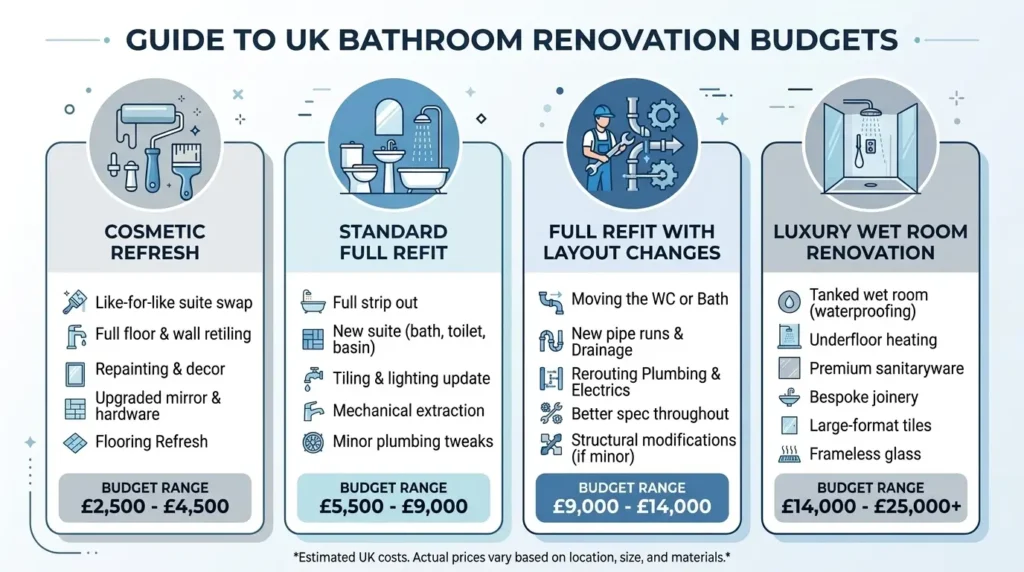
| Project type | Typical cost | What that buys |
| Cosmetic refresh | £2,500 to £4,500 | Like-for-like suite swap, retile, new flooring, layout untouched |
| Standard full refit | £5,500 to £9,000 | Full strip out, new suite, tiling, lighting, extraction, minor plumbing tweaks |
| Full refit with layout changes | £9,000 to £14,000 | Moving the WC or bath, new pipe runs, better spec throughout |
| High spec or wet room | £14,000 to £25,000+ | Tanked wet room, underfloor heating, premium sanitaryware, bespoke joinery |
Across all four, most of the UK works out at roughly £1,200 to £2,800 per square metre. London and the South East sit above that.
What’s usually in the price, and what isn’t
Those figures assume a proper job. Strip out and waste away, plumbing, electrics with certification, plastering and making good, waterproofing, tiling, flooring, sanitaryware, fitting, and someone coming back to sort the snags.
What they generally leave out is VAT, structural repairs found once the floor is up, boiler or cylinder upgrades, and redecorating anything outside the bathroom door. If a quote looks unusually cheap, two or three of those have often gone missing.
That’s the sort of clarity you should expect from any full home renovation service before a single tile comes off the wall.
Why the figures online contradict each other so badly
Search this question and you’ll be told the average is £3,000. Then £15,000. Neither number helps when you’re trying to work out what to put aside.
The gap comes from nobody saying what they’re pricing. Bathroom retailers quote supply only, because products are what they sell. Comparison sites blend a downstairs cloakroom with a master ensuite and publish the middle. Nobody’s lying. They’re answering a slightly different question from the one you asked.
A number only means something once you know what’s inside it. So let’s take it apart.
Bathroom renovation cost by size and room type
Size matters less than most people expect. A small bathroom needs the same trades, the same certification and roughly the same number of site visits as a big one. You just use fewer tiles. Which is why cost per square metre climbs as rooms shrink, and why halving the floor area doesn’t come close to halving the bill.
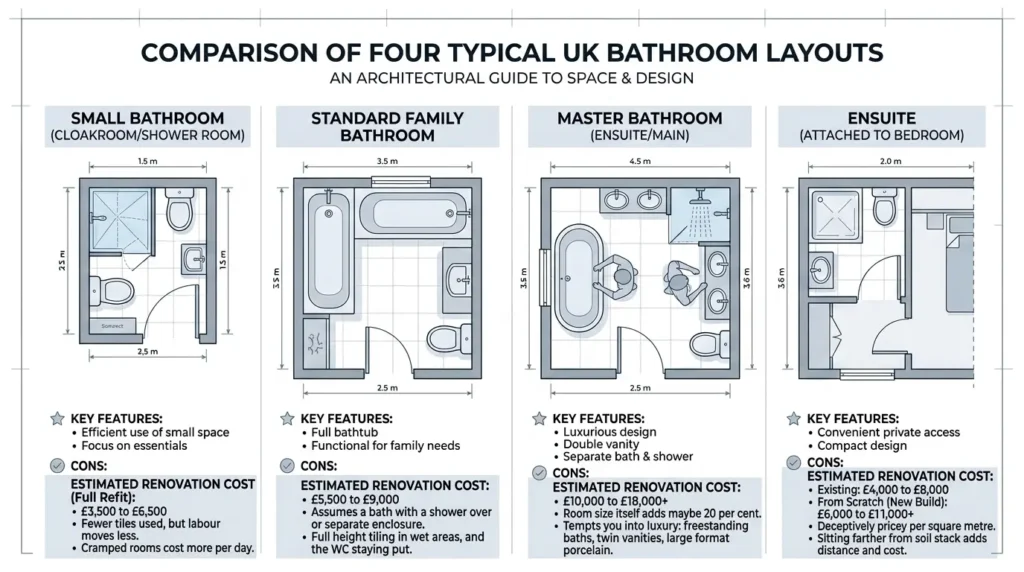
Small bathroom renovation cost (up to 4 m²)
£3,500 to £6,500 for a full refit.
Materials drop. Labour barely moves. Cramped rooms can genuinely cost more per day to work in, because there’s nowhere to stack materials and two trades can’t get in there at once.
Standard family bathroom cost (5 to 7 m²)
£5,500 to £9,000. This is the job we’re asked to price more than any other.
It assumes a bath with a shower over or a separate enclosure, full height tiling in the wet areas, and the WC staying put.
Large or master bathroom cost (8 m² and above)
£10,000 to £18,000, and often past that.
The room size itself adds maybe 20 per cent. What adds the rest is what bigger rooms tempt you into: freestanding baths, twin vanities, large format porcelain, underfloor heating.
Ensuite renovation cost
£4,000 to £8,000 to redo an existing one. £6,000 to £11,000 to build one into a bedroom from scratch, since you’re adding stud walls, a door, drainage and ventilation that were never there.
Ensuites are deceptively pricey per square metre. Small room, low material cost, but they nearly always sit further from the soil stack than the main bathroom, and drainage distance is exactly where the money disappears.
Downstairs WC or cloakroom cost
£2,500 to £5,000, assuming you can reach the drainage.
If you can’t, a macerator at £400 to £900 fitted is often the sensible answer. It also comes with maintenance nobody mentions at the point of sale.
Wet room and walk-in shower cost
£7,000 to £13,000 for a wet room formed properly.
The premium over a standard shower isn’t the drain or the glass. It’s the tanking. A wet room depends on a continuous waterproof membrane across the floor and up the walls, plus a correctly formed fall to the gully. Done right, that’s £700 to £1,500 of extra work. Done badly, it’s a ceiling repair downstairs inside two years, and we’ve been called out to more than a few. You can see how a properly formed wet room looks finished in our project gallery.
Cost per m²: the number worth remembering
If you take one figure from this page, take this one.
- Budget spec: £900 to £1,300 per m²
- Mid range: £1,300 to £2,200 per m²
- High spec: £2,200 to £4,000+ per m²
Measure your floor, pick your bracket, and you’ve got a working budget in about a minute. It travels between properties far better than any national average ever will.
Full cost breakdown: where the money actually goes
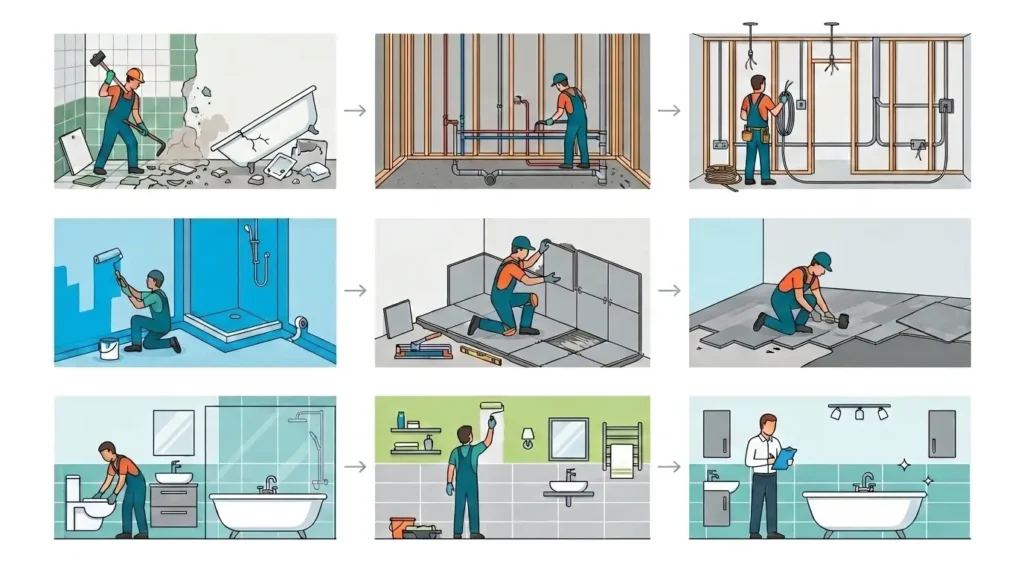
The order of work explains the price better than any table can. A bathroom happens in a fixed sequence, each stage waiting on the one before it, and every stage costs you in both labour and materials.
Labour against materials
Labour is 45 to 60 per cent of a typical UK bathroom budget. On a £7,500 refit, that’s around £3,750 of skilled time against £3,750 of products.
Most people assume it runs the other way round. That assumption is usually why the quote comes as a shock rather than the showroom.
The stages, and what each one costs
Strip out and waste removal, £350 to £900. Old suite out, tiles off, floor up if it needs to come up. Bathrooms produce more rubble than people expect. A skip is £250 to £450 in most places, more in cities where you may be paying for a parking suspension on top.
Plumbing first fix, £600 to £1,400. Hot and cold feeds, waste runs, isolation valves, everything that has to sit inside a wall or floor before it gets closed up. Cheap if nothing moves. Not cheap if it does. This is the stage where having a qualified plumber rather than a general fitter tends to pay for itself.
Electrics, lighting and extraction, £450 to £1,100. Bathrooms are special locations under the wiring regs, with zones around the bath and shower dictating what can go where. The work needs certifying, and that’s part of the price rather than an optional extra somebody’s padding the quote with. Any electrical work in a bathroom should come with paperwork you can hand to a solicitor years later.
Extraction deserves more attention than it gets. An undersized fan is the single most common reason a beautiful new bathroom grows mould in its second winter.
Plastering, boarding and making good, £400 to £900. Tile backer board in the wet areas, plasterboard and skim everywhere else. Saving £150 by skipping proper board behind a shower is one of the most expensive economies available to anyone.
Tanking and waterproofing, £250 to £1,500. Modest in a standard enclosure. Substantial in a wet room.
Tiling, £35 to £70 per m² for labour, plus materials. The most variable line on the list. Standard ceramic in a straight bond sits at the bottom. Large format porcelain, natural stone, herringbone, anything needing a levelling system, that’s the top, sometimes double.
Flooring and underfloor heating, £300 to £1,200. An electric mat runs £400 to £900 supplied and fitted in a typical bathroom. Of everything on this list, it’s the upgrade people thank us for most.
Sanitaryware, brassware and the shower, £900 to £6,000+. The widest range here, and the part you control most directly. A perfectly good suite from Vitra, Roca or Ideal Standard sits at the bottom end. Hansgrohe, Duravit or Villeroy & Boch at the top.
Painting, sealing and snagging, £200 to £500. The last two per cent of the job, and the part that decides how the whole thing reads.
Bathroom fitting and labour costs explained
Day rates against fixed price quotes
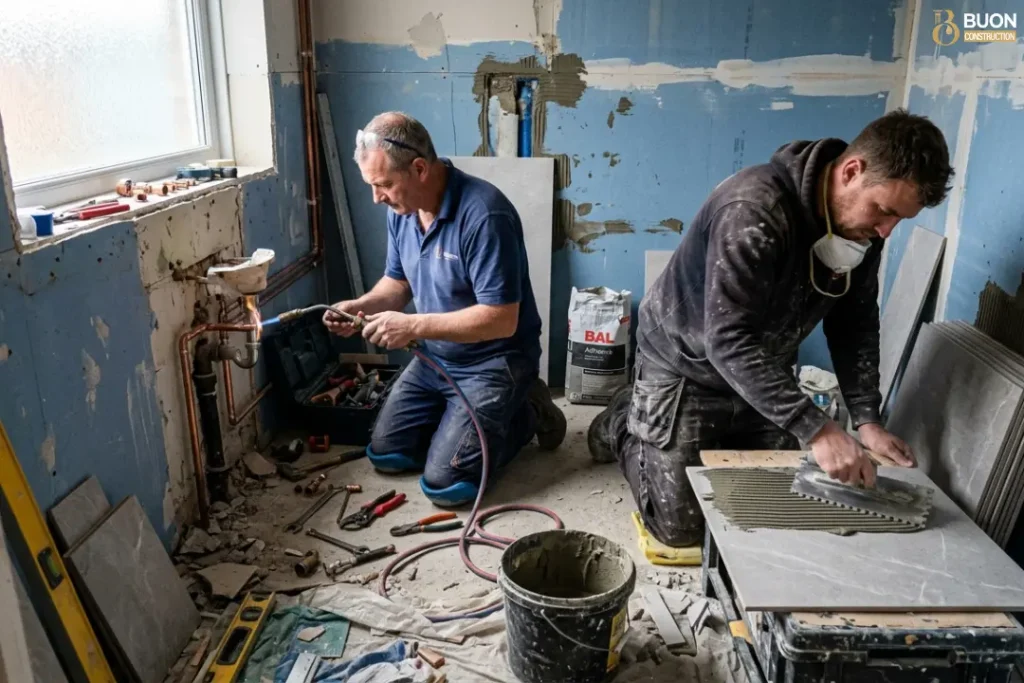
Bathroom fitters across the UK charge £180 to £350 a day, rising to £300 to £460 and beyond in London and the South East. Specialist trades sit at the top of their own bands: electricians, tilers working in large format, Gas Safe engineers.
Most established contractors won’t price a bathroom by the day, and there’s a reason for that. Day rates put every bit of the timing risk on you and none on them. A fixed price against a written scope is almost always the better deal, even where the headline figure looks worse.
Which trades you actually need
A full refit usually pulls in a plumber, an electrician, a tiler, a plasterer, and often a joiner. Plenty of fitters cover three or four of those competently. Very few cover all five, whatever the website says.
How long it takes
Five to ten working days for a like for like refit. Two to three weeks where the layout shifts, plaster needs drying time, or something bespoke is involved.
Time is the cost line nobody puts on a quote. Every extra day is labour you’re funding, which is exactly why the cheapest quote so often finishes up mid priced by the time the last man leaves.
Managing the trades yourself
Running your own trades can save 10 to 15 per cent. It also makes you responsible for the sequencing, and sequencing is where bathrooms come apart. Tiler turns up before the plaster’s cured. Electrician’s second fix is booked for Thursday and the tiling has slipped to Monday. Every gap in that chain lands on your bill.
Worth doing if you’ve got the time and the temperament for it. Genuinely expensive if you haven’t.
What makes a bathroom renovation more expensive?
Six things explain most of the variation between one quote and the next.
Moving the toilet, bath or soil stack
The quickest way to add cost. Relocating a WC means new drainage with a fall of around 1 in 40, and in a shallow floor void that often forces boxing in or dropping the ceiling underneath. Budget £600 to £1,800. A new external soil stack, with scaffold, is £800 to £2,000.
Shifting a bathroom to a different room altogether, common when a loft goes in or a box room gets reclaimed, usually lands between £10,000 and £18,000 once you count making good the space you’ve left behind.
Changing the layout against leaving it alone
Keeping the WC, bath and basin roughly where they are saves £1,500 to £3,000 against the same spec in a new arrangement.
Worth being honest with yourself here. If the current layout is merely uninspiring rather than genuinely unworkable, leaving it alone is the cheapest decision on the table.
Bath to walk-in shower, or bath to wet room
Straightforward as a swap. Expensive as a wet room, for the tanking reasons above.
One thing to think through before you commit. In a two bathroom house, taking out your only bath narrows the pool of people who’ll buy it from you later.
Water pressure, boilers and cylinders
Rainfall heads and body jets need flow to work. Fit one to a low pressure gravity system and you’ll get a polite drizzle and a phone call to us three weeks later.
Check pressure and flow before you specify, not after. A pump is £400 to £900. An unvented cylinder upgrade is £2,000 to £3,500, and it almost never appears in the original budget.
Tile choice and format
Quietly the biggest swing factor in the whole job. Tiles at £25 per m² and tiles at £90 per m² look much the same under showroom lighting and produce very different invoices. Format counts as much as price. Large format porcelain wants a flatter substrate, a levelling system and more hours from the tiler.
The age and condition of the house
Anything pre 1960s holds surprises. Older properties are where contingency budgets go to die, which brings us neatly to the costs that never make it onto a quote.
Flats and leaseholds
Flats carry a whole cost layer that houses don’t. Freeholder consent is often needed before anyone lifts a tool. Plenty of leases restrict moving pipework or insist on acoustic underlay to protect the flat below. Access, lift bookings, restricted working hours, nowhere to put a skip. It all turns into labour hours.
Assume an extra 10 to 20 per cent for a flat compared with the same bathroom in a house, and read your lease before you commission anything.
Hidden costs most bathroom quotes leave out
These are the items that turn a £7,000 job into a £9,000 one. None of them are rare.
Rotten or bouncing floors
You don’t find this out until the old floor comes up. A slow leak round a bath or WC will have been quietly working on the joists for years. Repairs run £300 to £1,500, and there’s no negotiating it. You can’t tile over a floor that flexes. Our recent projects include more than one bathroom where the joist repair was the biggest single line on the final invoice.
Old pipework
Lead, steel or tired copper doesn’t always survive being disturbed. Replacing back to a sound connection adds £300 to £900. Old push fit joints hidden behind boxing are a category of unpleasantness all their own.
Asbestos
Textured coatings from before 2000, artex ceilings especially, may contain asbestos. So might older vinyl floor tiles and the adhesive under them. Testing is £50 to £150. Licensed removal is a good deal more. Not a reason to panic. Very much a reason not to attack an old ceiling with a sander on a Saturday morning.
Ventilation and condensation
If the existing fan is undersized, or vents into the loft rather than outside, it wants sorting. £150 to £400. Considerably cheaper than the mould work that follows if it doesn’t.
Skips, permits and access
£250 to £450 for a skip, plus a parking suspension in a controlled zone. In a terrace with no side access, every bag of rubble and every tub of adhesive goes through your hallway by hand. That’s time, and time is money.
Provisional sums
If a quote contains a provisional sum, a placeholder for work nobody can price yet, treat it as a floor rather than a forecast. Ask what happens when the real cost lands above it, and get that answer in writing before you sign.
VAT: 20 per cent, 5 per cent, or nothing at all
Most bathroom work carries 20 per cent VAT. A contractor turning over below the VAT threshold won’t charge it, which is one perfectly honest reason smaller firms sometimes come in lower.
Two exceptions get missed constantly:
- The 5 per cent reduced rate applies where you’re renovating a dwelling that’s been empty for two years or more immediately before work starts. On a £10,000 project that’s £1,500 back in your pocket. It’s set out in HMRC’s VAT Notice 708.
- Zero rated work applies where a bathroom is installed, extended or adapted because of a disabled person’s condition, in their own home. That’s VAT Notice 701/7.
Neither gets applied automatically. You have to raise it, and give your contractor the evidence they need to justify the rate to HMRC.
Bathroom renovation costs across the UK
Nottingham and the East Midlands
Bathroom renovations in Nottingham and the surrounding area typically run at or slightly below the national average, putting a standard family bathroom at £5,000 to £8,500. Labour rates here sit well under the South East, and access is generally easier than in dense urban terraces, which keeps the labour hours down.
We work across Nottingham, West Bridgford, Beeston, Arnold, Mapperley and the villages around them, and the pricing above holds fairly consistently across that patch.
London and the South East
Expect 15 to 30 per cent above the national average. A bathroom costing £7,000 in the Midlands lands nearer £9,000 to £10,500 across most of London, and higher again in the central boroughs.
Day rates account for most of that. Access, parking, permits and narrow delivery windows account for the rest.
Everywhere else
The North West, North East, Wales and Scotland generally sit at or below the national average, with the widest gap running between London and the North East.
How much variation to expect
Materials cost roughly the same everywhere. Tiles don’t get cheaper in Newcastle. It’s labour that moves. So regional differences show up hardest on labour heavy work like tiling, and barely at all on a product heavy spec.
Should you renovate, refit, or replace?
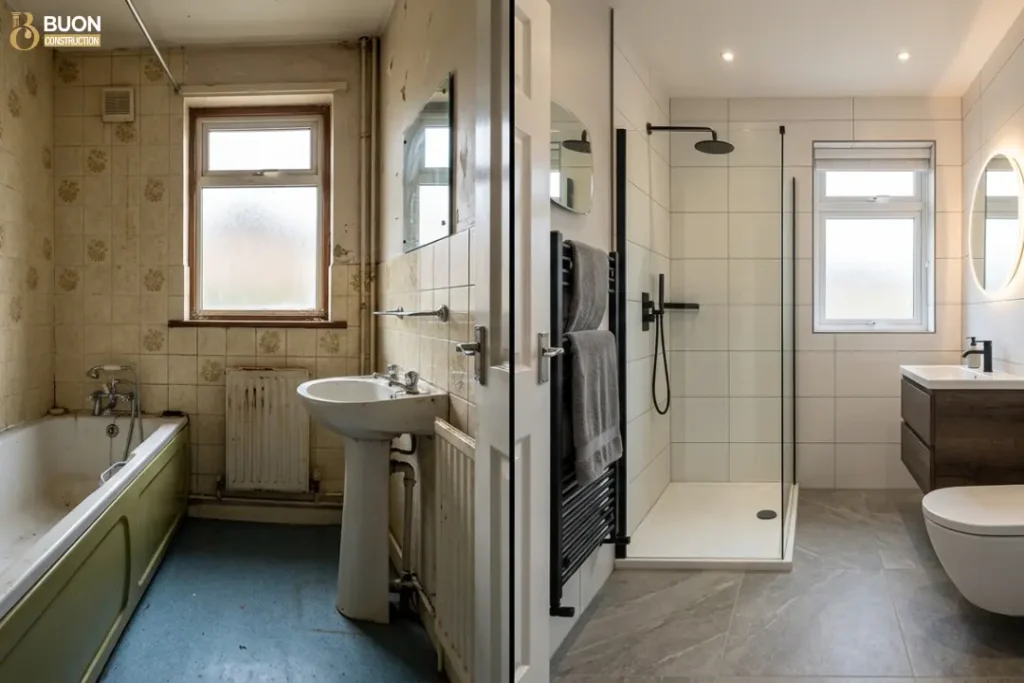
Refresh, full refit, or complete re-plan
Not every tired bathroom needs taking back to brick.
- Refresh, £2,500 to £4,500. The layout works, the tiling’s sound, the suite is just dated. New sanitaryware, new floor, regrout, repaint.
- Full refit, £5,500 to £9,000. Everything out, everything new, layout stays.
- Re-plan, £9,000 and up. The room genuinely doesn’t function and moving fixtures is the only real fix.
Be straight with yourself about which of the three you actually need. A fair number of people pay for the third when the first would have made them perfectly happy.
When repairing is the better call
If the suite is sound and only the tiling has gone, retiling alone is £1,200 to £2,500. A new shower valve is £200 to £450. There’s no rule saying a bathroom has to be done all in one go, and no shame in doing it in stages.
Adding a bathroom, or moving one upstairs
Adding a second bathroom is the strongest financial case anywhere in this article. It changes how buyers categorise the property in a way that a nicer version of an existing bathroom simply doesn’t. In an existing room with reachable drainage, that’s £6,000 to £12,000. If the bathroom is going into new space, price it as part of the extension or loft project rather than as a standalone job, because the drainage and structural work overlap.
How to read and compare bathroom quotes
This is the part people find hardest, and it’s where both the biggest savings and the biggest mistakes live.
What a proper quote contains
- Itemised labour and materials, not one figure on one line
- Named products with model numbers, so you can actually compare like with like
- A start date and an expected duration
- VAT stated plainly, in or out, no ambiguity
- A payment schedule tied to stages of work
- What’s excluded, written down
- Who’s handling waste removal and certification
If a quote is a single number on a single line, you can’t compare it with anything. Neither, frankly, can the person who wrote it.
Warning signs
- A large deposit demanded upfront, particularly in cash
- Pressure to decide today
- No written scope
- No mention of electrical certification
- An unexplained gap of thousands below everyone else
- Reluctance to give you addresses of finished work
Deposits and staged payments
Ten to 25 per cent to cover materials is normal. Anything near half the project value before anyone’s turned up is not. After that, payments should follow completed stages, first fix, second fix, completion, with a final balance held back until the snagging’s done.
Why the cheapest quote usually isn’t
Say three quotes come back at £6,200, £7,800 and £11,500. The instinct is to bin the highest and take the lowest.
Look hard at the lowest one first. It’s cheaper for a reason, and the reason is usually visible if you read carefully. Waste removal excluded. Tiling priced against a smaller area. A provisional sum sitting where the floor repair should be. No allowance for certification. Add those back and the cheap quote often lands within a few hundred pounds of the middle one. By which point you’ve already signed.
Checks worth making
Confirm the electrician is registered with a competent person scheme, NICEIC or NAPIT. Confirm any gas work goes to a Gas Safe engineer. Ask for public liability details. If you want to know who you’re actually dealing with, that information should be easy to find rather than something you have to prise out of somebody.
And ask to see a bathroom they finished two or three years ago, not one they finished last week. The flaws in a bathroom take a couple of winters to surface.
How to budget for your bathroom renovation
Setting a realistic figure
Price your target spec honestly, then add 10 to 15 per cent contingency and leave it alone. On an older property, make it 20.
That contingency isn’t pessimism. It’s the difference between a joist repair being a mild irritation and being the thing that stops the job dead for a fortnight while you find the money.
Bathroom cost calculators
Online calculators are fine for a ballpark and nearly useless for a decision. They can’t see your floor void, your water pressure, your soil stack, or how anything gets into the house, which happen to be the four things that most affect what you’ll pay.
Use one to work out whether you’re having a £6,000 conversation or a £12,000 one. Don’t use one to set a budget you then try to defend against a house that disagrees.
Savings you won’t regret
- Keep the layout. By some distance the biggest saving available.
- Tile the wet areas fully, part tile the rest. Costs less, and honestly often looks better than floor to ceiling everywhere.
- Mid range sanitaryware, then spend the difference on the shower valve. You use the valve every single day. Nobody has ever asked who made the WC.
- Standard format tiles, simple pattern. Saves on labour as well as materials.
- Book outside spring. Trade diaries are at their tightest from March through June.
Where to spend more
Waterproofing. The shower valve. Extraction. The tiler.
Every one of those is either hidden or unglamorous, and every one decides whether the room still looks right in five years. The freestanding bath is the bit you’ll photograph. The tanking is the bit that determines whether you’re doing all this again in 2031.
Do you need building regulations approval for a bathroom?
For a like for like refit, usually not. Beyond that, parts of the regulations apply whether or not you tell anybody.
Electrical work
Electrical installation in a bathroom falls under Part P in England and Wales. Bathrooms are special locations with defined zones governing what can be fitted where. New circuits are notifiable, and the work has to be certified, either through a registered competent person or through building control.
Ventilation, drainage and hot water
Part F covers mechanical extraction. Part G covers sanitation and hot water safety, including temperature limits on baths in certain situations. Part H covers drainage, the pipe falls and connections that make relocating a WC as expensive as it is.
Scotland works to its own Building Standards and Northern Ireland to its own regulations, though what they ask for in practice is broadly comparable.
When to notify Building Control
Notify where you’re adding new circuits, altering drainage, forming a bathroom in a room that wasn’t one, or making structural changes such as taking a wall out.
If you’re not sure, ask before the work starts rather than after. Regularising something retrospectively costs more, and it’s a familiar problem to run into during a conveyancing search years down the line.
Listed buildings, conservation areas and leasehold
Listed building consent can be required even for internal work. Leaseholders should check the freeholder consent position before commissioning anything at all.
Does a new bathroom add value to your home?
Partly. Not fully, and not always in the way people are hoping.
A dated bathroom actively drags offers down. Buyers mentally deduct the cost of replacing it, and they’re rarely conservative about it. Removing that deduction is real money. But a £20,000 bathroom in a £280,000 house won’t hand you £20,000 back on completion. Past a certain point you’re buying enjoyment rather than equity, and there’s nothing wrong with that as long as you know which one you’re doing.
Adding a bathroom is a different proposition entirely. A second bathroom, or a well placed ensuite, changes how the property gets marketed and widens the field of people who’ll buy it. That shows up in the price far more reliably than upgrading a room you already had. The same logic applies to a kitchen renovation, where layout changes tend to move a valuation more than finishes do.
Renovating to sell within the year? Go clean, neutral, well executed, mid range. Staying put? Spend where you’ll feel it every morning.
What to do next
Before you ask anyone for a price:
- Measure the room and note the floor area
- Decide whether the layout is genuinely staying or moving
- Check your water pressure and what boiler you’ve got
- Pick a spec bracket: budget, mid or high
- Set a contingency and keep it separate from the main pot
- Get three quotes against the same written scope
- Read what each one excludes before you compare the totals
Nobody can price a bathroom properly without standing in it. Pressure, access, how the floor’s built, where the soil stack runs, what’s behind the tiles. All of it changes the number, and none of it shows up in a photograph.
If you’d rather have a real figure than a range, get in touch for a detailed quote. We’ll survey the room, price it line by line, and tell you honestly which parts of the wish list are worth the money and which aren’t.
FAQs
Can I still use the bathroom while the work is being done?
Not for most of the job. In a single bathroom house you’ll usually be without a WC and shower for three to seven working days. Ask your contractor to leave the old toilet connected as long as possible and to reinstate the new one early, before tiling finishes. Plan for showering elsewhere.
Which parts of a bathroom renovation can I legally do myself?
You can strip out, decorate, tile and fit non plumbed items yourself. Electrical work in a bathroom falls under Part P and must be certified, and any gas work must go to a Gas Safe engineer. Uncertified electrical work will show up in a conveyancing search when you sell.
What guarantee should come with a new bathroom?
Expect a minimum of 12 months on workmanship, with two to five years from established contractors. Sanitaryware and brassware carry separate manufacturer warranties, often 10 years or longer on ceramics. Get the workmanship guarantee in writing, and check whether it covers the tanking and tiling as well as the plumbing.
Can I supply my own bathroom suite to save money?
Yes, and it typically saves 10 to 20 per cent on product cost. You take on responsibility for faults, damage and late deliveries, and most contractors won’t warrant items they didn’t supply. Order everything before work starts and unbox it on arrival, since a cracked basin found on day four stops the job.
Should I tell my home insurer before a bathroom renovation?
Yes, if the work involves structural changes, altered drainage, or leaves the property unoccupied for a period. Standard policies often exclude damage arising from building work, and failing to notify can invalidate a claim. A quick call and a note on file costs nothing and protects you if a leak occurs mid-project.

2 Responses